First-Time Owner Guide to Puppy Potty Training and Crate Setup
Master puppy potty training and crate setup with this first-time owner guide. Includes schedules, costs, and step-by-step tips for a smooth transition.
Welcome to Puppy Parenthood: The First 30 Days
Bringing a new puppy home is one of life's greatest joys, but the first few weeks can quickly become overwhelming for first-time dog owners. Between the midnight whining, the unexpected puddles on your favorite rug, and the sheer exhaustion of constant supervision, the honeymoon phase can feel fleeting. However, establishing a rock-solid foundation for potty training and crate acclimation during the first 30 days is the single most important investment you can make in your puppy's future. This comprehensive guide is designed specifically for first-time owners, stripping away the confusing jargon and providing actionable, step-by-step instructions, exact measurements, and realistic cost breakdowns to set you and your new furry companion up for lifelong success.
The Crate Setup: Creating a Safe Haven
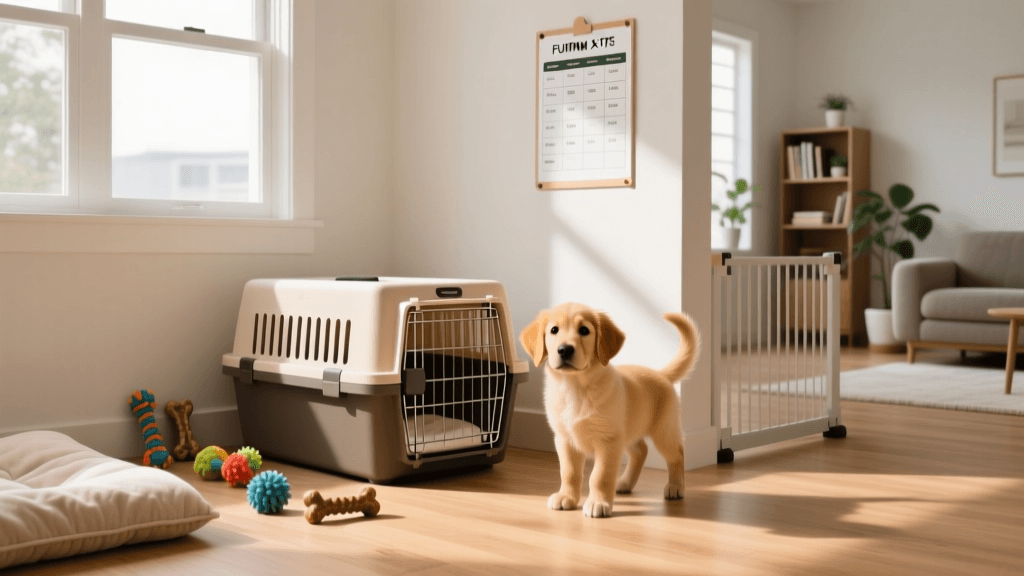
The crate is not a punishment zone; it is your puppy's bedroom, den, and safe haven. Dogs are naturally den-dwelling animals, and when introduced correctly, a crate becomes a place where they voluntarily seek comfort and security. For first-time owners, the crate is also your most powerful potty training tool, as puppies instinctively avoid soiling their immediate sleeping area. When the crate is sized correctly, it leverages this natural instinct to help them develop bladder control.
Choosing the Right Crate and Dimensions
Opt for a wire crate with a divider panel, such as the highly rated MidWest Homes for Pets iCrate. The divider is crucial because a crate that is too large will allow your puppy to designate one corner for sleeping and another for eliminating. Use the divider to shrink the space so your puppy has just enough room to stand up, turn around, and lie down comfortably. As your puppy grows, simply move the divider back to expand their living space.
- Small Breeds (e.g., Chihuahua, Pomeranian): 18 to 22 inches long.
- Medium Breeds (e.g., Beagle, Cocker Spaniel): 30 to 36 inches long.
- Large Breeds (e.g., Labrador, Golden Retriever): 42 inches long.
- Giant Breeds (e.g., Great Dane, Mastiff): 48 to 54 inches long.
Interior Setup and Placement
Avoid plush, easily shredded beds during the teething phase, as these can pose a severe intestinal blockage hazard if ingested. Instead, use a tightly woven, chew-resistant mat like the K9 Ballistics Tough Bed or a simple folded cotton towel. Place the crate in a high-traffic family area, such as the living room, so your puppy does not feel isolated during the day. At night, move the crate to your bedroom to reduce separation anxiety and allow you to hear when they need a midnight potty break.
Understanding the Puppy Bladder
To master potty training, you must understand your puppy's physiological limitations. A general veterinary rule of thumb is that a puppy can hold their bladder for one hour per month of age, plus one. Therefore, an eight-week-old (two-month-old) puppy can only hold it for approximately three hours under the best circumstances, and often much less when active or playing. Expecting an eight-week-old puppy to sleep through an eight-hour night without a potty break is biologically impossible and will only lead to frustration, soiled crates, and severe training setbacks.
The Ultimate Daily Potty Training Schedule
Consistency is the cornerstone of successful housetraining. Puppies thrive on routine, and their digestive systems will quickly adapt to a predictable feeding and potty schedule. Below is a structured daily template tailored for a working-from-home first-time owner with an 8-to-12-week-old puppy.
| Time of Day | Action | Potty Break Duration | Owner Notes |
|---|---|---|---|
| 6:30 AM | Immediate Wake-Up Potty | 5-10 Minutes | Carry the puppy outside to avoid en-route accidents. |
| 7:00 AM | Breakfast & Water | N/A | Remove water bowl 2 hours before bedtime. |
| 7:30 AM | Post-Meal Potty | 10-15 Minutes | Puppies usually need to go 15-30 mins after eating. |
| 8:30 AM | Nap Time (In Crate) | N/A | Puppies need 18-20 hours of sleep per day. |
| 10:30 AM | Wake & Potty | 10 Minutes | Followed by 30 mins of supervised play/training. |
| 12:00 PM | Lunch (Optional) & Potty | 10-15 Minutes | 3 meals a day recommended for puppies under 6 mos. |
| 1:00 PM | Mid-Day Nap (In Crate) | N/A | Enforce quiet time to prevent overtiredness. |
| 3:30 PM | Wake & Potty | 10 Minutes | Followed by socialization or a short walk. |
| 5:30 PM | Dinner & Water | N/A | Final meal of the day. |
| 6:15 PM | Post-Dinner Potty | 15 Minutes | Allow extra time for full elimination. |
| 8:00 PM | Water Bowl Removed | N/A | Crucial for overnight bladder management. |
| 9:30 PM | Final Potty & Bedtime | 10 Minutes | Keep lights dim and interaction minimal. |
| 2:00 AM | Nighttime Potty (Set Alarm) | 5 Minutes | Carry out, no talking, straight back to crate. |
Nighttime Potty Breaks: A Survival Guide
Nighttime wakeups are inevitable for the first few weeks. When your puppy whines at 2:00 AM, keep the interaction incredibly boring. Do not turn on bright overhead lights; use a dim nightlight instead. Do not speak to the puppy in a playful tone, and absolutely do not engage in play. Simply scoop them up, carry them to their designated potty spot, use your command word, praise quietly when they finish, and place them immediately back into the crate. This teaches them that nighttime wakeups are strictly for business, not for socializing.
Potty Training Command Words
First-time owners often make the mistake of simply putting the puppy outside and waiting. Instead, use a specific verbal cue such as 'Go Potty' or 'Do Your Business' while they are in the act of eliminating. Over time, your puppy will associate the phrase with the physical action. This becomes incredibly useful during inclement weather, road trips, or when you are in a hurry, as you can verbally prompt your dog to eliminate on command rather than waiting for them to sniff around for ten minutes.
Essential Gear and Estimated Costs
Setting up for success requires a few targeted investments. Here is a breakdown of the essential potty training and crate gear you will need during the first year, along with estimated costs to help you budget accordingly.
- Wire Crate with Divider Panel: MidWest iCrate ($60 - $90). Essential for adjusting space as your puppy grows without needing to buy multiple crates.
- Chew-Proof Crate Mat: K9 Ballistics Tough Bed ($120 - $160). Saves money in the long run by preventing the destruction of standard plush beds.
- Enzymatic Cleaner: Nature's Miracle Advanced Stain and Odor Eliminator ($15 - $20). Absolutely mandatory for breaking down uric acid crystals that standard household cleaners leave behind.
- High-Value Training Treats: Zuke's Mini Naturals or boiled chicken breast ($10 - $15). Used exclusively for rewarding outdoor elimination.
- Long Training Lead: 15-foot Biothane leash ($25 - $35). Gives the puppy room to wander and sniff in the yard while maintaining your control.
- Exercise Playpen: MidWest Foldable Metal Exercise Pen ($40 - $60). Perfect for creating a safe, enclosed 'puppy zone' when you cannot actively supervise them.
Handling Accidents Like a Pro
Accidents will happen. How you react to them will dictate how quickly your puppy learns. If you catch your puppy in the act indoors, interrupt them with a sharp 'Ah-ah!' or a quick clap, immediately scoop them up, and carry them outside to finish. Praise heavily and offer a high-value treat when they finish outdoors.
If you find an accident after the fact, do not punish the puppy. Dogs do not possess the cognitive ability to connect a past action with a present punishment; they will only learn to fear you and will begin hiding behind furniture to eliminate in secret. Clean the soiled area thoroughly with an enzymatic cleaner. Never use ammonia-based cleaners like Windex or standard bleach, as ammonia mimics the scent of urine and will actually attract your puppy back to the same spot to re-soil it.
Patience and positive reinforcement are your greatest tools. A puppy is essentially a human toddler; they are learning the rules of a completely new world, and they rely entirely on your guidance to understand what is expected of them.
Insights from Authoritative Organizations
According to the American Kennel Club (AKC), establishing a strict routine and utilizing positive reinforcement are the most effective methods for housetraining. The AKC emphasizes that rewarding the puppy immediately after they eliminate in the correct spot creates a strong neurological association between the outdoor location and the positive outcome.
Furthermore, the Humane Society of the United States emphasizes that a crate should never be used as a form of punishment. They note that when introduced properly with treats, meals, and favorite chew toys, the crate becomes a vital management tool that prevents destructive behaviors and accelerates the potty training process by capitalizing on the dog's natural den instincts.
For deeper insights into canine behavioral development and managing separation anxiety during crate training, the ASPCA provides excellent resources detailing the step-by-step desensitization process required to help a hesitant puppy feel completely secure in their new sleeping environment.
Final Thoughts for the First-Time Owner
The puppy phase is incredibly brief, even though the sleepless nights and puddle-cleaning sessions might make it feel endless. By investing the time upfront to properly set up your crate, adhere to a strict potty schedule, and utilize the right enzymatic cleaning products, you are building a foundation of trust and communication. Stay consistent, manage your expectations, and remember that every successful outdoor potty break is a massive victory for both you and your new best friend.
hannah-wickes
All our authors care for dogs every day — read more of their work on the authors page.