First-Time Owner Guide To Puppy Potty Training Success
Master puppy potty training with our first-time owner guide. Learn crate setups, hourly schedules, and expert tips to stop indoor accidents fast.
Welcome to Puppy Parenthood: The Potty Training Reality
Bringing a new puppy home is an exhilarating experience filled with cuddles, playful pounces, and unforgettable milestones. However, for first-time dog owners, the honeymoon phase can quickly be interrupted by the daunting reality of potty training. According to the American Kennel Club (AKC), consistency and positive reinforcement are the foundational pillars of successful housebreaking. This comprehensive guide is designed specifically for first-time owners, providing actionable schedules, precise product recommendations, and expert-backed strategies to help your puppy develop lifelong bathroom habits.
Setting Up the Perfect Crate Environment
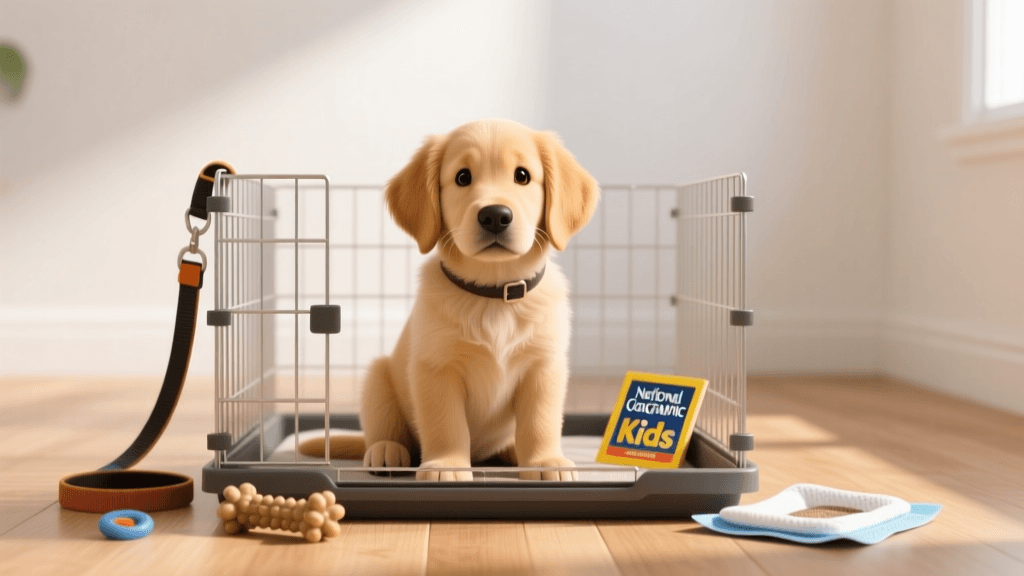
Crate training is not merely a tool for keeping your puppy safe when unsupervised; it is the most effective method for accelerating potty training. Dogs possess a natural instinct to avoid soiling their sleeping quarters. By leveraging this instinct, you can teach your puppy to hold their bladder until they are taken outside.
Crate Sizing, Measurements, and Costs
A common mistake first-time owners make is purchasing a crate that is too large. If a puppy has excess space, they will designate one corner for sleeping and another for eliminating. You should invest in a wire crate with an adjustable divider panel, such as the MidWest Homes for Pets iCrate (typically costing between $50 and $80 depending on size).
- Small Breeds (e.g., Chihuahuas, Pomeranians): 24-inch crate (approx. $45-$55).
- Medium Breeds (e.g., Beagles, Cocker Spaniels): 30-inch to 36-inch crate (approx. $55-$70).
- Large Breeds (e.g., Labrador Retrievers, Golden Retrievers): 42-inch crate (approx. $75-$90).
The correct measurement allows your puppy to stand up without hitting their head, turn around comfortably, and lie down stretched out. Adjust the divider panel every few weeks as your puppy grows to maintain this precise fit.
The Ultimate First-Time Owner Potty Training Schedule
Puppies thrive on routine. A predictable schedule helps their digestive system regulate and teaches them when to expect bathroom breaks. The general rule of thumb for bladder capacity is that a puppy can hold their urine for one hour per month of age, up to a maximum of eight hours. However, during active daytime training, you should take them out much more frequently.
| Puppy Age | Estimated Bladder Capacity | Daytime Potty Frequency | Nighttime Potty Frequency |
|---|---|---|---|
| 8-10 Weeks | 1 to 1.5 Hours | Every 1 Hour | Every 2-3 Hours |
| 11-14 Weeks | 2 to 3 Hours | Every 1.5 to 2 Hours | Every 3-4 Hours |
| 15-16 Weeks | 3 to 4 Hours | Every 2 to 3 Hours | Every 4-5 Hours |
| 4-6 Months | 4 to 6 Hours | Every 3 to 4 Hours | Usually sleeps through |
Always take your puppy outside immediately after waking up, within 15 to 20 minutes after eating or drinking, and immediately after vigorous play sessions. The ASPCA's House Training Guide emphasizes that taking your puppy out after these transitional activities drastically reduces indoor accidents.
Step-by-Step Outdoor Potty Routine
When you take your puppy outside, treat it as a focused mission rather than a casual stroll. Follow this exact sequence to build a strong associative habit:
- Use a Consistent Door: Always exit through the same door to the same designated potty spot in your yard.
- Employ a Verbal Cue: As soon as your puppy begins to eliminate, use a specific phrase like "Go potty" or "Do your business" in a calm, encouraging tone.
- Reward Immediately: The second your puppy finishes, praise them enthusiastically and offer a high-value training treat. We recommend Zuke's Mini Naturals (approx. $6 per bag), as they are small, low-calorie, and highly palatable, ensuring your puppy doesn't get full during repetitive training sessions.
- Leash Training Integration: Keep your puppy on a 6-foot standard nylon leash (avoid retractable leashes during potty training) to keep them focused on the task at hand rather than wandering off to sniff the garden.
Recognizing Potty Signals
First-time owners often miss the subtle cues that indicate a puppy needs to relieve themselves. While whining or scratching at the door are obvious signs, earlier indicators include:
- Sudden cessation of playfulness
- Intense sniffing of the floor or carpet edges
- Pacing or walking in tight circles
- Wandering away from the family toward a quiet corner or behind furniture
When you observe any of these behaviors, immediately interrupt the puppy, scoop them up or attach the leash, and head straight to the designated outdoor potty spot.
Handling Accidents Like a Pro
Accidents are an inevitable part of the potty training journey. How you react to them will dictate how quickly your puppy learns. Never punish, yell at, or rub your puppy's nose in an accident. The Humane Society of the United States warns that punishment only teaches your puppy to fear you and to hide when they need to eliminate, leading to sneaky accidents behind sofas or under beds.
The Science of Enzymatic Cleaners
Standard household cleaners, bleach, and ammonia-based products will not eliminate the uric acid crystals found in dog urine. If these crystals remain, your puppy's highly sensitive nose will detect them and mark the same spot again. You must use a dedicated enzymatic cleaner like Nature's Miracle Advanced Stain & Odor Eliminator or Rocco & Roxie Stain & Odor Eliminator (both costing around $12-$15 per bottle). Saturate the soiled area completely, allowing the enzymes to break down the biological matter, and let it air dry naturally.
Nighttime Potty Survival Guide
Nighttime potty training requires a separate strategy. To maximize your sleep and minimize midnight accidents, implement the following evening routine:
- Water Curfew: Remove your puppy's water bowl exactly two hours before bedtime. If bedtime is 10:00 PM, pick up the water at 8:00 PM.
- Late Night Potty Break: Take your puppy out for one final bathroom trip right before you go to sleep. Keep the lights dim and avoid playing to signal that it is time to wind down.
- Crate Placement: For the first few weeks, place the crate in your bedroom or just outside your door. Puppies often whine when they need to go; having the crate nearby ensures you hear them before an accident occurs.
- The Midnight Alarm: Set a gentle alarm on your phone for 3:00 AM for the first two weeks. Take the puppy out on a leash, reward them, and immediately return them to the crate. Gradually push this alarm back by 30 minutes every few nights until your puppy sleeps through the night.
"Patience and consistency are your greatest tools. Puppies are not being stubborn when they have an accident; they are simply learning a completely new set of rules in a foreign environment. Celebrate the small victories and maintain a predictable schedule."
Potty training a puppy as a first-time owner can feel overwhelming, but by utilizing a properly sized crate, adhering to a strict hourly schedule, and utilizing enzymatic cleaners, you will set your new companion up for success. Stick to the routine, stock up on high-value treats, and remember that every accident is just a learning opportunity in disguise.
tom-renshaw
All our authors care for dogs every day — read more of their work on the authors page.