Puppy Crate Training FAQ: Answers to Google's Top Questions
Discover answers to Google's most-asked puppy crate training questions. Learn crate sizing, crying solutions, and time limits for a happy pup.
Mastering the Crate: Answers to Google's Most-Asked Puppy Training Questions
If you have recently brought a new puppy home, you have likely found yourself tumbling down a late-night internet rabbit hole. Crate training is one of the most effective behavioral conditioning tools for housebreaking and creating a safe den for your dog, but it is also one of the most stressful experiences for new owners. According to search trend data, thousands of puppy owners type variations of 'People Also Ask' questions into Google every single day, desperately seeking actionable advice on how to make the crate a positive space rather than a punishment zone.
As a core component of foundational obedience and socialization, proper crate conditioning sets the stage for a well-adjusted adult dog. Below, we tackle Google's most frequently asked questions about puppy crate training, providing you with specific measurements, timing schedules, product recommendations, and expert-backed behavioral strategies.
1. What Size Crate Do I Need for My Puppy?
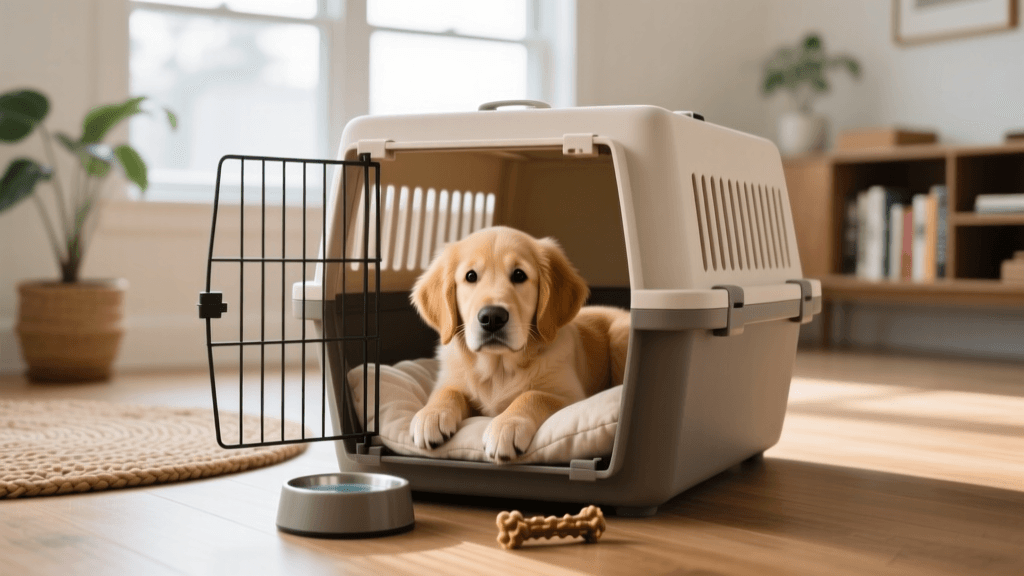
The most common mistake new owners make is buying a crate based on the puppy's current size or purchasing an oversized crate to 'give them room to grow.' According to the ASPCA, a crate should be just large enough for your dog to stand up without hitting their head, turn around comfortably, and lie down stretched out. If the crate is too large, your puppy will designate one corner for sleeping and the opposite corner for eliminating, entirely defeating the purpose of housebreaking.
Actionable Advice: Purchase a wire crate that includes a movable divider panel. This allows you to buy the adult-sized crate upfront and adjust the interior square footage as your puppy grows, saving you from buying multiple crates over the first year.
Puppy Crate Sizing Chart
| Crate Size | Dimensions (L x W x H) | Adult Weight Limit | Example Breeds |
|---|---|---|---|
| Small | 24' x 18' x 19' | Up to 25 lbs | Pug, Jack Russell Terrier, Shih Tzu |
| Medium | 30' x 19' x 21' | 26 - 40 lbs | Beagle, Cocker Spaniel, French Bulldog |
| Large | 36' x 23' x 25' | 41 - 70 lbs | Labrador Retriever, Golden Retriever, Boxer |
| Extra Large | 42' x 28' x 30' | 71 - 90 lbs | German Shepherd, Rottweiler, Bernese Mountain Dog |
2. How Long Can a Puppy Stay in a Crate?
Leaving a puppy in a crate for too long leads to accidents, separation anxiety, and a negative association with the den. Puppies lack the physical bladder control that adult dogs possess. The golden rule of thumb recommended by veterinarians and trainers is the 'Month Plus One' rule.
The Month Plus One Rule: Take your puppy's age in months and add one. This equals the maximum number of hours they can comfortably hold their bladder during the day. For example, a 2-month-old (8-week-old) puppy can hold it for a maximum of 3 hours. A 4-month-old puppy can wait up to 5 hours.
Nighttime Exceptions: Puppies sleep heavily at night, meaning their metabolism slows down. While a 3-month-old puppy might only last 4 hours during the day, they can often sleep for 6 to 7 hours overnight. However, be prepared to set an alarm for a 2:00 AM potty break for the first few weeks to prevent accidents and reinforce outdoor elimination.
3. Should I Put Food and Water in the Crate?
This is a highly debated topic on forums, but the answer depends on your daily schedule and housebreaking progress.
- Water: During the day, if your puppy is crated for short intervals (under 2 hours), you do not need to leave a water bowl inside, as it will likely be spilled, creating a damp, uncomfortable sleeping environment. To aid in overnight housebreaking, remove your puppy's water bowl exactly 1.5 hours before bedtime. Take them out for a final potty break right before the crate door closes.
- Food: Never use the crate for free-feeding. Instead, use the crate as a dining room to build positive associations. Feed your puppy their measured meals (e.g., 1/2 cup of high-quality kibble, divided into three daily meals) inside the crate with the door open, and eventually with the door closed. This conditions the puppy to view the crate as a provider of high-value resources.
4. How Do I Stop My Puppy From Crying in the Crate?
Hearing your puppy scream in a wire crate is emotionally exhausting. To address this, you must first identify the root cause of the vocalization. Is it a biological need, or is it a behavioral protest?
According to the American Kennel Club (AKC), if your puppy has been crated for several hours and suddenly wakes up crying, they likely need to eliminate. Take them outside immediately on a leash, keep the interaction boring and quiet, and return them to the crate.
However, if you just put them in the crate and they begin to wail, this is a behavioral protest. If you open the door or yell at them while they are crying, you have just taught them that noise equals freedom or attention. This reinforces the crying behavior.
Understanding the 'Extinction Burst'
When you begin ignoring the protest crying, be prepared for an 'extinction burst.' This is a well-documented psychological phenomenon where a behavior temporarily increases in intensity before it stops. Your puppy will cry louder, scratch the door, and throw a tantrum to see if the old rules still apply. You must remain completely silent and wait for a minimum of 5 to 10 seconds of absolute quiet before opening the door or offering praise.
Product Spotlight: The Snuggle Puppy
To ease the transition from the litter box to the crate, many trainers recommend the SmartPet Love Snuggle Puppy (Retail cost: approx. $39.99). This plush toy features a physical 'heartbeat' simulator and a heat pack. Placing this in the crate mimics the warmth and pulse of littermates, significantly reducing nighttime whining and anxiety in newly adopted puppies.
5. Where Should I Place the Crate at Night?
During the first two weeks, the crate should be placed in your bedroom, ideally within arm's reach of your bed. Dogs are pack animals, and isolating a young puppy in a dark laundry room or basement can trigger severe isolation distress. By keeping the crate near your bed, your puppy can hear you breathing and smell your scent, which lowers their cortisol levels.
Environmental Controls: Ensure the crate is not placed directly under an AC vent or next to a drafty window. The ideal ambient temperature for a sleeping puppy is between 68°F and 72°F (20°C - 22°C). Drape a breathable cotton sheet over the top and sides of the wire crate to block visual stimuli and create a cozy, den-like atmosphere.
Essential Crate Training Gear and Estimated Costs
Setting up a successful crate training station requires a modest financial investment. Here is a breakdown of the essential gear you will need:
- Wire Crate with Divider: The MidWest Homes for Pets iCrate is a top industry standard. It features dual latching doors and a leak-proof plastic pan. Cost: $45.00 - $85.00 depending on size.
- Enzymatic Cleaner: Accidents will happen. You must use an enzymatic cleaner to break down uric acid crystals so the puppy does not return to the same spot. Nature's Miracle or Rocco & Roxie are highly recommended. Cost: $12.00 - $18.00.
- Chew-Proof Bedding: Avoid plush beds until the puppy is past the teething phase (around 6 months). Use a tightly woven canvas cot or a simple fleece blanket that can be easily washed. Cost: $15.00 - $30.00.
- High-Value Treats: Use freeze-dried liver or boiled chicken breast exclusively for crate entry rewards. Cost: $10.00 - $25.00.
Final Thoughts on Behavioral Conditioning
Crate training is not a quick fix; it is a gradual process of behavioral conditioning that requires immense patience. The Humane Society emphasizes that a crate should never be used as a place of punishment for bad behavior. It must always be associated with safety, rest, and positive reinforcement. By following the guidelines above, adhering to strict time limits, and utilizing the right gear, you will transform the crate from a point of contention into your puppy's favorite sanctuary in the home.
priya-sutaria
All our authors care for dogs every day — read more of their work on the authors page.