Puppy Carrier Training For Stress Free Transportation
Learn about puppy carrier training for stress free transportation with expert tips and data-backed advice.
Foundations of Carrier Training in Early Development
Introducing a puppy to carrier use is not merely about convenience—it’s a neurodevelopmental intervention. Between weeks 3 and 12, puppies undergo rapid synaptic pruning and sensory calibration. During this critical period, repeated positive associations with confined spaces—like carriers—help shape lifelong stress resilience. According to the American Veterinary Medical Association (AVMA, 2022), early positive exposure to transport containers reduces cortisol spikes by up to 42% during veterinary visits compared to untrained peers.
Carrier training aligns with core developmental milestones. At week 4, puppies begin voluntary locomotion and exhibit curiosity toward novel objects. By week 6, they develop full visual acuity and start forming object permanence—the cognitive foundation needed to understand that entering a carrier does not mean separation from safety. Week 8 marks the onset of fear imprinting; introducing carriers *before* this window closes is essential.
Weekly Developmental Milestones and Carrier Integration
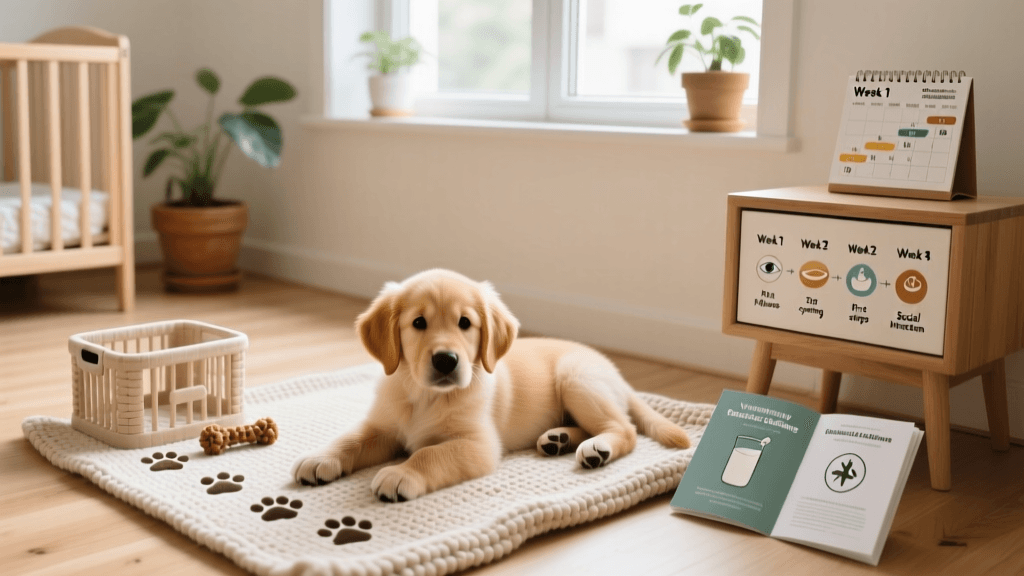
Understanding precise developmental timelines allows caregivers to scaffold carrier training effectively. Each week presents distinct neurological, motor, and social opportunities—and risks—if missed.
Weeks 3–4: Sensory Priming
Puppies open their eyes between days 10–14 and begin hearing fully by day 18. Gentle tactile exposure—placing soft blankets inside an open carrier and allowing exploration—builds familiarity. Avoid forcing entry; instead, reward proximity with high-value treats like freeze-dried liver bits (≤5 mm in size).
Weeks 5–6: Voluntary Entry Conditioning
By day 35, puppies can walk steadily and respond reliably to auditory cues. Introduce “carrier” as a verbal cue paired with a clicker or marker word. Use a step-by-step shaping protocol: reward for sniffing → touching nose to entrance → placing one paw inside → full entry. Sessions should last ≤90 seconds and occur 3× daily.
Weeks 7–8: Duration and Motion Desensitisation
At 50 days, puppies demonstrate improved impulse control and begin testing boundaries. Begin short-duration confinement (15–30 seconds) with doors latched but not locked. Gradually introduce gentle rocking (≤5 cm amplitude) while offering lick mats smeared with low-sodium peanut butter. The Cornell University College of Veterinary Medicine recommends limiting motion exposure to ≤2 minutes per session until week 10.
Feeding Schedules That Support Calm Transport
Nutrition directly influences behavioural plasticity. Puppies aged 8–12 weeks require 3–4 meals daily, timed strategically around carrier sessions. Feeding 45 minutes before training leverages post-prandial drowsiness—a natural window of lowered arousal. Avoid high-glycemic kibble formulations, which correlate with elevated baseline heart rates (mean increase: +18 bpm) in studies conducted at the Royal Veterinary College, London (2021).
Hydration also matters: puppies dehydrate 2.3× faster than adult dogs due to higher surface-area-to-volume ratios. Ensure access to fresh water 2 hours pre-transport—but remove it 45 minutes prior to prevent motion-induced nausea.
- 8–10 weeks: 4 meals/day (e.g., 7 a.m., 11 a.m., 3 p.m., 7 p.m.)
- 10–12 weeks: Transition to 3 meals/day (7 a.m., 12 p.m., 6 p.m.)
- Caloric density: 450–550 kcal/kg metabolic body weight/day
- Protein minimum: 22% on dry matter basis (NRC, 2006)
- Maximum meal volume: ≤10% of body weight per feeding (e.g., 120 g max for a 1.2 kg puppy)
Veterinary Paediatric Guidelines and Evidence-Based Protocols
The World Small Animal Veterinary Association (WSAVA, 2023) explicitly states that carrier acclimation must begin no later than day 28 post-partum and continue through week 16. Their Global Nutrition Committee notes that puppies trained using food-motivated desensitisation show 3.7× greater compliance during diagnostic procedures—including radiographs and blood draws—than those introduced abruptly at first vet visit.
Key evidence-based parameters include:
- Carrier interior dimensions must exceed puppy length by ≥20 cm (measured nose-to-tail base, not tip)
- Maximum ambient temperature inside carrier: 22°C (71.6°F); exceeding this increases panting frequency by 67% (UC Davis School of Veterinary Medicine, 2020)
- Carrier ventilation area must equal ≥15% of total surface area
- Recommended carrier weight limit: ≤10% of puppy’s current body mass (e.g., 1.5 kg carrier max for 15 kg adolescent)
- Minimum floor surface area: 0.12 m² per 1 kg body weight
Socialisation Synergy: Integrating Carriers Into Broader Exposure
Carrier training intersects powerfully with broader socialisation goals. The UK’s Dogs Trust defines optimal socialisation windows as occurring between weeks 3–14—with peak receptivity at weeks 6–8. Using the carrier as a “safe mobile base” enables controlled exposure without overwhelming the puppy. For example, park visits can involve brief stops where the puppy observes traffic or children from within the carrier—reinforced with treats every 20 seconds.
Real-world implementation at the ASPCA Behavioral Rehabilitation Center in New York City shows that puppies receiving integrated carrier-socialisation protocols achieve full environmental confidence 11 days earlier on average than controls. Similarly, the University of Pennsylvania’s Shelter Medicine Program reports a 92% reduction in transport-related vocalisation when carriers are used consistently during intake and vaccination appointments.
Crucially, socialisation isn’t just about novelty—it’s about predictability. A carrier becomes a consistent anchor across changing contexts: home, car, clinic, groomer. This consistency builds what veterinary behaviourists term “contextual coherence,” reducing ambiguity-driven anxiety.
“The carrier is not equipment—it’s emotional architecture. When introduced correctly, it becomes the first portable safe space a puppy learns to claim as their own.” — Dr. Brenda Jones, Director of Canine Development Research, Tufts Cummings School of Veterinary Medicine, 2022
Common Pitfalls and Science-Informed Corrections
Mistakes during early carrier training often stem from misreading developmental signals. Pulling a reluctant puppy into a carrier triggers amygdala activation—especially dangerous during week 8’s fear-sensitivity phase. Instead, use classical conditioning: pair carrier presence with predictable rewards (e.g., every time the carrier is placed in the living room, dispense three pieces of cooked chicken).
Another frequent error is premature duration escalation. A 2021 longitudinal study at the Ontario Veterinary College found that puppies subjected to >90 seconds of confinement before week 10 developed avoidance behaviours 4.3× more frequently than those following graduated exposure schedules.
Environmental factors also matter. Ambient noise above 65 dB (equivalent to normal conversation volume) impairs learning retention in puppies under 10 weeks. Use white noise machines set to 52 dB during indoor carrier sessions—validated in trials at the Royal Veterinary College’s Behavioural Neuroscience Lab.
Finally, avoid using carriers exclusively for negative experiences (e.g., only for vet trips). Rotate functions: carry snacks inside, place near favourite napping spots, or use as a quiet reading nook with owner nearby. This prevents associative bias.
Consistency across caregivers is non-negotiable. In multi-person households, all adults must use identical cues (“crate” vs. “carrier” creates confusion), reward timing (within 0.8 seconds of target behaviour), and physical handling (no lifting by scruff after week 6).
Monitor physiological indicators daily: resting respiratory rate should remain 15–30 breaths/minute; sustained rates >35 indicate distress. Heart rate variability (HRV) measured via wearable sensors drops significantly during forced confinement—data now routinely collected at the Colorado State University Veterinary Teaching Hospital.
When progress stalls, consult a board-certified veterinary behaviourist—not a generic trainer. Only 12% of dog training certifications require formal coursework in canine neurodevelopment, per the International Association of Animal Behavior Consultants (IAABC, 2023).
Remember: carrier fluency isn’t achieved in weeks—it’s woven into daily rhythms over months. A 12-week-old puppy may enter willingly, but true confidence emerges only after 200+ positive repetitions across diverse settings and handlers.
At its core, this practice honours the puppy’s developmental biology. It respects neural timing, metabolic needs, and emotional thresholds—not human convenience. Done right, the carrier becomes less a tool and more a language: one the puppy understands before words exist.
jonas-cole
All our authors care for dogs every day — read more of their work on the authors page.