Dog Training for a New Baby: The 2026 Transition Timeline
Learn how to prepare your dog for a new baby with our 2026 training timeline. Master nursery boundaries, desensitization, and routine shifts.
Why Early Training Matters for Major Life Transitions
Bringing a new baby home is one of the most profound life transitions a family can experience, and for your dog, it represents a massive shift in their environment, routine, and social structure. Dogs thrive on predictability, and the sudden introduction of strange noises, new scents, and restricted access to certain rooms can trigger anxiety or behavioral regression. According to the ASPCA, proactive behavioral conditioning is the most effective way to ensure a harmonious household. Waiting until the baby arrives to enforce new rules is a recipe for stress. By following a structured, months-long training timeline, you can seamlessly integrate your dog into your growing family while maintaining their obedience and emotional well-being.
Phase 1: Six Months Out – Establishing Nursery Boundaries
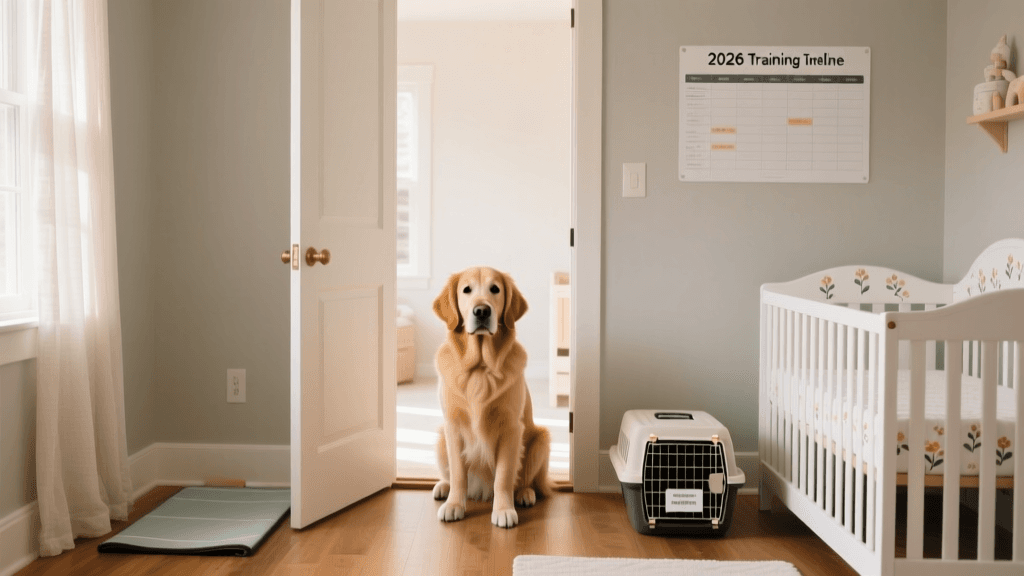
Half a year before your due date, the physical space of your home should begin to change, and your dog’s training must adapt accordingly. The nursery is a high-stimulation zone that will eventually become an off-limits or highly supervised area. Establishing these boundaries now prevents your dog from associating the baby's arrival with a sudden loss of territory.
Mastering the 'Place' Command
The 'Place' command is arguably the most valuable tool in your 2026 training arsenal. Unlike 'Down' or 'Sit', which are stationary positions, 'Place' directs your dog to a specific, designated mat or bed where they must remain until released. This is crucial for moments when you are nursing, changing the baby, or dealing with a chaotic household environment.
- Step 1: Luring and Marking. Use a high-value treat like Zuke's Mini Naturals to lure your dog onto a raised cot or specific training mat. The moment all four paws touch the mat, mark the behavior with a clicker or a verbal 'Yes!' and reward.
- Step 2: Adding the Cue. Once your dog reliably steps onto the mat for a treat, introduce the verbal cue 'Place' right before they move. Reward heavily for compliance.
- Step 3: Building the 3 Ds. Gradually increase Duration (how long they stay), Distance (how far away you step), and Distraction (adding baby sounds or dropping toys nearby). Aim for a solid 15-minute 'Place' while you move around the room.
Setting Up Invisible Boundaries
Install baby gates and nursery door barriers early. If the nursery will be strictly off-limits, use positive reinforcement to teach your dog to sit outside the threshold. Toss treats into the hallway when they voluntarily choose to sit outside the gate. If you plan to allow supervised access, invite your dog in only when you are present, rewarding calm behavior on their designated 'Place' mat in the corner of the room.
Phase 2: Three Months Out – Desensitization to Baby Gear
Infants bring a plethora of strange, noisy, and visually stimulating equipment into the home. The American Kennel Club (AKC) strongly recommends desensitizing your dog to these items well before the baby arrives. If a dog is already fearful of a mechanical swing or a stroller, the addition of a crying infant on that equipment will only amplify their stress.
The 2026 Desensitization Schedule
Set up the baby gear in your living spaces and allow your dog to investigate them passively. Never force an interaction. Instead, pair the presence of the gear with high-value rewards. Below is a structured desensitization plan for common baby items:
| Baby Gear | Introduction Method | Training Goal |
|---|---|---|
| Infant Stroller | Leave it in the living room. Feed meals nearby. Take the dog on walks with the empty stroller. | Dog ignores the stroller and walks politely on a loose leash beside it. |
| Motorized Swing | Turn it on at the lowest setting while the dog is on their 'Place' mat. Toss treats for calm observation. | Dog remains relaxed on their mat despite the mechanical whirring and motion. |
| White Noise Machine | Play tracks of white noise, lullabies, and eventually, recorded baby cries at a very low volume. | Dog does not react, whine, or bark at the audio stimuli. |
| Diaper Genie / Disposal | Practice opening and closing the lid. Reward the dog for maintaining a 'Sit-Stay' at a distance. | Dog avoids scavenging and respects the boundary around the disposal unit. |
Stroller Walks and Loose Leash Etiquette
Walking a dog while pushing a stroller requires impeccable loose-leash skills. Begin practicing with an empty stroller or a weighted doll. If your dog pulls, stop immediately. Consider upgrading to a 2026 front-clip no-pull harness, such as the PetSafe 3-in-1 Harness, which offers superior steering control without compromising the dog's shoulder mobility.
Phase 3: One Month Out – Routine Shifts and Scent Work
As your due date approaches, your daily schedule will inevitably become unpredictable. Dogs are highly attuned to routine, and sudden changes in feeding times, walk durations, and attention levels can trigger separation anxiety or attention-seeking behaviors.
Adjusting Walk and Feeding Schedules
Begin shifting your dog's routine to match what it will look like post-baby. If you currently take your dog for a two-hour walk every morning, scale it back to a realistic 30-minute walk, supplemented by mental enrichment. Introduce puzzle feeders, snuffle mats, and lick mats to tire your dog out mentally. If you plan to hire a dog walker or use a doggy daycare, start this transition now so your dog does not associate the new caregiver with the baby's arrival.
Managing Jealousy and Resource Guarding
Some dogs may begin to resource guard items that smell like you or items they perceive as high-value. Ensure your dog has a bulletproof 'Drop It' and 'Trade' command. Practice trading their favorite chew toys for ultra-high-value treats like freeze-dried liver. This ensures that if your dog ever picks up a baby toy, a pacifier, or a diaper, you can safely and calmly retrieve it without inciting aggression or panic.
Introducing the Baby's Scent
Before you bring the baby home, have a partner or family member bring a blanket or hat that the baby has worn at the hospital to your house. Allow your dog to sniff the item while on a leash, rewarding calm, polite investigation. Do not let them grab or chew the item. The Humane Society of the United States notes that scent introduction is a critical bridge, allowing the dog to process the new family member's smell before the overwhelming visual and auditory stimuli of the actual introduction.
The First Introduction: Bringing Baby Home
When you finally walk through the door, the energy will be high. Keep your dog on a leash for the first few interactions to ensure you have physical control. Have a second adult present to manage the dog if needed. Greet your dog calmly first, without the baby in your arms, to dissipate their initial excitement. Once they are settled, bring the baby into the room. Allow your dog to sniff the baby's feet from a safe distance while you feed high-value treats. Keep the first few sessions incredibly brief—under two minutes—and end on a positive note by sending your dog to their 'Place' mat with a long-lasting chew.
Recommended 2026 Training Gear for New Parents
To maintain training consistency while your hands are full, leverage modern pet technology. The Furbo 360 Dog Camera is an invaluable tool for 2026 parents. Its rotating lens allows you to monitor the nursery thresholds and living room boundaries from your phone, while the treat-tossing feature lets you remotely reward your dog for staying on their 'Place' mat while you are busy with the infant. Additionally, automated treat dispensers with scheduled release times can keep your dog occupied during the baby's nap times, reinforcing quiet behavior without requiring your direct intervention.
Conclusion
Preparing your dog for a new baby is not about a single training session; it is a comprehensive lifestyle transition. By establishing physical boundaries, desensitizing your dog to strange equipment, and proactively shifting their daily routine, you set the stage for a lifelong bond between your child and your canine companion. Patience, consistency, and positive reinforcement will ensure your dog feels secure, valued, and ready to embrace their new role as your family's gentle protector.
anouk-beaumont
All our authors care for dogs every day — read more of their work on the authors page.