Mastering the Place Command: A Step-by-Step Guide
Learn how to train a reliable place command with our step-by-step guide. Perfect for multi-dog homes, doorbell reactivity, and daily household harmony.
Why the 'Place' Command is a Game-Changer for Dog Owners
Sharing your life with a dog brings immense joy, but it also requires establishing boundaries and routines to maintain household harmony. Whether you are managing a multi-dog home, trying to cook dinner without a canine sous-chef underfoot, or dealing with a dog that goes wild when the doorbell rings, the 'Place' command is your ultimate management tool. Unlike a simple 'Sit' or 'Down' command, 'Place' directs your dog to a specific, designated spot—usually an elevated cot or a specific mat—where they must remain until released.
According to the ASPCA's Dog Training Resources, teaching dogs an incompatible behavior (like going to a bed) is one of the most effective ways to eliminate unwanted behaviors like jumping on guests or begging at the table. This step-by-step guide will walk you through the exact process of building a bulletproof 'Place' command, complete with gear recommendations, timing metrics, and troubleshooting tips.
Essential Gear and Setup: What You Need to Succeed
Before you begin training, you need to set up your environment for success. The right equipment makes a significant difference in how quickly your dog understands the concept.
1. The Right Dog Bed or Cot
While you can use a flat mat, an elevated cot is highly recommended. Elevated beds provide a clear physical boundary that dogs can easily see and feel, making it obvious when they are 'on' or 'off' their place. They also keep dogs cool and are easier on arthritic joints.
- Small to Medium Dogs (Under 30 lbs): Look for a bed measuring approximately 25 x 18 inches. The Coolaroo Elevated Pet Bed (Medium) is a great budget option at around $35.
- Large to Giant Dogs (Over 30 lbs): You will need a bed measuring at least 40 x 25 inches or up to 51 x 34 inches. The Kuranda Dog Bed is an industry standard for durability, costing roughly $110 to $150 depending on the size and material.
2. High-Value Training Treats
When teaching a new concept, you need high motivation. Soft, smelly treats work best. Zuke's Mini Naturals are a favorite among professional trainers because they are only 3 calories each and cost about $8.50 for a 16 oz bag. For high-distraction environments, upgrade to freeze-dried liver or boiled chicken breast (costing roughly $4 per pound).
3. A Clicker or Marker Word
Whether you use a mechanical clicker (about $5) or a verbal marker like the word 'Yes!', you need a precise way to tell your dog the exact millisecond they made the right choice.
Step 1: Introduction and Luring (Days 1 to 3)
The goal of this phase is simply to teach your dog that getting on the bed yields fantastic rewards. Keep your training sessions short—about 3 to 5 minutes, twice a day.
- Position the bed: Place the cot in a quiet room with minimal distractions, right next to you.
- Lure the dog: Hold a high-value treat right in front of your dog's nose and slowly move your hand over the center of the bed.
- Mark and reward: The moment all four paws are on the bed, click your clicker (or say 'Yes!') and give them the treat directly on the bed.
- Reset: Toss a second treat off the bed to encourage them to get off and reset for the next repetition.
Repeat this 10 to 15 times per session. The American Veterinary Medical Association (AVMA) emphasizes that positive reinforcement and keeping early training sessions brief prevents canine frustration and burnout.
Step 2: Fading the Lure and Adding the Verbal Cue (Days 4 to 7)
Once your dog is confidently following the lure onto the bed, it is time to fade the food from your hand so they do not become dependent on seeing the treat before complying.
- Empty hand lure: Point to the bed with an empty hand, using the exact same motion you used when holding the treat.
- Mark and reward: When they step onto the bed, mark the behavior and deliver the treat from your other hand or a treat pouch.
- Add the cue: Just before you point, clearly say 'Place'. The sequence should be: Verbal Cue ('Place') -> Hand Signal (Point) -> Dog gets on bed -> Mark -> Reward.
During this phase, start asking for a 'Down' once they are on the bed. A dog lying down is much more relaxed and less likely to break the command than a dog sitting in a sphinx-like posture.
Step 3: Building Duration and the Release Cue (Weeks 2 to 3)
A common mistake owners make is rewarding the dog and immediately letting them get up. You must teach your dog to stay on the bed until they hear a specific release word, such as 'Free', 'Break', or 'All Done'.
- Delay the reward: Ask your dog to go to 'Place'. Once they are down, wait 2 seconds before marking and rewarding. Gradually increase this to 5 seconds, then 10 seconds, then 30 seconds.
- Feed in position: If your dog gets up before you release them, calmly guide them back without a reward. Only reward while they are in the down position on the bed.
- Use the release word: After rewarding, toss a treat off the bed and say your release word ('Free!'). This teaches them that the command is not over until they hear the release.
Step 4: Adding Distance and Distractions (Weeks 4 to 6)
The American Kennel Club (AKC) Training Guidelines frequently remind owners that dogs do not generalize well. A dog that knows 'Place' in the living room might not understand it in the kitchen. You must systematically add the 'Three Ds': Duration, Distance, and Distraction.
| The Three Ds Progression Chart | Goal | Criteria for Success | Estimated Timeline |
|---|---|---|---|
| Duration | Staying on the bed for longer periods | Dog remains in a down position for 5 to 10 minutes while you sit nearby. | Weeks 2-3 |
| Distance | Obeying the cue from further away | Dog goes to the bed when you are 10 to 15 feet away, then stays until released. | Weeks 4-5 |
| Distraction | Holding the command amid chaos | Dog stays on the bed while you drop a toy, knock on the door, or have a guest enter. | Weeks 6-8 |
Important Rule: Only increase one 'D' at a time. If you are adding distance (walking across the room), drop your duration requirement back down to 2 seconds. If you are adding distractions (bouncing a tennis ball), stand right next to the bed (zero distance) and keep the duration short.
Real-Life Applications in a Multi-Dog Household
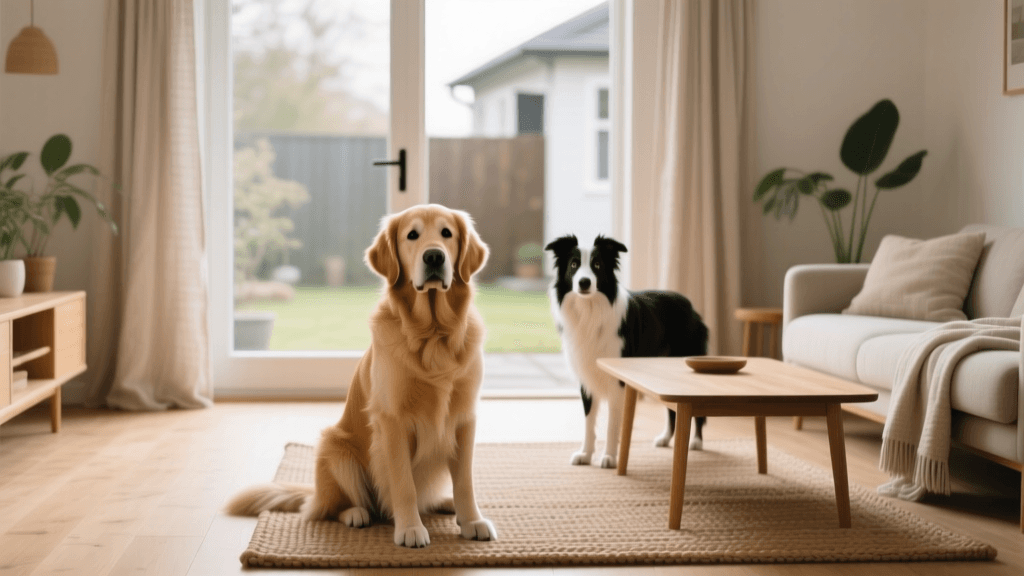
In a multi-pet household, the 'Place' command is an absolute necessity for maintaining peace. Here is how to apply it to daily routines:
Meal Prep and Feeding Time
Dogs weaving between your legs while you carry hot food or heavy bowls is a safety hazard. Train each dog to go to their individual 'Place' (spaced at least 6 feet apart to prevent resource guarding). They must remain in a down position while you prepare the bowls, place them on the floor, and until you give the release cue to eat. This drastically reduces kitchen anxiety and food aggression.
Doorbell Reactivity and Guest Greetings
When the doorbell rings, the excitement can trigger jumping and barking. Keep a jar of high-value treats near the door. When the bell rings, immediately cue 'Place'. Reward heavily for staying on the bed while you open the door. Over time, the sound of the doorbell becomes a cue to run to their bed rather than rush the front door.
Troubleshooting Common Roadblocks
Even with a solid step-by-step plan, you may encounter hurdles. Here is how to fix the most common issues:
- My dog gets up as soon as I walk away: You have likely increased the distance too quickly. Return to the bed, use a leash to gently prevent them from following you, take one step back, mark, reward, and release. Build distance one single step at a time.
- My dog won't lie down on the bed: Some dogs feel vulnerable lying down on an elevated surface. Spend a few days just rewarding them for sitting on the bed, and practice the 'Down' command on the floor nearby before transferring it to the cot.
- My dog whines on the bed: Whining usually indicates frustration or a lack of mental stimulation. Ensure you are giving them an appropriate chew toy (like a stuffed Kong or a bully stick, costing roughly $3 to $6 each) while they are on their place. The bed should be associated with relaxing and chewing, not just strict obedience.
Conclusion: Consistency is the Key to Harmony
Training a reliable 'Place' command is not an overnight process; it requires weeks of consistent, daily practice. By investing 10 to 15 minutes a day into this step-by-step protocol, you are giving your dog a clear job and a safe space to retreat to when the household gets chaotic. Whether you are managing the beautiful chaos of a multi-dog home or simply want to enjoy a quiet cup of coffee without a wet nose nudging your elbow, mastering the 'Place' command is one of the highest-return investments you can make in your life with your dog.
anouk-beaumont
All our authors care for dogs every day — read more of their work on the authors page.