Osteoarthritis Dog Training: 2026 Low-Impact Cues and Tricks
Discover 2026 training modifications for dogs with osteoarthritis. Learn low-impact obedience cues, mental stimulation tricks, and mobility aid conditioning.
The Intersection of Canine OA Treatment and Training in 2026
As we navigate through 2026, veterinary medicine has fundamentally transformed canine osteoarthritis (OA) treatment. With the widespread, long-term success of anti-NGF monoclonal antibody therapies and advanced joint supplements, dogs with OA are living longer, more comfortable, and highly active lives. However, pain management does not reverse structural joint degradation or cartilage loss. As a dedicated dog owner or trainer, you must adapt your behavioral conditioning and obedience training to protect your dog's biomechanics. Training a dog with OA is no longer about stopping the learning process; it is about pivoting to joint-friendly methodologies.
According to the American College of Veterinary Surgeons, osteoarthritis is a progressive, degenerative disease that affects the synovial joints, leading to pain, stiffness, and reduced mobility. Because the physical mechanics of the joints are compromised, traditional training methods that require repetitive impact, deep joint flexion, or sudden directional changes can accelerate joint wear. By modifying your training approach, you can maintain your dog's obedience, deepen your bond, and provide essential mental enrichment without compromising their physical health.
Rethinking Traditional Obedience Cues for Joint Health
Many foundational obedience cues were designed without considering the long-term biomechanical toll on a dog's skeletal system. For a dog with hip dysplasia, elbow osteoarthritis, or spinal spondylosis, the simple act of sitting or lying down can cause micro-trauma and inflammation over time.
The Problem with 'Sit' and 'Down'
When a dog sits, they must engage in deep flexion of the stifle (knee) and hock joints, while bearing significant weight on their pelvis and lower back. For a dog with hip OA, this position can be agonizing. Similarly, the 'down' cue requires the dog to lower their center of gravity, which places immense strain on the elbows, carpal (wrist) joints, and shoulders. Repeatedly asking an arthritic dog to perform these cues during a training session can lead to soreness and a negative association with training.
OA-Friendly Alternative Cues
In 2026, modern canine rehabilitation and behaviorists strongly advocate for replacing high-strain cues with biomechanically neutral alternatives. Here is a breakdown of how to modify your training vocabulary:
| Traditional Cue | Biomechanical Stress | OA-Friendly Alternative | Primary Benefit |
|---|---|---|---|
| Sit | Hip flexion, stifle compression, pelvic weight-bearing | Stand / Park | Keeps joints aligned, minimal flexion, equal weight distribution |
| Down | Elbow/shoulder strain, hip splaying, spinal flexion | Settle on Mat | Controlled descent onto orthopedic support, prevents hard floor impact |
| Jump / Up | High impact on carpal joints, shoulders, and spine | Touch (Nose to Hand) | Engages the mind and core, zero joint impact |
| Heel (Tight) | Neck strain, restricted gait, unnatural pacing | Loose Leash Walk | Allows natural spinal movement and comfortable stride length |
To teach the 'Stand' or 'Park' cue, simply lure your dog forward into a standing position, mark the behavior with a clicker or a 'yes,' and reward. This is an excellent alternative for grooming, veterinary exams, and greeting guests, as it keeps the dog's spine neutral and joints stacked comfortably.
Mental Stimulation: Tiring Out Your Dog Without the Strain
One of the greatest challenges of canine OA treatment is managing a dog's energy levels when physical exercise must be restricted. A dog that cannot go on a five-mile hike will quickly become bored, frustrated, and potentially destructive. The American Kennel Club emphasizes that mental exercise can be just as exhausting for a dog as physical exercise, making it a cornerstone of OA management.
Elevated Scent Work and Nosework
Scent work is arguably the best low-impact activity for senior and arthritic dogs. It taps into their natural olfactory instincts and provides immense mental fatigue. However, traditional nosework often involves hiding treats on the floor, which forces the dog to crane their neck downward, putting pressure on the cervical spine and front shoulders.
The 2026 Modification: Utilize elevated scent stations. Place snuffle mats, cardboard boxes with scent holes, or treat-dispensing puzzles on raised platforms, coffee tables, or sturdy stools. This allows your dog to work at chest height, keeping their spine neutral while they hunt for birch, anise, or clove scents.
Shaping and Capturing Calmness
Shaping is a training technique where you reward successive approximations of a desired behavior. You can use shaping to teach your dog to interact with low-impact puzzle toys or to simply 'capture calmness.' Sit in a quiet room with your dog and a pouch of high-value, soft treats. Every time your dog voluntarily lies down on their orthopedic bed, sighs, or relaxes their muscles, mark and reward the behavior. Over time, your dog will learn that being calm and resting is a highly rewarded 'trick,' which helps lower their overall arousal levels and reduces the desire for high-impact play.
Conditioning for Mobility Aids and Support Gear
As OA progresses, many dogs require mobility aids, such as rear-lift harnesses or dog wheelchairs (carts). Introducing this gear should be treated as a specialized training protocol, not a sudden necessity forced upon a confused dog.
Desensitizing to a Rear-Lift Harness
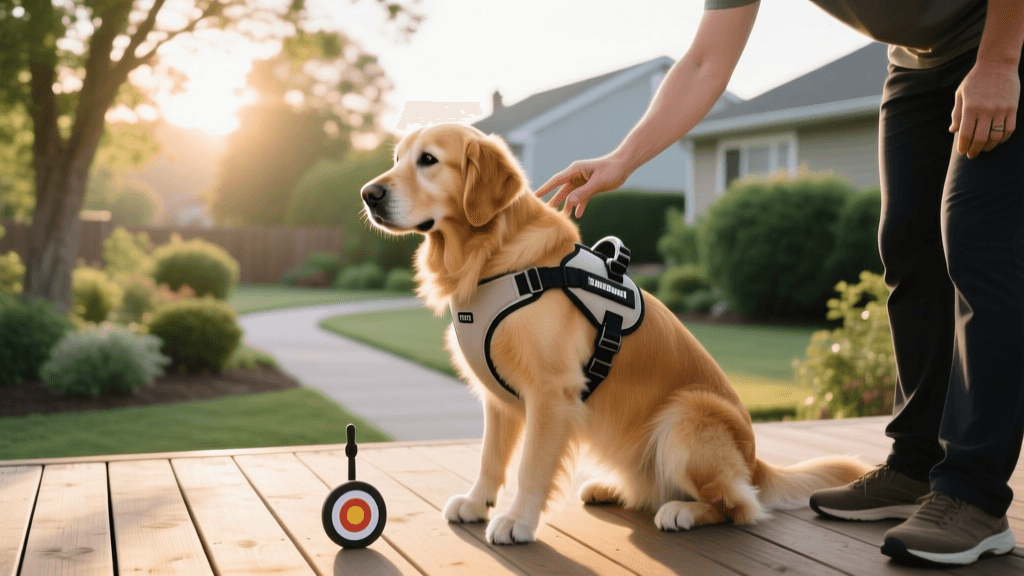
Harnesses like the Help 'Em Up Harness are invaluable for helping dogs up stairs, into cars, or out of the yard. To train your dog to accept the harness:
- Step 1: Visual Introduction. Place the harness on the floor near their bed. Reward any sniffing or looking at the harness.
- Step 2: Targeting. Teach your dog to push their nose through the neck opening using a target stick or a treat lure, rewarding heavily for voluntary participation.
- Step 3: The Belly Band. Fasten the belly band loosely while the dog is standing. Feed a continuous stream of treats (like lickable peanut butter from a silicone mat) while the harness is on, then remove it when the treats stop. This builds a positive emotional response.
- Step 4: The Lift. Once fully comfortable, gently apply upward pressure on the hip handles for just one second, mark, and reward. Gradually increase the duration and weight-bearing support over several weeks.
Wheelchair (Cart) Conditioning
For dogs requiring a wheelchair, training must focus on spatial awareness. Dogs in carts cannot feel where their hind legs are, so they may back up into walls or trip over rugs. Train a 'back up' cue using a tactile target mat on the floor, and practice navigating wide, obstacle-free corridors before attempting tight turns or outdoor terrain.
Pro Tip for 2026: Always consult with a Certified Canine Rehabilitation Therapist (CCRT) before introducing a wheelchair. They can measure your dog for the exact cart dimensions and provide a customized conditioning plan to ensure the cart supports the dog's specific joint angles without causing secondary strain to the shoulders.
Integrating Training with Veterinary OA Protocols
Successful training for a dog with OA requires synchronization with their medical treatment plan. In 2026, the gold standard for OA pain management often involves a multimodal approach, including monthly anti-NGF injections, daily NSAIDs (like grapiprant), and joint-supportive diets.
You must time your training sessions to coincide with your dog's peak pain relief windows. If your dog takes an NSAID in the morning, schedule your most cognitively demanding training sessions (like learning a new scent work discrimination) for mid-morning when their inflammation is lowest and their comfort is highest. Avoid training in the late evening when joint stiffness and fatigue typically set in.
Furthermore, keep training sessions incredibly short. A dog with chronic pain has a lower threshold for frustration and physical fatigue. Five minutes of focused, low-impact training twice a day is vastly superior to a single 30-minute session. Watch for subtle signs of pain or fatigue, such as lip licking, yawning, shifting weight, or a reluctance to take treats gently. If you see these signs, end the session immediately on a positive note by asking for an easy, well-known cue like 'touch.'
Conclusion
Canine osteoarthritis does not mean the end of your dog's training journey; it simply requires a more empathetic, biomechanically sound approach. By replacing high-impact obedience cues with joint-friendly alternatives, leveraging the power of elevated mental stimulation, and carefully conditioning your dog for mobility aids, you can ensure your companion remains engaged, happy, and comfortable. Always work in tandem with your veterinary team to align your training goals with the latest 2026 OA treatment protocols, ensuring your dog's golden years are as enriching as they are pain-free.
beth-carrasco
All our authors care for dogs every day — read more of their work on the authors page.