New Baby Dog Training: Desensitization & Place Commands 2026
Prepare your dog for a new baby in 2026 with expert desensitization, place command training, and smart home integration for a stress-free transition.
Bringing a new baby into your home is one of the most profound life transitions a family can experience. For your dog, however, this transition represents a seismic shift in their environment, routine, and social structure. In 2026, veterinary behaviorists and certified professional dog trainers emphasize that successful integration relies on proactive, force-free behavioral conditioning rather than reactive correction. Preparing your dog for a new baby requires a structured approach to desensitization, impulse control, and boundary training. This comprehensive guide will walk you through the exact steps, timelines, and modern techniques to ensure your dog and your new baby coexist safely and happily.
The 2026 Approach to Canine Life Transitions
Historically, many pet parents waited until the baby arrived to see how the dog would react. Today, the consensus among experts is that the preparation must begin during the first trimester. According to Family Paws Parent Education, a leading organization specializing in dogs and babies, proactive desensitization significantly reduces canine stress and prevents the development of resource guarding or anxiety-based behaviors. By leveraging modern positive reinforcement techniques and 2026's advanced smart home ecosystems, you can create a predictable, low-stress environment for your dog long before the nursery is fully occupied.
Phase 1: Environmental and Equipment Desensitization
Dogs are highly observant of environmental changes. The sudden appearance of a crib, a stroller, and a diaper genie can trigger curiosity or anxiety. Begin by setting up the nursery furniture months in advance. Allow your dog to investigate the crib and changing table under supervision. Reward calm sniffing with high-value treats, such as freeze-dried salmon or chicken breast.
One of the most critical pieces of equipment to introduce early is the baby stroller. Many dogs develop a fear of or aggression toward strollers because they resemble large, rolling predators. Start by leaving the stroller in your living room. Feed your dog their meals near it. Once they are comfortable, begin taking your dog on walks while you push the empty stroller. This builds a positive association and teaches your dog to walk politely on a loose leash while you are pushing a wide object, a crucial skill for neighborhood walks in 2026's busier urban environments.
Phase 2: Mastering the "Place" Command
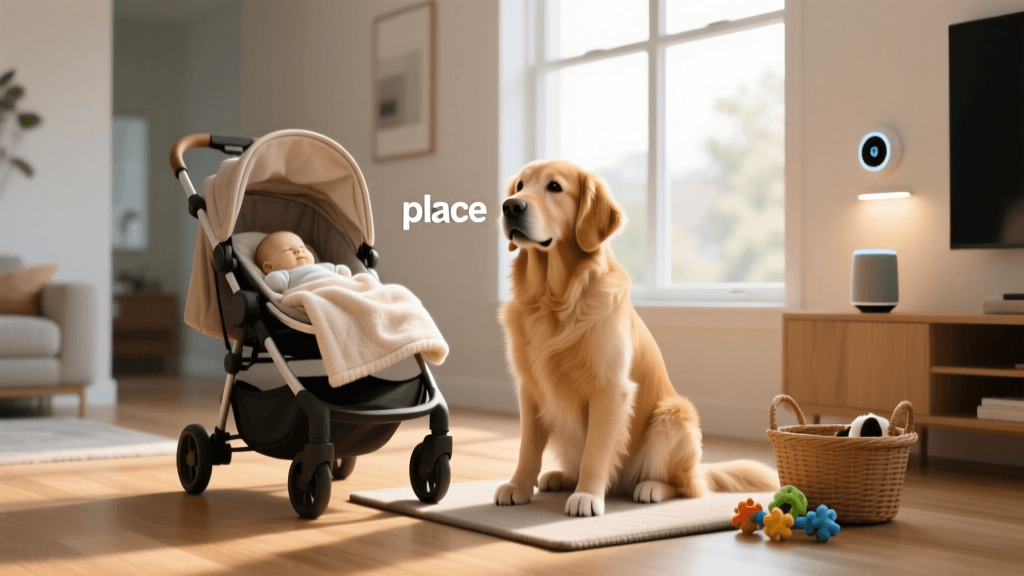
The "Place" command is arguably the most valuable obedience skill for a household with a newborn. It teaches your dog to go to a specific mat or elevated cot and remain there until released. This provides your dog with a safe sanctuary and gives you a reliable way to manage your dog's movements when you are nursing, changing a diaper, or holding the baby.
Step-by-Step "Place" Training
- Select the Right Bed: Use an elevated, chew-proof cot like a Kuranda or Coolaroo bed. The physical elevation helps define the boundary of the "Place" clearly for the dog.
- Lure and Mark: Hold a treat near your dog's nose and lure them onto the bed. The moment all four paws touch the mat, use a marker word like "Yes!" or a clicker, and deliver the treat.
- Add the Verbal Cue: Once your dog reliably follows the lure onto the bed, add the verbal cue "Place" just before you lure them.
- Build Duration: Delay the treat delivery. Ask for "Place," wait two seconds, mark, and reward. Gradually increase the time to five seconds, ten seconds, and eventually several minutes.
- The 3 Ds - Distance, Duration, Distraction: In 2026, modern dog training heavily emphasizes working the "3 Ds" separately. First, build duration while standing next to the bed. Next, add distance by taking one step away, returning, and rewarding. Finally, add distractions, such as dropping a baby toy nearby or playing a recording of a baby crying at a low volume.
Phase 3: Auditory Desensitization Using Smart Home Tech
Baby cries are biologically designed to be distressing, which can cause significant anxiety or hyper-arousal in dogs. You can use your home's Matter-compatible smart speakers to systematically desensitize your dog to these sounds. Create a smart home routine that plays recordings of baby cries, coos, and nursery rhymes at a very low volume while your dog is eating or engaging with a food puzzle toy like a Kong or Lickimat. Over several weeks, incrementally raise the volume. If your dog shows signs of stress (panting, pacing, whining), lower the volume immediately. The goal is to keep the dog under their stress threshold while building a positive emotional response to the sounds.
Structured Transition Timeline
To keep your training on track, follow this structured timeline. Consistency is far more important than the length of each training session. Aim for multiple short sessions throughout the day.
| Phase / Timeline | Primary Training Focus | Daily Commitment | Key Milestone |
|---|---|---|---|
| Months 1-2 (Early Pregnancy) | Environmental desensitization, stroller walks, basic obedience refresh. | 15 minutes | Dog walks calmly beside an empty stroller; ignores nursery furniture. |
| Months 3-4 (Mid Pregnancy) | "Place" command foundation, introducing smart home baby sounds. | 20 minutes | Dog holds "Place" for 5 minutes with mild household distractions. |
| Months 5-6 (Late Pregnancy) | Increasing distance on "Place", scent introduction, boundary training. | 20 minutes | Dog remains on "Place" while you simulate rocking a baby doll. |
| Month 7+ (Post-Arrival) | Leash management, supervised introductions, maintaining routines. | Ongoing | Dog greets baby calmly on leash; voluntarily goes to "Place" when baby cries. |
Phase 4: Scent Introduction and Boundary Setting
Before you bring the baby home from the hospital, have a partner or family member bring home a blanket or hat that carries the baby's scent. Allow your dog to sniff the item from a distance, rewarding calm behavior. Do not let the dog grab or play with the item. This introduces the baby's scent in a controlled, low-arousal manner.
Additionally, establish physical boundaries. If you plan to keep the dog out of the nursery when unsupervised, install a tall, hardware-mounted baby gate or use an indoor smart pet barrier well before the baby arrives. Teach your dog that crossing the threshold of the nursery without permission results in a gentle redirection out of the room, followed by a reward for staying in the hallway. The Humane Society of the United States strongly recommends using physical barriers to ensure that dogs and infants are never left alone together in the same room, regardless of how trustworthy the dog may seem.
The First Meeting and Beyond
When you finally bring the baby home, the first introduction should be calm and highly controlled. Leave the baby in the car with another adult while you enter the home to greet your dog. Allow your dog to burn off initial excitement with a quick walk or play session. Once the dog is calm, bring the baby inside.
Keep your dog on a secure, six-foot leather or biothane leash. Do not use a retractable leash, as they offer poor control in emergencies. Allow the dog to approach slowly and sniff the baby's feet, rewarding heavily with treats for gentle behavior. Avoid forcing the dog close to the baby's face. Over the following weeks, continue to reward your dog for choosing to go to their "Place" mat whenever the baby is active or crying.
Maintaining Enrichment Post-Arrival
A common mistake new parents make is neglecting their dog's physical and mental needs during the chaotic first few months. A bored or under-exercised dog is far more likely to exhibit nuisance behaviors like barking, chewing, or seeking attention inappropriately. In 2026, canine enrichment is recognized as a vital component of behavioral stability. Utilize snuffle mats, lick mats, and frozen Kong toys to provide mental stimulation that tires your dog out without requiring hours of physical exercise. Consider hiring a professional dog walker or enlisting a family member to ensure your dog receives at least one dedicated, structured walk daily. By making the right choices highly rewarding and ensuring their core needs are met, you transform a potentially stressful life transition into an opportunity to deepen the bond and obedience of your canine companion.
aaron-whyte
All our authors care for dogs every day — read more of their work on the authors page.