Training Multiple Dogs: Mastering Recall and Door Manners
Learn how to train multiple dogs for reliable recall and polite door manners. Discover actionable steps, gear recommendations, and pack management tips.

The Challenge of the Multi-Dog Household
Living with multiple dogs is an incredibly rewarding experience, but it introduces a unique set of behavioral challenges that single-dog owners rarely face. When one dog barks at the mail carrier, the entire pack joins in, creating a deafening chorus of arousal. When the front door opens, a chaotic stampede ensues, turning a simple bathroom break into a high-stakes game of catch. Training a single dog requires patience and consistency; training a multi-dog household requires strategic pack management, precise timing, and a deep understanding of canine social dynamics.
In a pack environment, dogs feed off each other's energy. This phenomenon, often referred to as 'social facilitation,' means that bad habits spread like wildfire, but fortunately, so do good ones. The key to mastering obedience in a multi-dog home is to control the environment, manage arousal levels, and build individual foundations before expecting group compliance. This guide will walk you through actionable, step-by-step protocols for mastering the two most critical skills in a multi-dog home: polite door manners and a reliable pack recall.
The Golden Rule: Isolate, Train, Integrate
The most common mistake owners make is attempting group training before individual foundations are laid. You cannot teach a chaotic pack to sit politely at the door if they have not mastered the 'sit' and 'stay' commands individually in a low-distraction environment. The American Veterinary Medical Association (AVMA) emphasizes that understanding individual behavioral baselines is critical before introducing complex multi-pet dynamics.
Phase 1: Individual Isolation
Train each dog separately for at least two weeks when introducing a new protocol. Keep the non-working dog in a separate room or a crate with a long-lasting chew, such as a bully stick or a frozen Kong stuffed with peanut butter. This prevents the non-working dog from practicing bad habits and teaches them that being separated from the 'action' is a positive, relaxing experience.
- Timing: Conduct 10-minute solo sessions twice a day per dog.
- Environment: Use a quiet room with no visual access to the rest of the pack.
- Reward Rate: Use a 1:1 treat-to-repetition ratio to build strong muscle memory.
Phase 2: Controlled Integration
Once both dogs can perform the target behavior (e.g., 'Place' or 'Recall') individually with 90% reliability, bring them together. Keep both dogs on leashes to prevent them from breaking their commands and rewarding themselves by running off to play.
Mastering Threshold and Door Manners
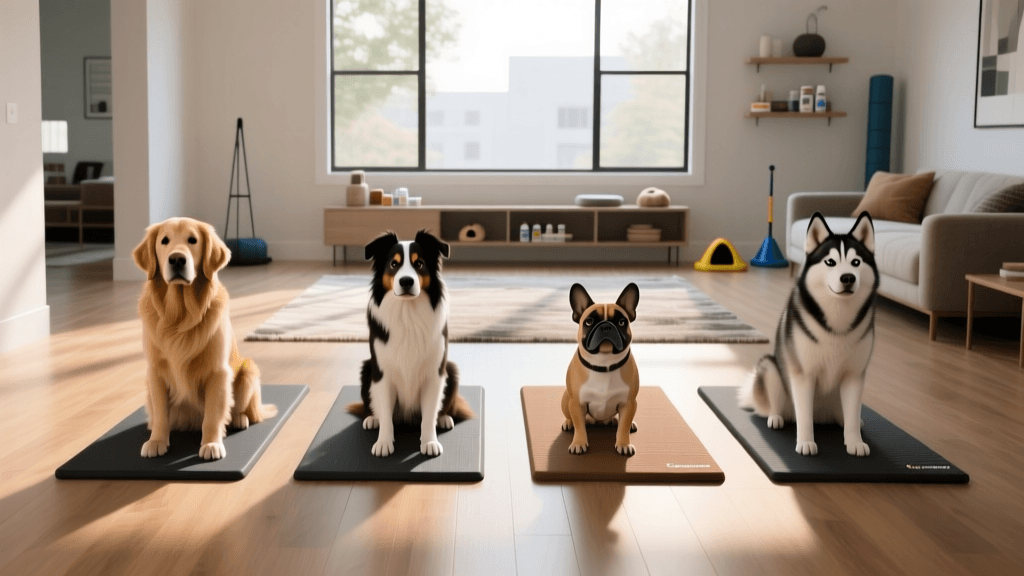
Door dashing is not just annoying; it is highly dangerous. In a multi-dog home, competition at the threshold amplifies the prey drive and escape motivation. To solve this, we must change the dogs' emotional response to the door opening. Instead of the door being a 'start button' for a sprint, it must become a 'cue' to settle on their designated mats.
The 'Place' Command Protocol
The 'Place' command requires the dog to go to a specific elevated or textured surface and remain there until released. For multi-dog homes, elevated cots are superior to flat mats because they provide clear spatial boundaries that dogs can easily distinguish.
- Select Your Gear: Invest in durable, chew-resistant beds. The Kuranda PVC Chewproof Dog Bed (approx. $130) is an industry standard for multi-dog homes because it is easy to clean and provides clear physical boundaries.
- Assign Stations: Place the beds at least four feet apart to respect each dog's spatial bubble and reduce tension.
- Lure and Mark: With a dog on a 6-foot leather lead, toss a treat onto the bed. The moment all four paws touch the bed, use a marker word like 'Yes!' and reward heavily.
- Build Duration: Use a kitchen timer. Start with 30 seconds and gradually increase to 5 minutes. If a dog breaks the command, calmly guide them back without repeating the verbal cue.
Desensitizing the Door
Once both dogs can hold their 'Place' command for three minutes while you walk around the room, introduce the door. Touch the handle. If they stay, reward. Turn the handle. If they stay, reward. Open the door one inch. If they break, calmly close the door and reset them. This process, known as systematic desensitization, teaches the pack that the door opening is entirely irrelevant to their current job of staying on their beds.
Pro Tip: Always use a physical barrier, such as a baby gate, during the early stages of door training. This provides a fail-safe that prevents the dogs from rehearsing the unwanted behavior of bolting out the door while they are still learning the new protocol.
The 'Pack Recall' Strategy
Recalling one dog from a distracting scent is challenging; recalling three dogs who are feeding off each other's excitement in the yard seems nearly impossible. When dogs run in a pack, their predatory drift takes over, and individual training often falls apart. To build a bombproof pack recall, you must become the most exciting element in their environment.
Upgrading Your Rewards
Dry kibble will not cut it when competing with the thrill of a pack chase. You need high-value, aromatic rewards. Stella & Chewy's Freeze-Dried Beef Liver (approx. $12 per bag) is an excellent choice because the strong scent cuts through outdoor distractions. Break the treats into pea-sized pieces to allow for rapid-fire rewarding without filling the dogs up too quickly.
The Restrained Recall Exercise
This exercise builds immense frustration and drive to return to you, utilizing the pack's competitive nature to your advantage.
- Equipment: Fit each dog with a well-fitting harness, such as the Ruffwear Front Range Harness ($40), and attach a 15-foot biothane long line ($25). Biothane is essential for multi-dog homes as it does not tangle or absorb mud and water like nylon.
- The Setup: Have a helper hold Dog A by the harness. You stand 15 feet away with Dog B on the long line.
- The Release: Call Dog B enthusiastically ('Buster, Come!'). As Dog B runs to you, reward heavily with the high-value liver.
- The Pack Effect: Dog A, watching from a restrained position, will become highly motivated to join the fun. Swap roles and repeat. The restraint builds a psychological 'magnet' effect toward the handler.
Creating a Group Recall Cue
In addition to individual name recalls, establish a specific cue that means 'everyone comes to me for a party.' Many trainers use a unique word like 'Cookies!' or a specific whistle blast. When you use the group cue, scatter a massive handful of treats on the grass upon their arrival. This teaches the dogs that returning together results in a communal jackpot, reducing competition and jealousy at the finish line.
Managing Resource Guarding and Space
When training multiple dogs, you must be hyper-aware of resource guarding. The ASPCA's guidelines on resource guarding highlight that competition over high-value items, spatial pressure, and owner attention are primary triggers for inter-dog aggression. In a training context, the 'resource' might be the treat pouch or the handler themselves.
Structured Feeding and Rewarding
Never toss treats into the middle of a group of dogs. This encourages snapping, competition, and bullying. Instead, establish a strict protocol: call a dog by name, make eye contact, and deliver the treat directly to their mouth. If Dog A attempts to steal Dog B's reward, use your body to block Dog A and withhold the treat until they back off. This enforces polite manners and ensures that the working dog feels secure in their reward.
Managing Arousal and Decompression
High-arousal training sessions can lead to redirected frustration, where a dog might nip at their housemate when they fail to get a treat. To mitigate this, incorporate 'sniffing games' and decompression walks into your routine. Allow the dogs to sniff the environment on a loose leash for 20 minutes before beginning formal obedience training. Sniffing naturally lowers a dog's heart rate and promotes a calm, receptive learning state.
Multi-Dog Training Schedule & Gear Guide
Consistency is the bedrock of canine behavior. Below is a structured weekly guide and gear breakdown to help you organize your multi-dog training sessions effectively.
| Training Phase | Primary Focus | Recommended Gear | Est. Cost | Daily Time Commitment |
|---|---|---|---|---|
| Phase 1: Isolation | Individual Recall & Place Command | 6ft Leather Leash, Treat Pouch | $45 | 20 mins (10 per dog) |
| Phase 2: Integration | Group Door Manners & Mat Work | Kuranda Raised Beds, Baby Gates | $180 | 15 mins combined |
| Phase 3: Proofing | Outdoor Pack Recall & Distraction | 15ft Biothane Long Lines, Harnesses | $130 | 20 mins combined |
| Maintenance | Real-World Application & Decompression | Freeze-Dried High-Value Treats | $15/wk | Ongoing (Integrated into walks) |
Knowing When to Call a Professional
While many multi-dog behavioral issues can be resolved with consistent management and positive reinforcement, some situations require professional intervention. If you observe stiff body language, hard staring, or aggressive resource guarding between your dogs, cease group training immediately. For complex behavioral issues, consulting a certified professional listed via the Association of Professional Dog Trainers (APDT) is highly recommended. A professional can assess the subtle micro-expressions between your dogs that an untrained eye might miss, ensuring the safety and harmony of your entire household.
Conclusion
Training multiple dogs is a marathon, not a sprint. By respecting the individual learning curves of each dog, managing their environment with the right gear, and systematically building up to group challenges, you can transform your chaotic pack into a cohesive, well-mannered team. Remember that every interaction is a training opportunity. Whether you are opening the front door, dispensing treats, or walking down the street, consistency and clear communication will ultimately forge a peaceful, obedient, and joyful multi-dog home.
priya-sutaria
All our authors care for dogs every day — read more of their work on the authors page.