Moving With A Puppy: Potty Training & Routine Transitions 2026
Moving with a puppy? Learn how to reset potty training, manage teething stress, and establish new routines in your new home with our 2026 guide.
Introduction: The Reality of Relocating With a Young Dog
Moving is universally recognized as one of the most stressful life events for humans, but for a puppy in their first year of life, a change of address can feel like an entire planetary shift. During the first twelve months, your puppy is navigating crucial developmental milestones, including early socialization, intense teething phases, and the foundational stages of potty training. When you uproot their environment, you inadvertently disrupt the spatial cues and routines they have worked so hard to memorize. As of 2026, veterinary behaviorists emphasize that a successful move with a young dog requires a deliberate, structured approach to resetting their expectations and re-establishing boundaries.
Whether you are moving across the country or just to a new apartment across town, the transition demands patience and a strategic overhaul of your daily schedule. This comprehensive guide will walk you through the exact steps needed to manage potty training resets, protect your new baseboards from teething damage, and maintain your puppy's gut health and socialization progress during this major life transition.
The Developmental Impact of Moving on Puppies
Puppies rely heavily on environmental predictability to feel secure. In their first year, their brains are highly plastic, absorbing information about what is safe, what is a bathroom, and what is a play zone. When you move, the olfactory markers, visual landmarks, and acoustic environment change entirely. According to the ASPCA guidelines on moving with pets, this sudden loss of familiar scents and routines can trigger a spike in cortisol, leading to regression in previously learned behaviors.
It is entirely normal for a fully potty-trained four-month-old puppy to suddenly have accidents indoors after a move. This is not a sign of disobedience; it is a symptom of environmental confusion. Understanding this physiological response is the first step in approaching your puppy's transition with empathy rather than frustration. By anticipating regression, you can proactively implement management strategies that set your puppy up for success in their new home.
The Potty Training Reset: Re-Establishing Boundaries
Puppies do not generalize potty training the way humans do. A puppy learns that 'the grass in the old backyard' is the bathroom, not necessarily that 'any grass outside' is the bathroom. When you arrive at your new home, you must assume that your puppy is completely untrained and start from day one. The AKC house training guidelines recommend reverting to a strict, high-frequency outdoor schedule to build new spatial associations.
Step-by-Step Potty Reset Protocol
- Tethering and Supervision: For the first two weeks in the new house, your puppy should be tethered to you or confined to a small, puppy-proofed area when not actively supervised. This prevents them from wandering off to find a hidden corner for an accident.
- Frequent Excursions: Take your puppy outside every 45 to 60 minutes, as well as immediately after waking up, eating, or playing. Use a consistent verbal cue like 'go potty' and reward heavily with high-value treats the moment they finish.
- Enzymatic Cleaners: Accidents will happen. Keep a 2026-formula enzymatic cleaner like Nature's Miracle Advanced Stain & Odor Eliminator on hand. Standard household cleaners do not break down uric acid crystals, meaning your puppy will still smell the biological marker and return to the same spot.
- Smart Monitoring: If you must leave your puppy in a playpen, utilize a smart camera like the Furbo 360 Dog Camera. The latest 2026 models feature AI-driven behavior alerts that notify your phone if your puppy begins circling or sniffing, allowing you to intervene before an accident occurs.
Managing Teething and Destructive Chewing in a New Space
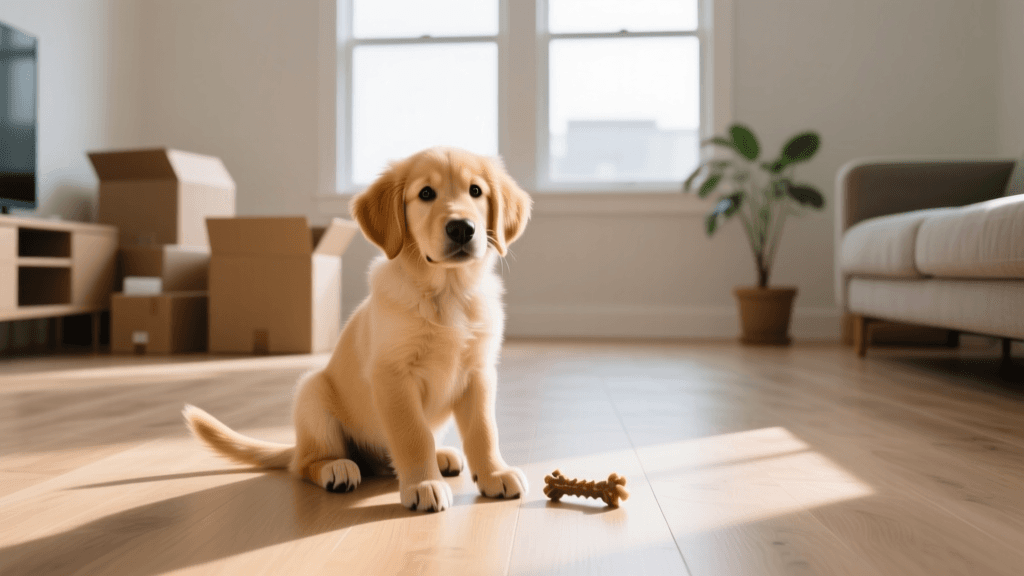
The stress of a move often exacerbates teething discomfort. Puppies between three and six months of age are losing their deciduous teeth and growing adult molars, a process that causes significant gum inflammation. In a new environment filled with unfamiliar smells, moving boxes, and new wooden baseboards, a stressed, teething puppy will seek relief through destructive chewing.
To protect your new home and your puppy's dental health, you must provide appropriate, highly engaging alternatives. Freeze a rubber Kong Classic stuffed with plain pumpkin puree and low-sodium chicken broth. The cold temperature numbs inflamed gums, while the mental effort required to extract the food tires them out. Additionally, durable options like the Benebone Wishbone offer ergonomic shapes that puppies can easily grip with their paws while chewing. Never leave a teething puppy unsupervised in a room with exposed wires, toxic houseplants, or freshly painted drywall, as their curiosity and jaw strength can lead to expensive and dangerous emergencies.
Protecting Gut Health and Feeding Schedules
The gastrointestinal tract of a puppy is incredibly sensitive to stress. A phenomenon known as stress colitis is common during relocations, resulting in loose stools, decreased appetite, and general lethargy. To mitigate this, your feeding schedule must remain absolutely identical to what it was in your old home. Do not use a move as an excuse to switch kibble brands or introduce new table scraps.
Incorporate a high-quality canine probiotic, such as Purina Pro Plan FortiFlora, into their meals starting three days before the move and continuing for two weeks after arrival. This helps maintain a healthy microbiome and firms up stools during the transition. Ensure that fresh, filtered water is always available, as puppies are prone to dehydration if they experience stress-induced diarrhea. If your puppy refuses to eat for more than 12 hours post-move, consult your veterinarian immediately, as young dogs can develop hypoglycemia rapidly.
Early Socialization in a New Neighborhood
The primary socialization window for puppies closes around 14 to 16 weeks of age. If your move occurs during this critical period, you must actively work to socialize your puppy to the new neighborhood's unique sights and sounds. A bustling urban street sounds vastly different from a quiet suburban cul-de-sac. Carry your puppy in a structured sling or hold them in your arms while sitting on your new front porch. Allow them to observe garbage trucks, delivery drivers, and unfamiliar dogs from a safe distance.
Pair these novel experiences with high-value rewards. If a loud siren passes by, feed your puppy a piece of boiled chicken. This classical conditioning technique teaches the puppy that new, loud, or strange things in their new environment predict positive outcomes, building confidence and preventing fear-based reactivity later in life.
The 7-Day Post-Move Puppy Routine
Consistency is the ultimate antidote to relocation anxiety. Below is a structured daily schedule designed to provide maximum predictability for your puppy during their first week in a new home.
| Time | Activity | Transition Goal | Equipment Needed |
|---|---|---|---|
| 6:30 AM | Wake up & Immediate Potty Trip | Establish new outdoor bathroom spot | Leash, high-value treats |
| 7:00 AM | Breakfast & Probiotic | Maintain gut health & routine | Slow feeder bowl, FortiFlora |
| 8:00 AM | Structured Play & Training | Build confidence in new living room | Snuffle mat, training clicker |
| 10:00 AM | Crate Nap (with white noise) | Enforce downtime, block new sounds | Crate, Adaptil Calm Diffuser |
| 12:30 PM | Potty Trip & Neighborhood Walk | Safe socialization & scent mapping | Harness, 15ft long line |
| 3:00 PM | Chew Time & Mental Enrichment | Relieve teething stress & boredom | Frozen Kong, Benebone |
| 6:00 PM | Dinner & Evening Potty Trip | Reinforce schedule consistency | Standard food bowl, leash |
| 8:30 PM | Wind Down & Final Potty Trip | Prepare for uninterrupted sleep | Dim lighting, calming chews |
Conclusion: Patience is the Key to a Successful Transition
Relocating during your puppy's first year is undeniably challenging, but it is also a profound opportunity to strengthen your bond. By treating the move as a chance to refresh your training, strictly managing their environment, and prioritizing their physical and emotional comfort, you will help your puppy adapt to their new home with resilience. Remember that setbacks are a normal part of the process. Stick to your 2026 routine, celebrate the small victories, and give your puppy the grace they need to navigate this major life transition. Within a few weeks, the new house will no longer be a strange, scary place—it will simply be home.
hannah-wickes
All our authors care for dogs every day — read more of their work on the authors page.