2026 Service Dog Puppy Public Access Socialization Guide
Master 2026 public access socialization and joint care protocols for mobility service dog puppies. Includes gear lists, milestones, and ADI guidelines.
Raising a Mobility Service Dog Puppy in 2026
Raising a mobility service dog puppy is a profound responsibility that requires a delicate balance of early socialization, structured training, and meticulous health management. Unlike standard companion pets, mobility service dogs—typically large breeds like Labrador Retrievers, Golden Retrievers, and Bernese Mountain Dogs—must grow up to be physically robust, environmentally bombproof, and deeply attuned to their handler's physical needs. The first year of life is the most critical developmental window, setting the foundation for a working career that can last a decade or more.
In 2026, the landscape of service dog training has evolved significantly, integrating advanced behavioral science, updated veterinary orthopedic guidelines, and refined public access protocols. Whether you are an independent owner-trainer or volunteering as a puppy raiser for an established program, understanding the specific milestones of the first year is essential. This comprehensive guide covers the current 2026 standards for public access socialization, joint care, teething management, and essential gear for your future mobility partner.
The 2026 Public Access Socialization Framework
Socialization for a service dog puppy is not merely about meeting new people; it is about cultivating environmental neutrality. A successful mobility dog must remain focused and calm amidst the chaos of a bustling city street, the sterile environment of a hospital, or the confined space of an elevator. According to the Assistance Dogs International (ADI), early and structured exposure to diverse stimuli is the single greatest predictor of a service dog's long-term success in public access environments.
The American Kennel Club (AKC) emphasizes that the primary socialization window closes around 16 weeks of age. Therefore, puppy raisers must implement a systematic desensitization protocol well before the puppy is fully vaccinated, utilizing safe environments and controlled exposures to build confidence without compromising the puppy's immune system.
Weeks 8 to 12: The Foundation Phase
During this critical window, the focus is on novel surfaces, sounds, and gentle handling. Mobility dogs must be comfortable walking on metal grates, slippery linoleum, gravel, and moving surfaces like automatic doors or elevators. Raisers should carry the puppy into pet-friendly hardware stores, allowing them to observe the environment from the safety of a shopping cart or a specialized puppy sling. Introduce the sound of dropping items—such as metal bowls, keys, or canes—to prepare the puppy for the auditory realities of assisting a handler with mobility impairments. Every novel experience must be paired with high-value treats, such as boiled chicken or freeze-dried liver, to build a positive conditioned emotional response.
Weeks 12 to 16: Expanding Environments
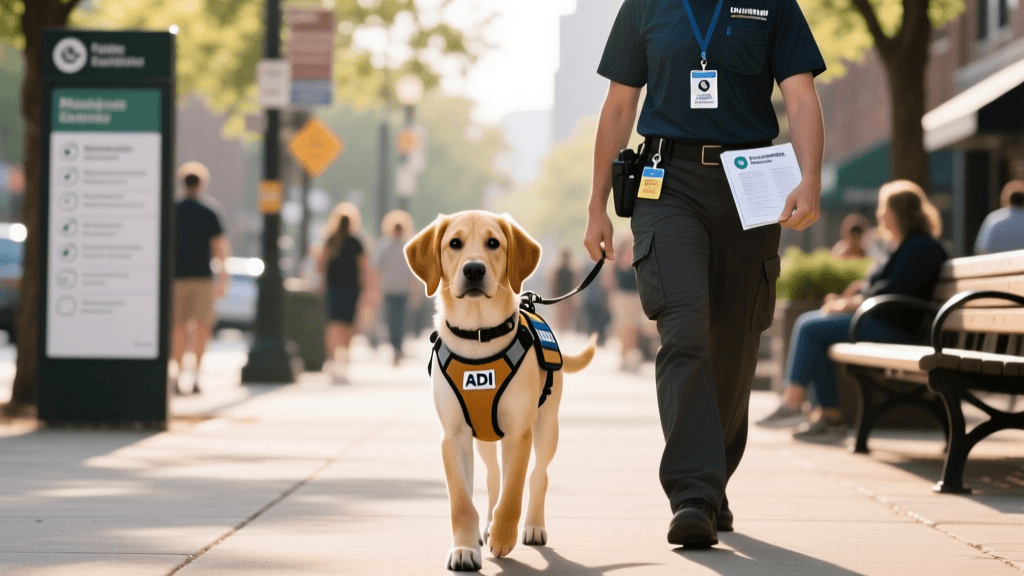
As the puppy's vaccination series progresses, you can begin placing their paws on the ground in public spaces. This is the time to introduce the 'Service Dog in Training' vest. The vest becomes a crucial environmental cue, signaling to the puppy that it is time to work and focus. Begin practicing 'settle' or 'mat' protocols in quiet coffee shops or library lobbies. The goal is not prolonged obedience, but rather the ability to relax and ignore distractions like rolling chairs, crying infants, and dropped food. By 16 weeks, the puppy should be able to navigate a grocery store aisle without reacting to the movement of shopping carts or overhead intercom announcements.
Essential Gear for Early Public Access
Outfitting your puppy with the correct gear is vital for safety, control, and public perception. The 2026 market offers highly specialized equipment designed specifically for the biomechanics of growing large-breed working dogs.
- Kurgo Tru Fit Smart Harness (2026 Model): Priced around $85, this crash-tested harness features a chest-led D-ring that discourages pulling without putting pressure on the puppy's developing trachea or shoulder joints. The padded chest plate is essential for comfort during long socialization outings.
- High-Visibility 'Service Dog in Training' Cape: A breathable, mesh cape with bold, reflective lettering is essential. Look for capes with Velcro side-release buckles that allow for quick removal if the puppy becomes overheated. Expect to spend $40 to $60 for a high-quality, durable cape.
- Magnetic Closure Treat Pouch: When training in public, fumbling with drawstrings or zippers can break your timing. A silicone or nylon treat pouch with a silent magnetic closure allows you to reward the puppy instantly for ignoring distractions.
- Biothane Long Line (15-foot): For outdoor recall practice in open spaces, a waterproof Biothane long line provides the puppy with freedom to explore while ensuring you maintain total control in unfenced areas.
Managing Teething and Bite Inhibition in Working Puppies
Between 12 and 24 weeks, your puppy will go through the teething process. For a mobility service dog, managing this phase is uniquely important because these dogs are often tasked with retrieving dropped items like keys, phones, medication bottles, or clothing. A mobility dog must possess a 'soft mouth'—the ability to pick up objects gently without puncturing or damaging them.
To soothe inflamed gums and prevent destructive chewing, provide a variety of textured, freezable teething toys. The classic KONG rubber toy, stuffed with plain Greek yogurt and blueberries and frozen overnight, is a staple. Nylabone's specialized puppy teething rings are also excellent for massaging gums. Crucially, you must enforce strict bite inhibition. If the puppy's teeth make contact with human skin or clothing, immediately withdraw attention and use a marker word like 'Oops' or a gentle 'Ouch,' followed by redirecting them to an appropriate chew toy. Never use punitive measures, as these can create hand-shyness, which is an automatic disqualifier for any service dog prospect.
Joint Health and Exercise Limitations for Mobility Breeds
Because mobility dogs are typically large or giant breeds, protecting their orthopedic health during the first year is paramount. Growth plates in large breeds do not fully close until 18 to 24 months of age. Forced exercise, repetitive jumping, or slipping on hard floors can cause micro-trauma to these developing joints, leading to early-onset dysplasia or arthritis.
The Orthopedic Foundation for Animals (OFA) emphasizes that controlled, voluntary exercise is far superior to forced endurance activities. Avoid activities like running alongside a bicycle, playing intense games of fetch on hard surfaces, or allowing the puppy to repeatedly jump in and out of the back of an SUV. Instead, utilize ramps or lift the puppy into vehicles. Many 2026 veterinary protocols also recommend starting large-breed puppies on joint supplements containing glucosamine, chondroitin, and EPA/DHA, such as Dasuquin Advanced for Puppies, starting at 12 weeks of age to support cartilage development.
Structured Milestone and Exercise Table
Use the following chart to guide your daily exercise limits and socialization focus during the puppy's first six months. Remember, the '5-minute rule' (5 minutes of structured walking per month of age) is a general guideline; free play on soft surfaces like grass is always permitted.
| Age | Max Structured Walk | Socialization Focus | Joint Care Note |
|---|---|---|---|
| 8-12 Weeks | 10-15 Minutes | Novel surfaces, household sounds, gentle handling, car rides. | Carry puppy on hikes; block access to steep stairs. |
| 12-16 Weeks | 15-20 Minutes | Automatic doors, shopping carts, distant traffic, vet clinic floors. | No jumping off furniture; use non-slip rugs indoors. |
| 16-20 Weeks | 20-25 Minutes | Public transit, elevators, hospital lobbies, ignoring dropped food. | Avoid repetitive fetch; prioritize sniffing and mental work. |
| 20-24 Weeks | 25-30 Minutes | Crowded sidewalks, outdoor dining, prolonged 'settle' in public. | Monitor for post-exercise stiffness; adjust routine if lame. |
Potty Training on Command in Public
A unique requirement for service dogs is the ability to eliminate on cue, regardless of the environment. A mobility handler may not always have the physical ability to take their dog for a long walk to find a suitable spot. Begin associating a specific verbal cue, such as 'Go Potty' or 'Do Your Business,' the moment the puppy begins to eliminate in their designated home area. Over time, move this training to different substrates, including concrete, gravel, and mulch.
When in public, always carry a specialized service dog cleanup kit. This should include biodegradable waste bags, a small bottle of enzyme-based odor neutralizer, and a collapsible water bowl to rinse away urine from concrete or storefront windows. Public access privileges rely heavily on the handler's ability to leave the environment exactly as they found it.
Navigating Public Reactions and Advocacy
In 2026, public awareness of service dogs is higher than ever, but misconceptions remain. People will inevitably want to pet your 'Service Dog in Training' puppy. It is your job to advocate for the puppy's training. Implement a strict 'Four on the Floor' rule for strangers: the puppy only receives attention if all four paws remain on the ground. Teach the puppy a 'Visit' cue, which releases them to greet a person calmly, and a 'Back to Work' cue to end the interaction and return to the heel position. If a puppy becomes overly aroused or fearful during a public outing, immediately end the session, return to the car, and decompress with a frozen chew toy. Pushing a puppy past their threshold of stress is counterproductive to building a confident, reliable working dog.
Conclusion
Raising a mobility service dog puppy is a marathon, not a sprint. By adhering to the 2026 protocols for public access socialization, strictly managing joint health, and utilizing the correct gear, you are laying the groundwork for a dog that will one day provide life-changing independence to their future handler. Patience, consistency, and proactive health management are your greatest tools in this incredible journey.
aaron-whyte
All our authors care for dogs every day — read more of their work on the authors page.