Mobility Service Dog Training: Wheelchair & Door Tasks in 2026
Master mobility service dog training in 2026. Learn step-by-step wheelchair retrieval and door tasks with expert gear recommendations and safety tips.
Introduction to Mobility Assistance Training in 2026
Training a mobility assistance dog is one of the most rewarding yet physically demanding journeys in the canine working world. As of 2026, the standards for service dog training have evolved significantly, emphasizing not only task reliability but also the long-term biomechanical health and psychological well-being of the dog. Mobility service dogs are trained to mitigate physical disabilities by performing tasks such as retrieving dropped items, pulling wheelchairs, opening doors, and providing balance support.
According to the Americans with Disabilities Act (ADA), a service dog must be individually trained to do work or perform tasks for a person with a disability. The task must be directly related to the person's disability. For individuals with limited mobility, a dog trained to retrieve a wheelchair or open heavy doors is not just a convenience; it is a vital lifeline that fosters independence.
This comprehensive guide will walk you through the precise, force-free methodologies used by top Assistance Dogs International (ADI) accredited programs in 2026 to teach wheelchair retrieval and door manipulation tasks safely and effectively.
Biomechanical Safety and Physical Prerequisites
Before initiating any pulling or heavy retrieval tasks, it is critical to prioritize the dog's physical development. The 2026 veterinary orthopedic guidelines strictly advise against any repetitive pulling or heavy weight-bearing tasks until a dog's growth plates have fully closed. For large breeds typically used in mobility work (such as Labrador Retrievers, Golden Retrievers, and Bernese Mountain Dogs), this usually occurs between 18 and 24 months of age.
Engaging a juvenile dog in door-pulling or wheelchair retrieval can lead to severe, irreversible joint damage, including early-onset hip dysplasia and shoulder luxation. Always consult with a board-certified veterinary sports medicine specialist to clear your dog for mobility work. Furthermore, ensure your dog is at an optimal body condition score (BCS of 4-5 out of 9) to prevent unnecessary strain on their skeletal structure during task execution.
Essential Gear for Mobility Task Training
Using the correct equipment is non-negotiable in mobility training. Standard flat collars or back-clip walking harnesses are entirely unsuitable for pulling tasks, as they can cause tracheal damage or uneven spinal loading. Below is a comparison of the top-rated mobility training gear utilized by professionals in 2026.
| Equipment | 2026 Top Pick | Est. Cost | Purpose |
|---|---|---|---|
| Mobility Harness | Julius-K9 IDC Powerharness (Custom Fit) | $115 | Distributes pulling weight safely across the chest |
| Tug Strap | Braided Leather Tug Toy with Carabiner | $28 | Provides a durable, ergonomic grip for retrieval |
| Door Rope | Paracord with Wooden Toggle Handle | $20 | Allows dogs to grip and pull heavy doors open |
| Treat Pouch | Ruffwear Treat Trader | $35 | Enables rapid reward delivery during shaping phases |
Step-by-Step: Training Wheelchair Retrieval
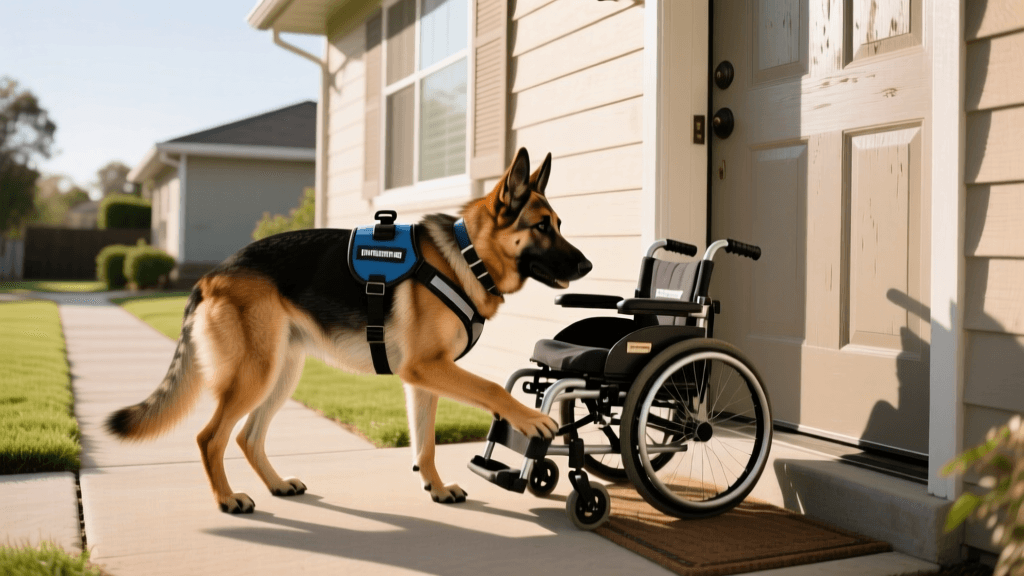
Wheelchair retrieval requires the dog to locate the chair, grasp a designated tug strap, and pull the chair toward the handler. This complex behavior chain is broken down into manageable phases using operant conditioning and shaping.
Phase 1: Targeting and Grasping the Tug Strap
Attach a braided leather tug strap to the back of the wheelchair. Start with the wheelchair in a stationary position. Use a high-value reward, such as freeze-dried liver or boiled chicken, to lure the dog's nose toward the tug strap. The moment the dog's nose touches the strap, mark the behavior with a clicker or a verbal 'Yes!' and reward.
Once the dog is consistently targeting the strap with their nose, raise the criteria. Wait for the dog to open their mouth and place their teeth on the strap before marking and rewarding. Gradually increase the duration of the hold, requiring the dog to keep the strap in their mouth for one, then three, then five seconds before receiving their reward.
Phase 2: The Backward Pull
With the dog holding the tug strap, take a single step backward and encourage the dog to follow you. If the dog steps forward while maintaining their grip, mark and reward enthusiastically. This teaches the dog that the physical sensation of tension on the strap is a cue to move backward toward you.
Slowly increase the distance you step backward. If the dog drops the strap, calmly reset and try again, ensuring you do not exceed the dog's current understanding of the task. Keep training sessions short—no more than 5 to 10 minutes—to prevent physical fatigue and mental burnout.
Phase 3: Adding the Cue and Distance
Once the dog reliably pulls the chair toward you from a distance of five feet, introduce the verbal cue, such as 'Bring Chair' or 'Wheelchair.' Say the cue exactly one second before the dog naturally moves to grab the strap. Over time, the dog will associate the verbal cue with the action.
Begin placing the wheelchair in different rooms and at varying angles. The dog must learn to generalize the task, understanding that they must retrieve the chair regardless of its orientation or location in the home.
Step-by-Step: Training Door Opening and Closing
Door tasks are essential for handlers who cannot easily reach or grasp door handles. The American Kennel Club (AKC) notes that task training for service dogs requires immense patience, as environmental distractions like the noise of a closing door can startle sensitive dogs.
Phase 1: Targeting the Door Rope
Install a sturdy paracord rope with a wooden toggle onto the door handle, ensuring it hangs at a height easily accessible to the dog's mouth when they are sitting or standing naturally. Similar to the wheelchair tug strap, begin by shaping the dog to touch and then hold the wooden toggle.
It is crucial to desensitize the dog to the sound of the door latch clicking. Have a helper gently click the latch while you feed the dog high-value treats on the opposite side of the room. Gradually move closer to the door over several days until the dog is entirely relaxed by the mechanical sounds.
Phase 2: The Pull and Release
Once the dog has a firm grip on the toggle, stand near the door and encourage the dog to back up. The goal is for the dog to pull the rope with enough force to engage the latch and swing the door open. Mark and reward heavily the moment the door begins to move.
Teach a clear 'Drop' or 'Out' cue so the dog releases the rope immediately after the door is open. This prevents the dog from becoming tangled in the rope or getting struck by a swinging door.
Phase 3: Pushing the Door Shut
Closing a door requires a completely different biomechanical movement—pushing rather than pulling. Teach the dog to target a specialized 'push pad' (a textured, rubberized mat) attached to the door at the dog's nose level using a 'Touch' cue. Reward the dog for pressing their nose firmly against the pad. Gradually require more force until the dog's push is strong enough to swing the heavy door shut.
Proofing and Public Access Readiness
A mobility service dog must perform tasks reliably in highly distracting public environments. Proofing is the process of testing and solidifying the dog's training under varying conditions. In 2026, public access training protocols emphasize systematic desensitization to modern urban stimuli, including automatic sliding doors, revolving doors, and crowded transit hubs.
Begin proofing in low-distraction environments, such as a quiet office building after hours. Gradually introduce variables: ask the dog to retrieve the wheelchair while a television is playing, or practice door tasks while a stranger is talking nearby. If the dog fails a task, it indicates that the distraction level is too high; reduce the distraction and rebuild the behavior chain.
Remember that public access manners are just as important as task training. A mobility dog must remain unobtrusive, ignoring dropped food, passing strangers, and other animals while waiting for their handler's cue to perform a task.
Conclusion
Training a mobility service dog to perform wheelchair retrieval and door tasks is a profound commitment that requires time, specialized equipment, and a deep understanding of canine biomechanics. By adhering to the 2026 standards for force-free shaping and physical safety, you ensure that your working dog remains healthy, confident, and capable of providing life-changing assistance for years to come. Always seek guidance from certified professional dog trainers (CPDT-KA) or veterinary behaviorists if you encounter roadblocks in your training journey.
aaron-whyte
All our authors care for dogs every day — read more of their work on the authors page.