Mastering Multi-Dog Training: Teach Two Dogs at Once
Master multi-dog training with our expert guide. Learn to teach two dogs at once, manage distractions, prevent resource guarding, and build focus at home.

Mastering the Chaos: An Introduction to Multi-Dog Training
Living in a multi-dog household is a profoundly rewarding experience, but it introduces a unique set of behavioral and logistical challenges that single-dog owners rarely face. When you bring a second or third canine companion into your home, the dynamic shifts from a simple human-canine relationship to a complex canine-canine social structure. Training multiple dogs simultaneously is not merely about repeating the same commands twice; it requires a strategic approach to manage distractions, prevent competition, and ensure that each dog learns at their own pace. According to the ASPCA's resources on common dog behavior issues, multi-pet environments can inadvertently trigger behavioral problems like resource guarding, barrier frustration, and over-arousal if not managed with clear boundaries and structured routines.
Whether you are raising two littermates, introducing a new puppy to an older resident dog, or simply trying to teach your existing pack to walk politely on leash together, this comprehensive guide will provide you with the actionable steps, specialized gear, and psychological insights needed to succeed. The American Kennel Club's training experts emphasize that consistency and spatial awareness are the cornerstones of successful multi-dog training. Let us dive into the methodology of teaching two dogs at once without the chaos.
The Psychology of Canine Social Facilitation
Before picking up a treat pouch, it is crucial to understand social facilitation. In canine psychology, social facilitation occurs when the presence of one dog increases the arousal level or intensity of another dog's behavior. If Dog A becomes excited by a squirrel, Dog B will likely mirror that excitement, creating a feedback loop of over-arousal. This is why joint training sessions often devolve into barking matches or jumping frenzies.
To combat this, you must become the most interesting and grounding force in the room. Training two dogs together requires you to reward calmness and disengagement from the other dog just as heavily as you reward obedience. You are not just teaching 'sit' or 'stay'; you are teaching your dogs how to exist peacefully in each other's presence while maintaining focus on you.
Essential Gear for Multi-Dog Households
Standard training equipment often falls short when managing multiple dogs. Investing in specialized gear can drastically reduce your frustration and improve safety. Here is a breakdown of the essential tools required for multi-dog training, including specific product recommendations and estimated costs:
- Dual-Clip Harnesses: Use the Ruffwear Front Range Harness (approx. $39.95 per dog). The front chest clip gives you superior steering control to prevent dogs from tangling their leashes or pulling you off balance when they lunge at each other.
- Fixed-Length Leashes: Ditch the retractable leashes. Opt for the Mendota Products Slip Lead or a standard 6-foot leather leash (approx. $15.99 to $25.00). A 1/2-inch thickness provides a good grip when holding two leashes simultaneously.
- High-Value, Low-Calorie Treats: When training two dogs, your treat consumption will double. Use Zuke's Mini Naturals (approx. $6.49 per 6oz bag). At only 2 calories per treat, you can reward both dogs heavily without causing obesity.
- Spatial Barriers: The Regalo Easy Step Walk Thru Baby Gate (approx. $39.99) is vital for indoor management. It allows you to separate dogs during cool-down periods or when practicing individual 'stay' commands without completely isolating them from the household's social environment.
- Raised Place Beds: Two separate K&H Pet Products Original Cot Bed (approx. $35.00 each) give each dog a designated 'safe zone' to practice the 'place' command, preventing spatial crowding.
Step-by-Step Joint Training Protocol
Teaching two dogs at once requires a phased approach. Never attempt to train both dogs together until they have individually mastered the foundational cues.
Phase 1: Isolate and Educate
Before combining them, each dog must know the target behavior (e.g., 'down-stay') in a low-distraction environment. Train Dog A in the living room while Dog B is safely behind a baby gate with a long-lasting chew, like a Kong Classic stuffed with frozen peanut butter ($15.99). Swap their roles after 15 minutes. This teaches the waiting dog that being separated while the other works is a positive, rewarding experience.
Phase 2: The Name Game and Disengagement
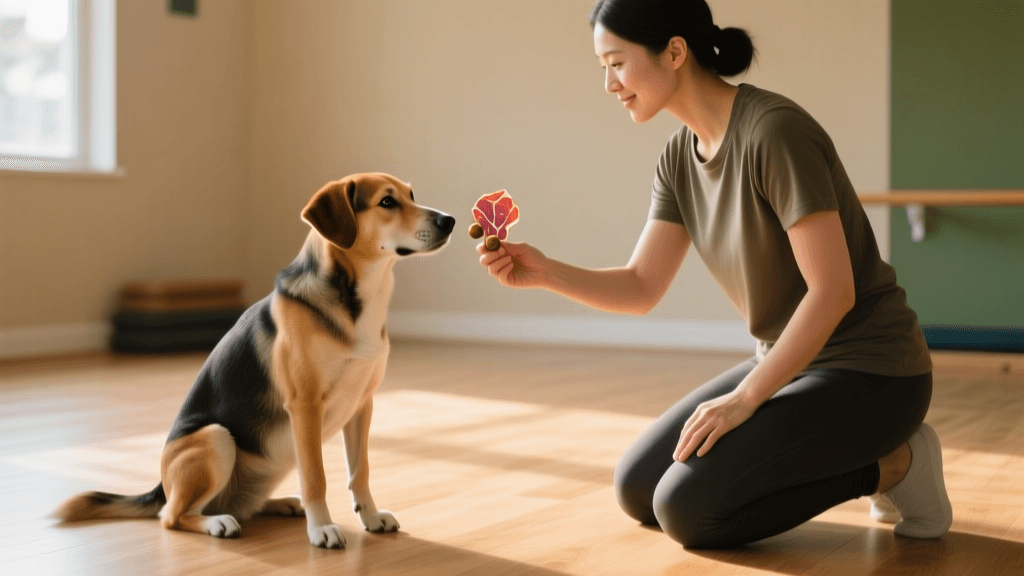
When both dogs are in the same room, the first joint exercise is name recognition. Stand between both dogs with a treat in each hand. Say Dog A's name. When Dog A makes eye contact, mark with a 'yes' and deliver the treat. Ignore Dog B. Then, say Dog B's name and reward. This trains them to tune out their sibling when their own name is called, effectively breaking the social facilitation loop.
Phase 3: Parallel Stationing
Place the two raised cots about six feet apart. Send Dog A to their cot and reward. Send Dog B to their cot and reward. The goal is to have both dogs on their respective 'place' commands simultaneously. If Dog A breaks their stay to investigate Dog B, calmly guide Dog A back without offering a treat, and heavily reward Dog B for maintaining their position despite the distraction.
Phase 4: Joint Recall and Leash Manners
When taking both dogs for a walk, use the 'Umbilical Cord' method. Attach both leashes to a sturdy waist belt (like the Ruffwear Roamer Leash setup, approx. $44.95) to keep your hands free for treating. Stop walking the moment either dog pulls. Only move forward when both leashes are slack. Call both dogs by name simultaneously for a joint recall, and scatter a handful of Zuke's Mini Naturals on the grass so they can forage together without competing for a single treat from your hand.
Tackling Resource Guarding and Sibling Rivalry
Resource guarding is one of the most dangerous behavioral issues in multi-dog homes. Veterinary behaviorists referenced by the American Veterinary Medical Association note that competition over food, toys, or even human affection can lead to severe intra-household aggression. To prevent this, implement a strict 'Nothing in Life is Free' protocol combined with spatial separation during high-value activities.
Pro Tip: Never feed two dogs from the same bowl or drop high-value chews (like bully sticks) into the middle of the room. Always feed them in separate crates or on opposite sides of a baby gate. Once they finish, pick up the bowls before releasing them from their stations.
If you notice stiff body language, whale eye, or lip licking when one dog approaches the other's toy, immediately intervene by tossing a high-value treat (like freeze-dried beef liver) away from the guarded item to redirect the dog, then remove the contested object. Do not punish the guarding behavior, as this will only increase anxiety and make the dog guard the item more fiercely next time.
Training Metrics: Single vs. Multi-Dog Households
Managing expectations is critical. The table below illustrates how your training parameters must shift when transitioning from a single-dog to a multi-dog household.
| Training Metric | Single Dog Household | Multi-Dog Household |
|---|---|---|
| Average Session Length | 15 - 20 Minutes | 5 - 10 Minutes (per dog, alternating) |
| Daily Treat Allowance | 10% of daily caloric intake | 10% per dog (requires precise tracking) |
| Primary Distraction | Environmental (noises, scents) | Social (the other dog's movements) |
| Equipment Cost (Initial) | $45 - $60 | $150 - $220 (plus gates and barriers) |
| Cue Delivery Speed | Moderate / Conversational | Rapid / Staccato (to beat the sibling) |
Troubleshooting Common Setbacks
Over-Arousal: If both dogs begin barking at each other during a 'stay' command, the criteria is too high. Increase the distance between their place mats from six feet to twelve feet, or use a visual barrier like a folding screen between them.
Attention Guarding: If Dog A nudges your hand away when you are petting Dog B, immediately stand up and withdraw all attention for 30 seconds. Dog A must learn that monopolizing human affection results in the complete cessation of affection.
Inconsistent Responses: If Dog A responds to 'sit' but Dog B does not, avoid repeating the word 'sit' louder. Instead, use a lure for Dog B while Dog A remains seated. Reward Dog A heavily for maintaining their sit despite the movement of the lure near their face.
Conclusion: Patience and Pack Harmony
Training two dogs at once is an exercise in patience, timing, and environmental management. By utilizing specialized gear like dual-clip harnesses and baby gates, breaking sessions into manageable micro-durations, and proactively managing resources, you can transform your chaotic pack into a harmonious, well-mannered team. Remember that every dog is an individual; celebrate their unique learning speeds, and always prioritize their emotional well-being over rapid obedience results. With consistent daily practice, your multi-dog home will become a sanctuary of cooperation rather than a battleground of competition.
tom-renshaw
All our authors care for dogs every day — read more of their work on the authors page.