Managing Canine Weight: Portion Control & Enrichment Feeding Guide
Discover practical strategies for managing your dog's weight through precise portion control, slow feeders, and daily enrichment feeding routines for a healthier life.
The Silent Epidemic in Our Living Rooms
When we think about sharing our lives with our dogs, food often becomes a primary love language. We celebrate their birthdays with pupcakes, reward their good behavior with biscuits, and occasionally share a piece of cheese from the cutting board. However, this well-intentioned generosity has led to a significant health crisis. According to the Association for Pet Obesity Prevention, nearly 59% of dogs in the United States are classified as overweight or obese. This is not merely a cosmetic issue; excess weight drastically reduces a dog's lifespan, exacerbates osteoarthritis, and increases the risk of metabolic diseases.
Integrating proper nutrition and weight management into your daily routine doesn't mean depriving your dog of joy. Instead, it requires a shift in how we view meals: moving from a simple caloric delivery system to an opportunity for mental stimulation, behavioral enrichment, and precise health management. This deep dive will equip you with the actionable tools, mathematical formulas, and daily routines necessary to optimize your dog's health and transform their relationship with food.
Decoding Caloric Needs: The Science of RER and MER
The most common mistake dog owners make is feeding based on the guidelines printed on the back of a kibble bag. These guidelines are notoriously broad and often overestimate the caloric needs of the average, modern, indoor dog. To truly manage your dog's weight, you must calculate their specific caloric requirements using veterinary nutrition formulas.
The Math Behind the Meal
Veterinary nutritionists rely on two primary metrics to determine daily caloric intake:
- Resting Energy Requirement (RER): The calories needed to maintain basic bodily functions at rest. The formula is:
70 x (body weight in kg)^0.75. - Maintenance Energy Requirement (MER): The RER multiplied by a lifestyle factor. For a typical neutered/spayed adult dog with moderate activity, the multiplier is usually 1.4 to 1.6.
Practical Example: Let's take a 20 kg (44 lb) neutered adult dog.
1. Calculate RER: 70 x (20)^0.75 = approximately 660 kcal/day.
2. Calculate MER (using a 1.4 multiplier for a mildly active, indoor dog): 660 x 1.4 = 924 kcal/day.
This 924 kcal is the total daily allowance, which must include all meals, treats, and chews.
Ditch the Scoop: Why Gram Scales are Essential
A landmark study highlighted by the Tufts University Cummings Veterinary Medical Center revealed that measuring cups are incredibly inaccurate for portioning dry dog food. Depending on how the owner scoops, shakes, or packs the kibble, the caloric variance can be as high as 20% per meal. Over a year, a 20% surplus in a 500-calorie daily diet results in an extra 36,500 calories—equivalent to several pounds of excess body fat.
The Solution: Invest in a digital kitchen scale (typically costing between $10 and $15).
1. Place your dog's bowl on the scale and zero it out (tare).
2. Pour the kibble until you hit the exact gram weight corresponding to your dog's caloric needs.
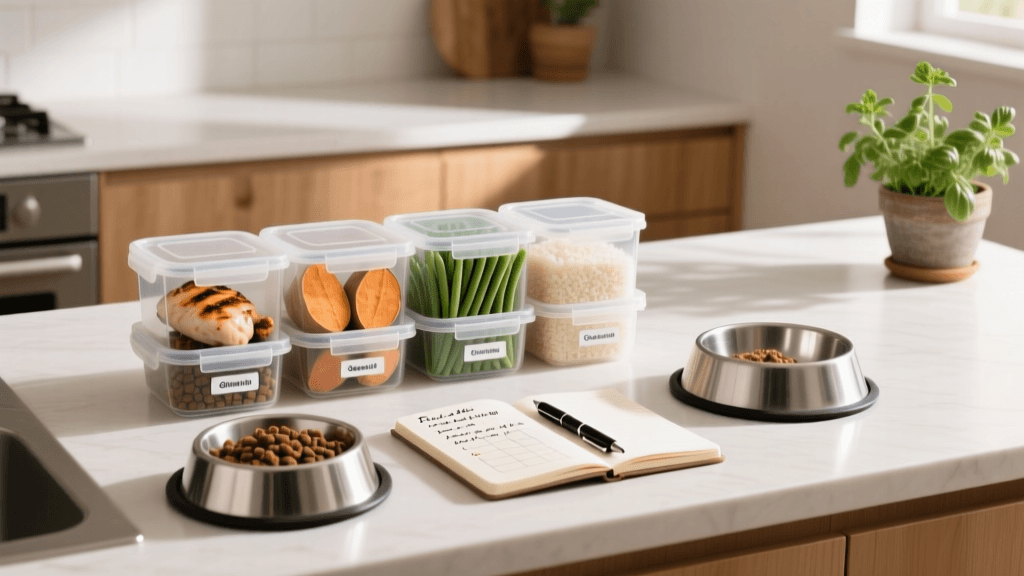
3. Do this once a day, portioning the total daily allowance into a designated storage container. This prevents the "just a little more" syndrome that occurs when feeding multiple meals directly from the main bag.
Enrichment Feeding: Turning Meals into Mental Workouts
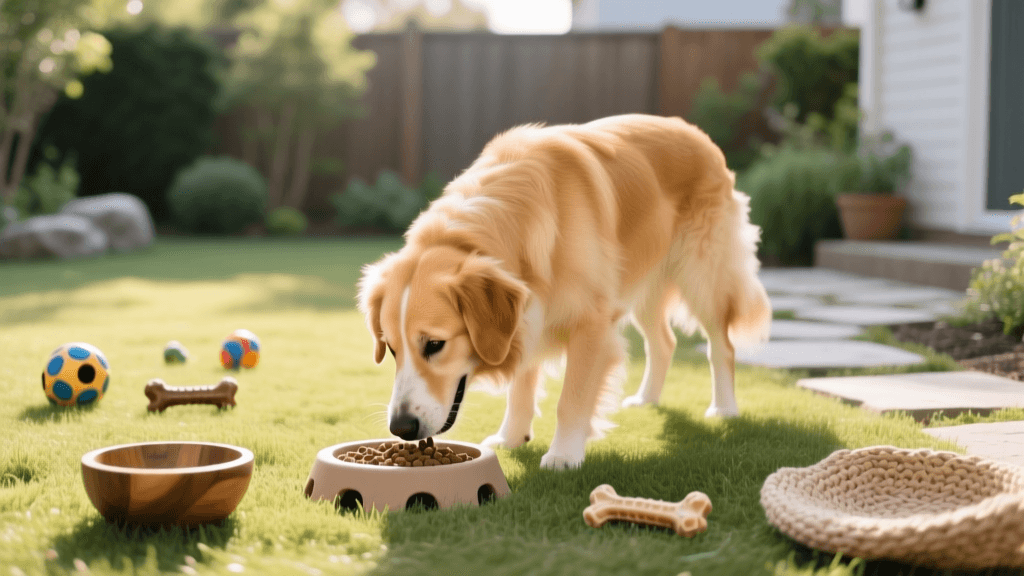
In the wild, canines spend up to 80% of their waking hours foraging and hunting. In our living rooms, breakfast is often inhaled in thirty seconds from a stainless-steel bowl, leaving the dog bored and prone to destructive behaviors. Enrichment feeding integrates nutrition with mental stimulation, slowing down eating to prevent bloat and burning mental energy.
Daily Enrichment Routine Integration
Morning Routine (The Departure Distraction): Instead of a bowl, use a Kong Classic or a West Paw Toppl. Soak a portion of their daily kibble in low-sodium bone broth or plain pumpkin puree, seal it, and freeze it overnight. Handing this to your dog as you leave for work provides a calming, lick-based activity that reduces separation anxiety and can keep them engaged for up to 45 minutes.
Afternoon Routine (The Foraging Game): Utilize a Snuffle Mat. Scatter a portion of their dry daily allowance deep into the fabric folds. This engages their primary sense—smell—and mimics natural foraging, tiring them out mentally without requiring a strenuous physical walk.
Evening Routine (The Puzzle Challenge): Use a slow feeder like the Outward Hound Fun Feeder or an interactive puzzle toy. This forces the dog to use their paws and snout to extract food, slowing their eating pace and improving digestion.
Comparison: Traditional Bowl vs. Enrichment Feeding
| Feeding Method | Average Consumption Time | Mental Stimulation Level | Best Used For |
|---|---|---|---|
| Standard Stainless Bowl | 30 - 60 seconds | Very Low | Quick feeding, highly food-motivated working dogs needing rapid refuel. |
| Slow Feeder Maze | 5 - 10 minutes | Moderate | Dogs that inhale food, prone to regurgitation or gastric dilatation-volvulus (bloat). |
| Snuffle Mat / Scatter | 10 - 15 minutes | High (Olfactory) | High-energy dogs needing mental fatigue; rainy days when walks are shortened. |
| Frozen Lick Mat / Kong | 20 - 45 minutes | High (Soothing) | Departure routines, crate training, and anxiety reduction. |
Smart Treat Swaps and the 10% Rule
The World Small Animal Veterinary Association (WSAVA) strictly recommends that treats and chews should never constitute more than 10% of a dog's total daily caloric intake. For our 20 kg example dog eating 924 kcal/day, the treat budget is a mere 92 calories. A single commercial dental chew or pig ear can easily exceed this, throwing the entire day's nutritional balance off course.
Low-Calorie, High-Value Alternatives
To maintain a robust training and bonding routine without packing on the pounds, swap high-fat commercial treats for whole foods:
- Green Beans (Canned, No Salt Added): Approximately 2 calories per bean. Excellent for repetitive obedience training.
- Cucumber Slices: High water content, satisfying crunch, roughly 4 calories per ounce.
- Blueberries: Packed with antioxidants, about 1 calorie per berry.
- Apples (Core and Seeds Removed): Great for chewing and dental health, roughly 15 calories per ounce.
Pro Tip: If you use high-value treats like freeze-dried liver or cheese for intense training sessions, you must deduct those calories from their main meal. Measure the training treats in the morning, place them in a separate pouch, and subtract that exact caloric weight from the evening dinner portion.
Tracking Progress: The Body Condition Score (BCS)
Scales only tell half the story. A heavily muscled working breed might weigh more than the "breed standard" but still be perfectly lean. This is why veterinary professionals use the 9-point Body Condition Score (BCS) system. You should perform a physical BCS assessment on your dog every two weeks as part of your grooming and bonding routine.
How to perform the Rib Test:
Run your hands along your dog's ribcage with flat palms, applying the same pressure you would use to stroke a cat.
- Ideal (Score 4-5): You can easily feel the individual ribs without pressing hard, but they are not visibly protruding. The dog has a visible abdominal tuck when viewed from the side.
- Overweight (Score 6-7): You have to press firmly through a layer of fat to feel the ribs. The waist is barely discernible.
- Obese (Score 8-9): Ribs cannot be felt at all, and the abdomen sags or bulges outward.
Building a Sustainable Daily Routine
Managing your dog's weight is not a temporary diet; it is a permanent lifestyle adjustment that deepens the bond between you and your pet. By replacing the mindless scoop-and-pour method with precise gram weighing, you eliminate the guesswork that leads to accidental overfeeding. By transitioning from a static food bowl to a rotation of frozen Kongs, snuffle mats, and puzzle feeders, you transform a two-minute chore into a daily cornerstone of your dog's mental health and behavioral enrichment.
Start small. Introduce one slow feeder this week and purchase a digital kitchen scale. Calculate your dog's true MER, audit your treat jar, and observe how quickly your dog's energy levels, joint mobility, and overall zest for life begin to improve. A healthy, enriched dog is a happier companion, ready to share countless more active, vibrant years by your side.
aaron-whyte
All our authors care for dogs every day — read more of their work on the authors page.