Loose lead walking training, step by step
Stop the pulling without choke chains or harsh corrections — a methodical plan to teach a relaxed walk in five short sessions a week.
What Loose Lead Walking Actually Means
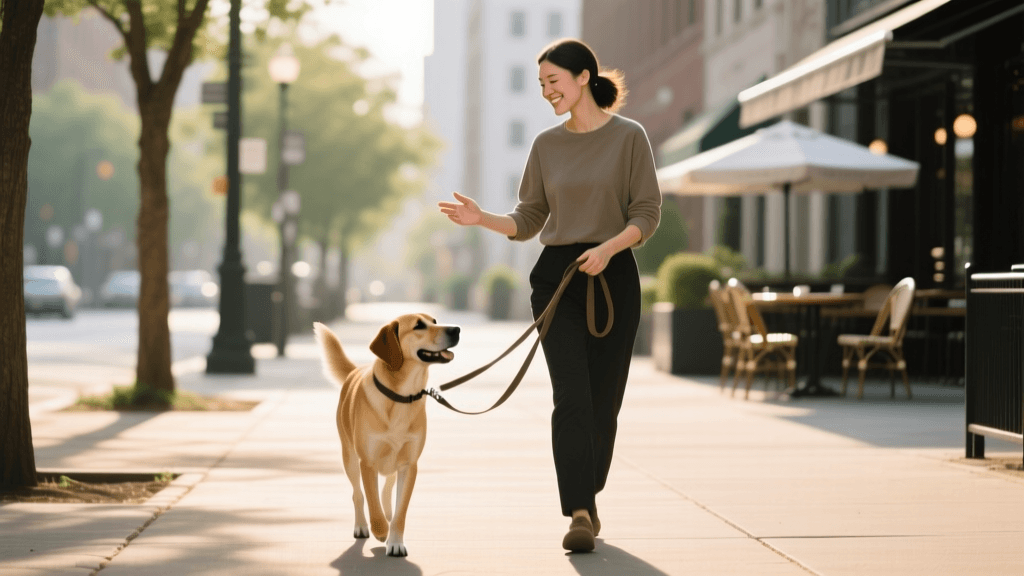
A loose lead walk is not about a dog that heels perfectly at your left hip for an entire mile. It means the leash forms a soft J-shape between your hand and the dog's collar or harness — no tension, no pulling, no bracing. The dog moves at roughly your pace, checks in with you periodically, and responds when you change direction. That is the practical, achievable goal that trainers at the Association of Professional Dog Trainers (APDT) describe in their foundational curriculum.
Pulling on leash is one of the top three reasons owners surrender dogs to shelters, according to a 2019 survey conducted by the American Humane Society. It is also one of the most misunderstood behaviors. Dogs pull because it works — forward movement is the reward. Every step a dog takes while the leash is taut reinforces the pulling. Changing that equation requires a systematic approach built on positive reinforcement, not corrections.
The Science Behind Positive Reinforcement Training
Positive reinforcement operates on a simple principle: behaviors that produce good outcomes are repeated. When applied to leash walking, this means the dog learns that a slack leash predicts treats, praise, sniffing opportunities, and continued forward movement. A tight leash predicts the opposite — forward movement stops.
Research published by Karen Pryor Clicker Training (2017) demonstrated that dogs trained with marker-based positive reinforcement acquired new behaviors in an average of 15 repetitions, compared to 42 repetitions required when aversive methods were used. The marker — a clicker or a verbal "yes" — bridges the gap between the correct behavior and the delivery of the reward, giving the dog precise information about what earned the treat.
A landmark study from the University of Bristol's School of Veterinary Sciences (2020) followed 92 dogs across 12 weeks of leash training. Dogs in the reward-based group showed a 68% reduction in pulling incidents by week six, while dogs trained with prong or choke collars showed only a 22% reduction and exhibited significantly higher cortisol levels, indicating chronic stress. Stress impairs learning, which explains why punishment-based methods often plateau early.
"The leash is a safety line, not a steering wheel. When we use it to force direction, we teach the dog nothing about how to make good choices. When we use it as a communication tool alongside reinforcement, the dog becomes an active participant in the walk." — Sarah Stremming, certified behavior consultant and host of The Cognitive Canine Podcast
Equipment That Supports the Process
Before beginning any training protocol, equipment selection matters. The wrong tool can undermine even the best technique. A standard flat collar is appropriate for dogs that already walk reasonably well. For dogs that pull hard, a front-clip harness redirects the dog's momentum toward you rather than allowing them to use their chest muscles to power forward. The Freedom No-Pull Harness and the Ruffwear Front Range are two commonly recommended options among certified trainers.
Avoid retractable leashes during training. They provide 16 to 26 feet of variable tension, which teaches the dog that pulling eventually yields more length. Use a fixed 4-foot or 6-foot leash. A 6-foot leash gives the dog enough room to move naturally while keeping you close enough to mark and reward quickly.
Treat selection also affects training speed. Use high-value rewards — small pieces of cooked chicken, cheese, or commercial soft treats — cut to roughly the size of a pea. Smaller treats mean faster consumption, which means more repetitions per session. Aim for 30 to 50 treat deliveries in a 10-minute session during early training.
Step-by-Step Training Protocol
Step 1 — Build Value for the Heel Position
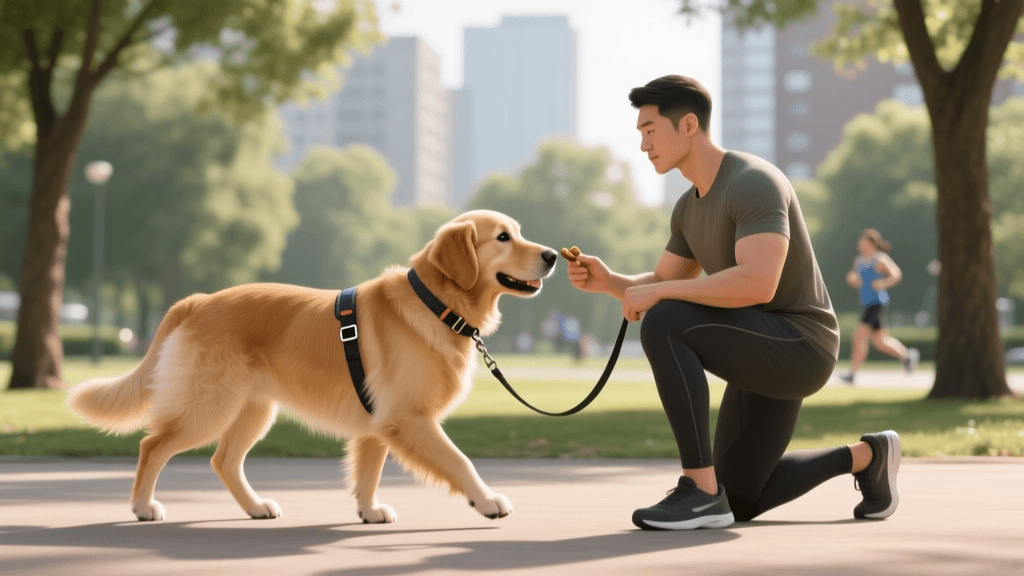
Before you ever leave the driveway, teach the dog that standing at your left side (or right, if you prefer) is the most rewarding place on earth. Stand still. Every time your dog orients toward you or drifts into the heel position, mark with a click or "yes" and deliver a treat directly to your hip — not in front of you, not behind you, but at the exact spot where you want the dog's nose to be.
Practice this for 3 to 5 minutes per session, two to three sessions per day, for at least three days before adding movement. The dog should be actively seeking the heel position by the end of this phase. You will know you are ready to progress when the dog returns to your side within 2 seconds of drifting away, without any prompt from you.
Step 2 — Add Movement in a Low-Distraction Environment
Begin in your living room or backyard. Take one step forward. If the leash stays loose and the dog moves with you, mark and reward. If the dog surges ahead and the leash tightens, stop immediately. Do not say anything. Do not pull back. Simply become a tree — still, silent, and immovable.
Wait. The dog will eventually turn to look at you or step back toward you. The moment the leash goes slack, mark and reward. Then take another step. This stop-and-wait technique, sometimes called the "Be a Tree" method, was formalized by trainer Pia Silvani at the St. Hubert's Animal Welfare Center in Madison, New Jersey, and remains one of the most widely taught protocols in APDT-certified courses.
In early sessions, expect to stop 20 to 30 times in a single 10-minute walk. That is normal. By session five or six in a low-distraction environment, most dogs are stopping fewer than five times per session.
Step 3 — Introduce Direction Changes
Once the dog walks with a loose leash for 10 to 15 consecutive steps in a low-distraction area, begin adding direction changes. Without warning, turn 90 degrees to the right. If the dog follows and the leash stays loose, mark and reward. If the dog continues straight and the leash tightens, stop and wait as before.
Direction changes accomplish two things: they teach the dog to pay attention to your movement rather than fixating on what is ahead, and they interrupt the forward momentum that makes pulling self-reinforcing. Trainers at the Karen Pryor Academy recommend practicing direction changes for at least 50 repetitions before moving to higher-distraction environments.
Proofing the Behavior Across Environments
A dog that walks perfectly in the backyard but pulls on the sidewalk has not generalized the behavior. Generalization must be trained deliberately. The process follows a predictable progression:
- Master the behavior in the lowest-distraction environment (indoors or a quiet backyard).
- Move to a slightly more distracting environment — a quiet street at an off-peak time, such as early morning.
- Increase distraction gradually: add other pedestrians, then other dogs at a distance, then busier streets.
- At each new level of distraction, temporarily increase your rate of reinforcement back to the level you used in early training, then fade it again as the dog succeeds.
- Never increase distance, duration, and distraction simultaneously. Change only one variable at a time.
This framework mirrors the criteria-splitting approach described in Bob Bailey's operant conditioning workshops, which have trained thousands of professional animal trainers since the 1970s. Bailey's rule of thumb: if the dog is failing more than 20% of the time, the criteria are too difficult and you need to step back one level.
Managing Real-World Challenges
Even well-trained dogs encounter triggers that spike arousal and make loose lead walking temporarily impossible. Common triggers include squirrels, bicycles, other dogs, and children running. The solution is not to push through the trigger but to increase distance from it until the dog can respond to you again.
This threshold management is central to behavior modification. A dog that is over threshold — meaning arousal is so high that the dog cannot process information — cannot learn. Identify the distance at which your dog notices the trigger but can still take a treat and respond to a cue. That is your working distance. Gradually decrease it over multiple sessions as the dog builds a positive association with the trigger's presence.
For dogs with significant reactivity, a structured protocol such as Behavior Adjustment Training (BAT 2.0), developed by trainer Grisha Stewart, provides a framework for working at threshold using functional rewards — allowing the dog to move away from the trigger as the reward for calm behavior — rather than relying solely on food.
Reinforcement Schedules and Fading Treats
A common concern among owners is that they will need to carry treats forever. In practice, continuous reinforcement (rewarding every correct response) is only necessary during the acquisition phase. Once the dog reliably walks on a loose leash in a given environment, shift to a variable ratio schedule — reward unpredictably, sometimes after 5 steps, sometimes after 20, sometimes after a direction change. Variable ratio schedules produce the most durable behavior, which is the same principle that makes slot machines compelling.
Research from the APDT's 2021 Training Practices Survey found that 78% of certified trainers reported successfully fading food rewards to an intermittent schedule within 8 to 12 weeks for leash walking, provided the initial training was conducted with a high enough rate of reinforcement to build a strong behavioral foundation.
| Training Phase | Reinforcement Schedule | Typical Duration | Success Indicator |
|---|---|---|---|
| Acquisition (indoors) | Continuous (every correct step) | 3–7 days | Dog seeks heel position unprompted |
| Fluency (low distraction) | Fixed ratio (every 5–10 steps) | 1–2 weeks | Fewer than 5 stops per 10-minute walk |
| Generalization (new environments) | Return to continuous, then fade | 2–4 weeks per environment | Loose leash in 3+ distinct locations |
| Maintenance | Variable ratio (unpredictable) | Ongoing | Consistent loose leash without daily treats |
Common Mistakes That Slow Progress
- Inconsistency between handlers. If one family member allows pulling while another trains against it, the dog learns that pulling works with some people. Every person who walks the dog must follow the same protocol.
- Training sessions that are too long. Dogs learn best in short, frequent sessions. Ten minutes of focused training twice a day outperforms a single 45-minute session. Fatigue and frustration degrade performance.
- Moving to high-distraction environments too quickly. Owners often want to train on their regular walking route immediately. If that route passes a dog park or a busy intersection, it is too distracting for early training. Build the skill first, then bring it to the real world.
- Rewarding after the leash goes tight. Timing is everything. If you wait until the dog has already pulled and then reward when they return to your side, you may inadvertently be rewarding the return rather than the loose leash. Mark the moment the leash goes slack, not a second later.
- Expecting perfection before the dog is ready. Loose lead walking is a complex skill that requires the dog to manage arousal, attend to the handler, and inhibit the impulse to surge forward — all simultaneously. Give the process the time it requires.
Progress is rarely linear. Most dogs have good days and bad days depending on sleep, arousal levels, and environmental factors. A regression after a period of success does not mean the training has failed. It means the dog encountered a challenge that exceeded their current skill level. Return to an easier environment, rebuild confidence, and try again.
Loose lead walking is one of the most practical skills a dog can have, and it is entirely achievable through patient, consistent application of positive reinforcement principles. The investment in early training pays dividends across the entire life of the dog — and makes every walk a genuinely enjoyable experience for both ends of the leash.
Robin Maitland
All our authors care for dogs every day — read more of their work on the authors page.