Stop Leash Pulling in 2026: Front-Clip Harness Training
Learn how to stop leash pulling in 2026 using a front-clip no-pull harness. Step-by-step loose leash training protocol for strong dogs.
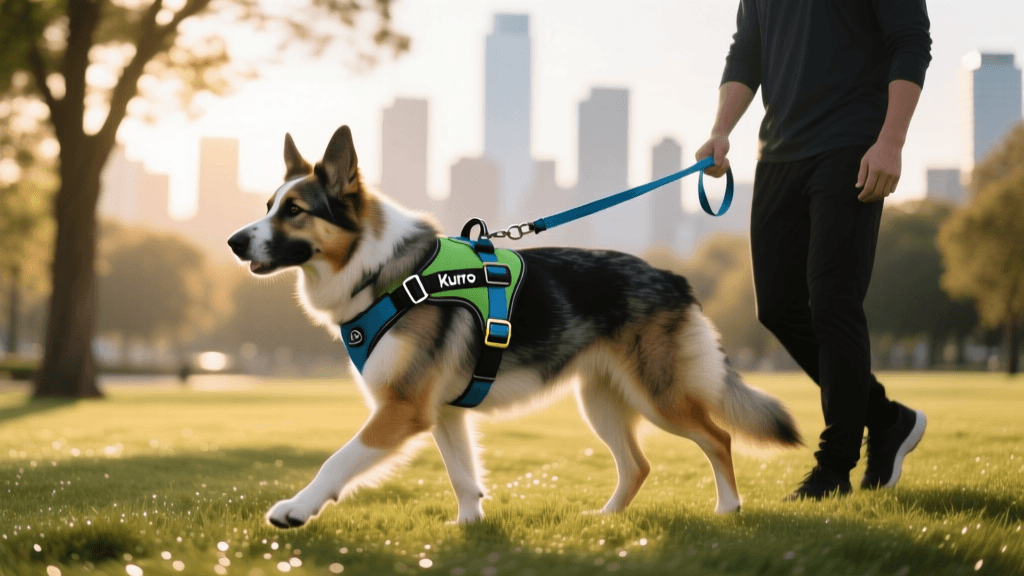
Walking a strong, enthusiastic dog should be a relaxing bonding experience, but for many owners, it quickly devolves into a frustrating game of tug-of-war. As we navigate the dog training landscape in 2026, force-free methods and biomechanically sound gear have firmly established themselves as the gold standard. If your dog drags you down the street, a standard back-clip harness or flat collar is likely working against you. The solution lies in combining a high-quality front-clip no-pull harness—like the highly rated Kurgo Tru-Fit Smart Harness—with a structured, positive reinforcement training protocol.
The Biomechanics of Pulling: Why Back-Clip Harnesses Fail
To understand how to stop pulling, we first need to understand why dogs do it. Dogs naturally move faster than humans, and their environment is filled with stimulating scents and sights. When a dog pulls on a back-clip harness, the pressure is distributed across their broad chest and shoulders. This triggers the opposition reflex, an instinctual canine response where they push against pressure. Essentially, a back-clip harness turns your dog into a sled dog, giving them the leverage needed to pull you forward with maximum efficiency.
Conversely, flat collars concentrate all that pulling force onto the dog's delicate trachea and cervical spine. Veterinary professionals in 2026 strongly advise against using collars for strong pullers due to the high risk of tracheal collapse and neck injuries. A front-clip no-pull harness solves both problems. By attaching the leash to a D-ring located on the dog's chest, any forward pulling creates a gentle pivoting motion that redirects the dog's momentum back toward the handler, neutralizing their leverage without causing pain or discomfort.
Choosing the Right No-Pull Harness in 2026
Not all front-clip harnesses are created equal. The market in 2026 offers advanced materials, including breathable ripstop nylon, padded chest plates, and escape-proof dual-clip systems. When selecting a harness for training, look for a Y-shaped chest plate that allows for full shoulder extension and a sturdy, welded front D-ring.
| Harness Model (2026 Editions) | Front Clip Type | Best For | Estimated Price Range |
|---|---|---|---|
| Kurgo Tru-Fit Smart Harness | V-Ring Chest Clip | Strong pullers, hiking, car safety | $45 - $55 |
| Ruffwear Front Range | Aluminum Chest D-Ring | Active dogs, everyday walking | $40 - $50 |
| Rabbitgoo No-Pull Harness | Standard Metal O-Ring | Budget-conscious owners, mild pullers | $25 - $35 |
| Petsafe 3-in-1 Harness | Nylon Loop Front Clip | Reactive dogs needing dual-clip control | $30 - $40 |
For the training protocol outlined below, we highly recommend a harness with a secure metal front ring, such as the Kurgo Tru-Fit or Ruffwear Front Range, as they provide the most reliable steering control without twisting the chest straps.
The 4-Step Front-Clip Training Protocol
A no-pull harness is a management tool, not a magic wand. It prevents your dog from practicing the unwanted behavior of pulling, but you must simultaneously teach them what to do instead. According to the ASPCA Virtual Pet Behaviorist, consistent, reward-based loose-leash walking training is the most effective way to build long-term walking habits.
Step 1: Harness Desensitization and Positive Association
Before hitting the pavement, your dog must feel completely comfortable in their new gear. Many dogs exhibit "shutting down" behavior or freeze when a harness is first placed over their head.
- The Lure Technique: Hold a high-value treat (like boiled chicken or freeze-dried liver) near the neck hole of the harness. Let your dog poke their head through to get the treat.
- Clip and Reward: Once the harness is on, immediately feed 3-5 treats in rapid succession, then take the harness off. Repeat this until your dog happily dives into the harness.
- Indoor Wear: Have your dog wear the harness indoors during meal times or play sessions for 10-15 minutes to build a positive emotional response.
Step 2: The Red Light, Green Light Method
This foundational exercise teaches your dog that tension on the leash means the walk stops, while a slack leash means the walk continues.
- Stand in a low-distraction environment (your backyard or a quiet driveway) with your dog on a standard 6-foot leash attached to the front chest clip.
- Begin walking forward. The exact second you feel tension on the leash, become a tree. Stop completely. Do not yank the leash; just hold your ground.
- Wait. Your dog will eventually look back at you, take a step back, or shift their weight, which will create slack in the leash.
- The moment the leash forms a "J" shape (slack), say "Yes!" or click your clicker, reward with a treat, and resume walking (Green Light).
Step 3: The 180-Degree U-Turn Redirect
If your dog is highly distracted and the Red Light method isn't breaking their fixation, use the U-Turn. As outlined by The Humane Society of the United States, changing direction forces the dog to re-engage their brain and pay attention to your movements.
- When your dog hits the end of the leash and pulls, immediately pivot 180 degrees and walk in the opposite direction.
- Do not jerk the leash; let the front-clip do the work of gently turning their shoulders.
- When your dog catches up to you and is walking by your side, reward them heavily at your knee.
- This teaches the dog that pulling away from you actually results in moving further away from their goal, while staying near you yields rewards.
Step 4: Capturing and Rewarding the Sweet Spot
The "Sweet Spot" is the area right next to your leg, roughly around your knee or shin. You want your dog to realize that this specific geographical location is the most rewarding place to be.
- Keep high-value treats in your hand on the same side your dog walks on.
- Every time your dog naturally falls into the Sweet Spot without being prompted, deliver a treat right at your knee seam.
- Gradually increase the number of steps required between treats (e.g., 1 step, then 3 steps, then 10 steps) as your dog's understanding improves.
Understanding the Opposition Reflex in Depth
The opposition reflex (or thigmotaxis) is an evolutionary survival mechanism. If a predator grabs a dog from behind or pushes against them, their instinct is to push forward to escape. In 2026, modern canine behaviorists emphasize that punishing a dog for pulling is counterproductive because pulling is often an involuntary reflex triggered by equipment pressure. By using a front-clip harness, you bypass the opposition reflex entirely. The pressure is applied to the side of the sternum, causing a rotational pivot rather than a forward-driving brace. Understanding this biological mechanism helps handlers maintain patience, realizing the dog isn't being "stubborn," but simply reacting to physical physics.
Common Training Mistakes to Avoid in 2026
Even with the best gear, human error can derail your training progress. Avoid these common pitfalls:
- Using Retractable Leashes: Retractable leashes teach dogs that pulling = more leash. They also maintain constant, light tension, which prevents the dog from ever feeling what a truly slack leash is. Stick to a fixed 6-foot biothane or leather leash.
- Switching to the Back-Clip Too Soon: Many owners use the front-clip for a week, see improvement, and immediately switch to the back-clip. The dog will quickly revert to pulling. Use the front-clip exclusively for at least 3 to 6 months of consistent loose-leash walking before testing the back-clip in low-distraction areas.
- Inconsistency: If you allow your dog to pull to a fire hydrant just once because you are in a hurry, you have just taught them that pulling sometimes works. This creates a "slot machine" effect, making the pulling behavior much harder to extinguish. You must enforce the rules 100% of the time.
- Leash Corrections / Jerking: Yanking the leash on a front-clip harness can cause shoulder strain and damage the trust between you and your dog. Focus on redirection and stopping, not physical punishment.
Final Thoughts on Force-Free Walking
Transitioning a strong puller to a polite walking companion takes time, patience, and the right equipment. The front-clip no-pull harness is an invaluable bridge between chaotic pulling and harmonious loose-leash walking. By combining a well-fitted 2026 harness model like the Kurgo Tru-Fit with the Red Light and U-Turn training protocols, you protect your dog's physical health and transform your daily walks from a stressful chore into an enjoyable adventure. Remember to keep your training sessions short (10-15 minutes), end on a positive note, and celebrate the small victories along the way.
robin-maitland
All our authors care for dogs every day — read more of their work on the authors page.