Force-Free Leash Training 2026: Kurgo Tru-Fit Harness Guide
Master force-free loose leash walking in 2026 using the Kurgo Tru-Fit harness. Discover positive reinforcement techniques for a stress-free stroll.
The 2026 Shift Away From Aversive Training
As we navigate the dog training landscape in 2026, the paradigm has decisively shifted toward force-free, positive reinforcement methods. Gone are the days when prong collars, choke chains, and electronic shock collars were considered standard tools for teaching leash manners. Today, veterinary behaviorists and certified professional dog trainers universally agree that aversive tools not only cause physical harm but also severely damage the human-canine bond. Instead, modern force-free leash training relies on biomechanically sound harnesses, high-value rewards, and operant conditioning to teach dogs how to walk politely without fear or pain.
The American Veterinary Society of Animal Behavior (AVSAB) firmly advocates against the use of aversive tools, noting that positive reinforcement is both safer and more effective for long-term behavioral modification. When a dog pulls on a flat collar or choke chain, the pressure is applied directly to the delicate trachea and cervical spine, risking severe injury. Force-free methods eliminate this risk entirely, replacing physical correction with clear communication and reward-based learning.
Why the Kurgo Tru-Fit Smart Harness is a Force-Free Favorite
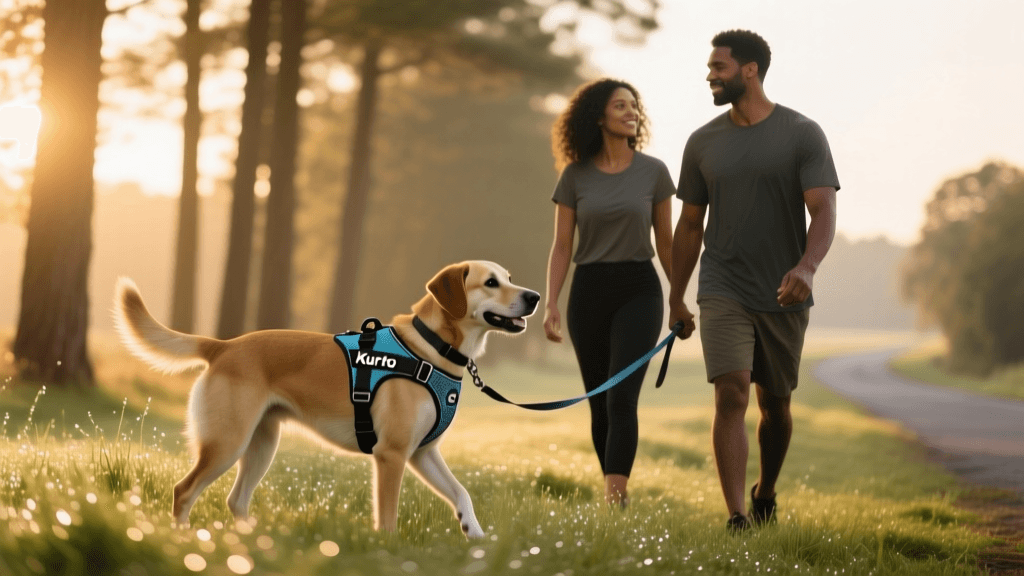
At the core of any successful force-free leash training protocol is the right equipment. In 2026, the Kurgo Tru-Fit Smart Harness remains a top recommendation among certified force-free trainers. Priced accessibly at around $38 to $42, this harness is engineered with a V-neck design that specifically relieves pressure on the dog's trachea and throat.
The Magic of the Front D-Ring
The secret to the Kurgo Tru-Fit's success in loose leash walking is its front chest D-ring. When a dog pulls forward, the front clip gently redirects the dog's momentum back toward the handler. Unlike a back-clip harness, which can actually encourage pulling by allowing the dog to lean into the chest strap (like a sled dog), the front clip acts as a passive, force-free steering mechanism. It does not cause pain or restrict breathing; it simply changes the dog's physical orientation, making pulling inefficient and unrewarding.
Structuring Your Reward System
Positive reinforcement requires a currency that your dog values. In 2026, trainers emphasize the concept of a "treat hierarchy." For high-distraction environments like outdoor walks, dry kibble is rarely sufficient.
- High-Value Treats: Zuke's Mini Naturals or freeze-dried beef liver. These are small, aromatic, and can be consumed quickly without breaking the dog's stride.
- Mid-Value Treats: Soft training chews or small pieces of string cheese.
- Low-Value Treats: Dry kibble or plain biscuits (best reserved for indoor, low-distraction practice).
According to guidelines from The Humane Society of the United States, timing is everything. You must mark the exact moment the dog exhibits the desired behavior (e.g., the leash goes slack) using a marker word like "Yes!" or a clicker, followed immediately by the treat delivery.
Step-by-Step Force-Free Loose Leash Walking Protocol
Teaching loose leash walking is not an overnight process. It requires consistency, patience, and a structured approach. Follow this three-phase protocol to build reliable walking manners.
Phase 1: The Living Room Baseline
Before stepping outside, your dog must understand the mechanics of the harness and the reward system in a zero-distraction environment.
- Put the Kurgo Tru-Fit harness on your dog and attach the leash to the front D-ring.
- Stand still in your living room. Wait for your dog to look at you or take a step toward you, creating slack in the leash.
- The exact second the leash forms a "J" shape (slack), say "Yes!" and deliver a high-value treat right at the seam of your pant leg, near the dog's shoulder. This teaches the dog that the "reward zone" is right next to you.
- Take three steps forward. If the dog stays with you and the leash remains slack, mark and reward. Repeat this for 10 minutes daily.
Phase 2: The "Be a Tree" Technique
Once you move to the driveway or sidewalk, distractions will increase. When your dog pulls to the end of the leash to sniff a bush or chase a squirrel, use the "Be a Tree" method.
- The moment you feel tension on the leash, stop walking immediately. Do not yank the leash back; simply freeze your body and become an immovable tree.
- Wait. Your dog will eventually realize that pulling has not gotten them closer to their goal. They will turn their head to look at you or take a step back, creating slack.
- Mark that slack with "Yes!" and reward at your leg.
- Resume walking. If they pull again, stop again. This teaches the dog a clear contingency: Pulling = Forward motion stops. Slack leash = Forward motion continues.
Phase 3: The Engage-Disengage Game
For dogs that pull specifically toward triggers (other dogs, bicycles, children), use the Engage-Disengage game to change their emotional response.
- Spot a trigger at a distance where your dog notices it but does not react or pull (this is called being "under threshold").
- Mark the moment your dog looks at the trigger ("Yes!") and feed a treat. This is the Engage phase.
- After several repetitions, wait for your dog to look at the trigger, and then wait a second to see if they voluntarily turn their head back to look at you. Mark and reward heavily when they look back. This is the Disengage phase.
Force-Free Harness Comparison Chart
While the Kurgo Tru-Fit is an excellent entry-level force-free harness, it is helpful to understand how it compares to other popular front-clip models available in 2026.
| Harness Model | Front Clip Placement | Padding & Fit | 2026 Est. Price | Best Use Case |
|---|---|---|---|---|
| Kurgo Tru-Fit Smart | Center chest, V-neck design | Lightweight, padded chest plate | $38 - $42 | Everyday walking, beginner force-free training |
| Ruffwear Front Range | Lower chest sternum strap | Heavy-duty foam, dual-point adjust | $45 - $50 | Hiking, rugged terrain, high-energy dogs |
| Rabbitgoo No-Pull | Upper chest metal O-ring | Breathable mesh, wide belly straps | $25 - $30 | Budget-friendly, short-nosed breeds |
| Balance Harness (Blue-9) | Customizable Y-front | Minimalist webbing, no shoulder restriction | $55 - $65 | Reactivity work, strict gait preservation |
Troubleshooting Common Setbacks
Even with the best force-free methods, you will encounter hurdles. Here is how to handle the most common issues in 2026.
Issue: The Dog Bites the Leash
Leash biting is often a sign of over-arousal or frustration, not dominance. Solution: Carry a secondary "decoy" toy or a treat scatter. When the dog grabs the leash, do not play tug-of-war. Instead, toss a handful of low-value treats onto the grass. The sniffing and foraging behavior naturally lowers the dog's heart rate and redirects their mouth away from the leash.
Issue: The Dog Freezes and Refuses to Move
Some dogs, particularly rescues or those previously trained with aversive collars, may freeze when they feel leash pressure because they have been conditioned to fear it. Solution: Remove the pressure entirely. Take a step toward the dog to create slack, use a happy, encouraging voice, and reward any weight shift forward. Never drag a frozen dog; allow them time to process the environment.
Variable Reinforcement and Fading Treats
A common myth in positive reinforcement training is that you must carry treats forever. In reality, once the behavior of walking on a loose leash becomes fluent, you transition to a "variable reinforcement schedule." Instead of treating every three steps, you might treat after 10 steps, then 25 steps, then 5 steps. Eventually, the opportunity to sniff the environment and move forward becomes the primary reward, with food treats used only intermittently to maintain the behavior. This mirrors how slot machines keep humans engaged; the unpredictability of the reward makes the behavior stronger.
"Training is not about showing your dog who is boss; it is about showing your dog how to succeed in a human world. When we remove fear from the equation, we unlock our dog's true potential to learn."
Final Thoughts on Force-Free Walking
Loose leash walking is arguably one of the most complex behaviors we ask of our dogs. We are asking a naturally fast-moving, scent-driven predator to walk at a slow, unnatural human pace while ignoring a symphony of environmental triggers. By utilizing a biomechanically supportive tool like the Kurgo Tru-Fit Smart Harness and committing to positive reinforcement protocols, you are setting your dog up for success. Embrace the force-free philosophy in 2026, celebrate the small victories, and enjoy the journey of building a deep, trust-based relationship with your canine companion.
beth-carrasco
All our authors care for dogs every day — read more of their work on the authors page.