How Kids Can Safely Manage Puppy Teething and Nipping
Learn how to teach your children to safely handle puppy teething and nipping. Discover actionable tips, safe chew toys, and boundary-setting strategies.

The Reality of Puppy Teeth and Toddler Tears
Bringing a new puppy into a home with children is one of the most magical experiences a family can share. The bond between a child and their dog can foster empathy, responsibility, and lifelong memories. However, the intersection of sharp puppy teeth and young children can quickly turn that magic into chaos. Puppies explore the world with their mouths, and children, with their erratic movements and high-pitched voices, often inadvertently trigger a puppy's instinct to nip and chew. Navigating the puppy teething phase requires patience, strict supervision, and a clear set of rules that both kids and adults can enforce.
This comprehensive guide will help your family survive the teething phase by explaining the biology behind the biting, providing age-appropriate interaction rules, and offering actionable strategies to protect both your children's skin and your puppy's developing jaw.
The Biology of Puppy Teething: What is Happening?
To effectively manage nipping, it is crucial to understand why it happens. Puppies are not being aggressive when they bite; they are experiencing intense oral discomfort. A puppy's teething timeline is remarkably fast and can be quite painful:
- 3 to 6 Weeks: The 28 deciduous (baby) teeth begin to erupt. These teeth are incredibly sharp, often described as 'needle teeth,' because the puppy's jaw muscles are not yet strong enough to cause serious damage, but the teeth need to pierce the mother's milk supply.
- 12 to 16 Weeks: The baby teeth begin to fall out, making way for the 42 permanent adult teeth. This is the peak of the teething discomfort. The gums are swollen, itchy, and sore.
- 6 Months: By six months of age, most puppies have their full set of adult teeth. However, the habit of mouthing can persist if it has been inadvertently reinforced by the family.
During the 12 to 16-week window, puppies have a biological imperative to chew to relieve the pressure in their gums. When a child runs past a teething puppy, the puppy may grab the nearest available object—which is often an ankle or a swinging hand—to soothe their aching mouth.
Why Puppies Nip at Children Specifically
Children are uniquely stimulating to puppies. Kids tend to move unpredictably, wave their arms, squeal, and run away. To a puppy, this behavior mimics the movement of prey or an invitation to rough-and-tumble play. According to the ASPCA, puppy mouthing is a normal developmental phase, but it must be redirected appropriately, especially around children who may not understand how to react. When a child squeals and pulls their hand away quickly, it triggers the puppy's prey drive, causing them to bite down harder and chase. Teaching children how to react calmly is just as important as teaching the puppy bite inhibition.
Age-Appropriate Rules for Kids and Puppies
Not all children are developmentally capable of interacting with a teething puppy in the same way. Setting age-appropriate boundaries ensures safety for both the child and the dog. Below is a structured guide on how to manage interactions based on your child's age.
| Child's Age | Interaction Level | Rules and Boundaries | Supervision Requirement |
|---|---|---|---|
| Under 3 Years | Observation Only | No direct petting. Child sits on a parent's lap to watch the puppy. No sharing of toys. | 100% physical separation or constant adult physical restraint. |
| 3 to 5 Years | Guided Touch | Child can pet the puppy's back with an open hand ('pet like a turtle'). No face-to-face contact. | Adult must be within arm's reach, actively guiding the child's hand. |
| 6 to 9 Years | Supervised Play | Child can participate in training games and toss toys. Must know the 'Be a Tree' method. | Adult must be in the same room, actively monitoring body language. |
| 10+ Years | Independent Care | Child can handle feeding, basic training, and walking (in safe areas). Can redirect nipping. | Adult check-ins required; child must know when to ask for help. |
The 'Be a Tree' Technique: Teaching Kids to Stop Nipping
One of the most effective tools for children aged five and older is the 'Be a Tree' method. This technique teaches kids how to instantly remove themselves from the 'game' without triggering the puppy's chase instinct. Practice this with your children when the puppy is asleep or in another room, so they know exactly what to do when the puppy gets too mouthy.
Step-by-Step 'Be a Tree' Guide:
- Stop Moving: The moment the puppy's teeth touch skin or clothing, the child must freeze completely. Running or pulling away will make the puppy bite harder.
- Fold Your Branches: The child should cross their arms tightly over their chest and tuck their hands into their armpits. This protects the fingers and hands, which are the most common targets for puppy nips.
- Look at Your Roots: The child should look down at their feet. Avoiding eye contact with the puppy signals that the play session is over and removes the social engagement the puppy is seeking.
- Be Quiet: Squealing or yelling 'No!' excites the puppy. The child must remain completely silent until the puppy loses interest and walks away, or until an adult intervenes.
Pro Tip for Parents: Turn the 'Be a Tree' method into a game like 'Simon Says.' Practice it in the living room without the puppy first. Reward your child with praise when they execute the steps perfectly. This builds muscle memory for when a real nipping incident occurs.
Curating a Family-Friendly Teething Toy Box
You cannot simply tell a puppy to stop chewing; you must give them an appropriate alternative. Create a dedicated 'Teething Toy Box' that is easily accessible to both the puppy and the children. When the puppy nips, the child (if age-appropriate) or the adult can immediately redirect the puppy to a toy from the box.
Top Vet-Recommended Teething Toys for Families:
- KONG Puppy (Small Size, approx. $11): Designed specifically for puppy jaws, the blue or pink KONG rubber is gentle on developing teeth. Actionable Tip: Smear the inside with plain, xylitol-free Greek yogurt or mashed banana, and freeze it for two hours. The cold soothes inflamed gums, and the puzzle aspect keeps the puppy occupied for up to 30 minutes.
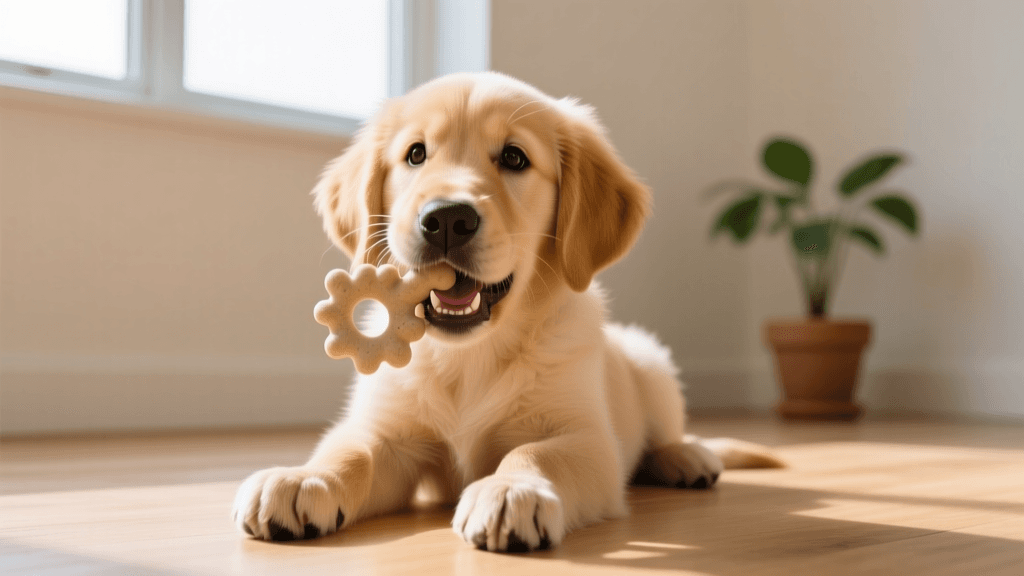
- Nylabone Puppy Chew Textured Ring (approx. $9): The raised nubs on this toy help massage the gums and clean teeth as they erupt. It is highly durable and safe for unsupervised chewing in a playpen.
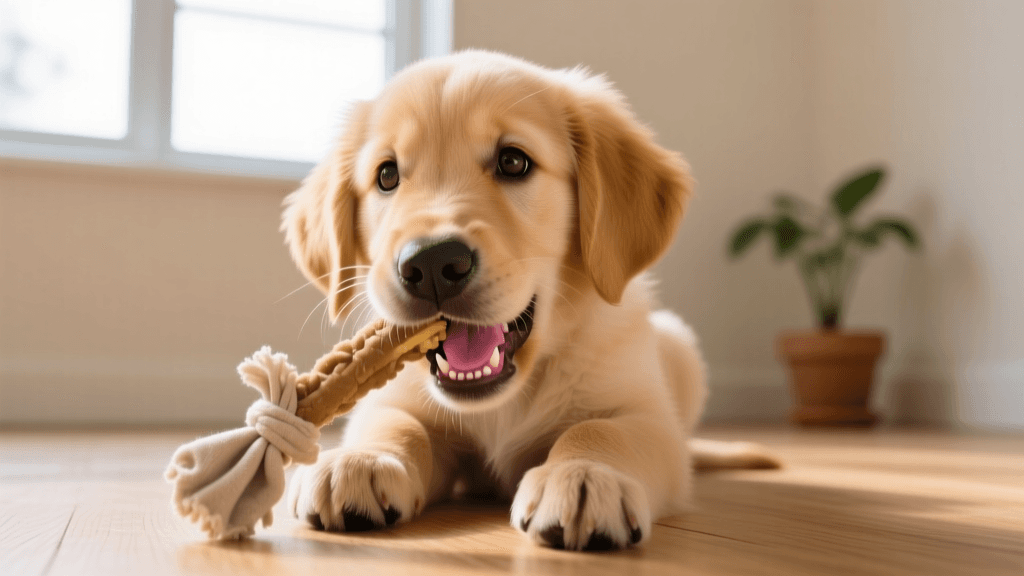
- The Frozen Washcloth Trick (Cost: $1): Take a clean, standard cotton washcloth, wet it, wring it out completely, twist it into a rope, and freeze it. The texture mimics the feeling of chewing on a littermate, and the ice numbs the pain. Safety Note: Always supervise this toy and throw it away once the puppy starts tearing the fabric to prevent intestinal blockages.
- Whole Raw Carrots (approx. $2 per bag): Large, whole carrots act as nature's toothbrush. They are low in calories, safe for digestion, and provide a satisfying crunch. Never use baby carrots, as they pose a choking hazard for small puppies.
Designing Safe Zones and Supervision
Constant supervision is exhausting, and lapses in attention are when most puppy-child biting incidents occur. The American Veterinary Medical Association (AVMA) emphasizes that creating physical barriers and safe spaces is a critical component of dog bite prevention in homes with children. You must design your home to allow the puppy to decompress away from the kids.
Essential Gear for Safe Zones:
- Modular Playpens: Invest in a metal exercise pen, such as the Midwest Homes for Pets 4-Panel Playpen (approx. $60, featuring 24x24 inch panels). Set this up in the living room so the puppy can be part of the family action without having direct access to running children. Fill it with a bed, water bowl, and the Teething Toy Box.
- Hardware-Mounted Baby Gates: Avoid pressure-mounted gates for the top of stairs or areas where a determined puppy might push through. Use a hardware-mounted gate like the Carlson Pet Products Walk-Thru Gate (approx. $40, 29 inches tall). This allows adults to pass through easily while keeping the puppy confined to a 'puppy-proofed' room when adult supervision drops below 100%.
- The '1-to-1-to-1' Rule: Never leave a child and a puppy together without an adult. A good rule of thumb for families is one adult supervising one child and one puppy. If the adult needs to answer the door or use the restroom, the puppy goes into the playpen, or the child goes to a different room.
Redirecting and Rewarding Good Behavior
Punishing a puppy for nipping can lead to fear-based aggression or cause the puppy to suppress warning signs, making them more dangerous in the long run. Instead, focus on positive reinforcement. When the puppy chooses to chew on their KONG toy instead of your child's sock, offer calm, quiet praise. If the puppy approaches your child and sits politely without jumping or mouthing, have the child toss a high-value training treat (like Zuke's Mini Naturals, cut into pea-sized pieces) to the puppy. This teaches the puppy that keeping their teeth off human skin results in wonderful rewards.
When to Seek Professional Help
While nipping and teething are normal, true aggression is not. If your puppy exhibits stiff body language, growls deeply when approached while eating or sleeping, or bites with the intent to puncture and hold on, it is time to consult a professional. Reach out to a Certified Professional Dog Trainer (CPDT-KA) or a Veterinary Behaviorist immediately. Early intervention is the key to ensuring a safe, harmonious relationship between your new puppy and your children for years to come.
By understanding the teething process, enforcing age-appropriate boundaries, and utilizing tools like the 'Be a Tree' method and structured safe zones, your family can navigate this challenging developmental milestone successfully. Remember, the patience you invest today builds the foundation for a gentle, trustworthy family dog tomorrow.
hannah-wickes
All our authors care for dogs every day — read more of their work on the authors page.