Teaching Kids and Dogs Safe Play: A Complete Parent Guide
Learn how to foster a safe, loving bond between your children and family dog with expert tips on body language, boundaries, and age-appropriate play.

The Magic and Responsibility of Multi-Species Families
Growing up with a family dog is one of the most enriching experiences a child can have. Dogs teach children empathy, responsibility, and provide an unwavering source of comfort and companionship. However, blending the chaotic, loud, and unpredictable nature of childhood with the instincts and boundaries of a canine requires intentional parenting and proactive management. It is a common misconception that family dogs will naturally tolerate all behaviors from children. In reality, dogs have limits, and when those limits are pushed, the results can be dangerous.
According to the American Veterinary Medical Association (AVMA), children are the most frequent victims of dog bites, and the vast majority of these incidents involve a familiar family pet rather than a stray or unknown dog. This statistic is not meant to induce panic, but rather to highlight a critical gap in understanding: most bites occur because adults misinterpret canine body language or fail to supervise interactions adequately. By shifting our perspective to see the world through our dog's eyes, we can create a harmonious household where both toddlers and terriers thrive safely.
Decoding Canine Body Language: The First Line of Defense
Dogs do not speak human languages; they communicate through a complex system of posture, facial expressions, and vocalizations. Children, especially toddlers, are naturally drawn to faces and eyes, often misinterpreting a dog's warning signs as an invitation to play. The American Kennel Club (AKC) emphasizes that teaching children to recognize canine stress signals is the most effective way to prevent bites before they happen.
Many parents believe that a wagging tail always means a happy dog. This is a dangerous myth. A tail wag simply indicates arousal or stimulation, which can easily tip into fear or aggression depending on the tail's position and stiffness. Below is a quick-reference guide to help you and your children decode what your dog is truly saying.
| Canine Signal | What It Actually Means | What the Child Should Do |
|---|---|---|
| Yawning or Lip Licking | Stress, anxiety, or an attempt to self-soothe in an uncomfortable situation. | Stop petting immediately, take a step back, and give the dog space. |
| "Whale Eye" (Showing the whites of the eyes) | Fear, guarding a resource, or feeling trapped. | Back away slowly without making direct eye contact; alert an adult immediately. |
| Stiff Body or Frozen Posture | High alert, extreme discomfort, and a potential precursor to a bite. | Freeze like a statue, avoid sudden movements, and wait for the dog to move away. |
| Fast, High, Stiff Tail Wag | Over-arousal or agitation; the dog is highly stimulated and not necessarily friendly. | Stop playing, put toys away, and allow the dog to decompress in a quiet zone. |
| Turning Head Away or Leaning Back | A polite request for the interaction to end. | Respect the boundary, remove hands, and let the dog leave the area. |
Creating Physical Boundaries and Safe Zones
Management is just as important as training. You cannot expect a dog to have infinite patience, nor can you expect a toddler to have perfect impulse control. Physical barriers are your best friends in a multi-species household. Every home with a dog and young children should have designated "dog-only" safe zones where the canine can retreat without being followed.
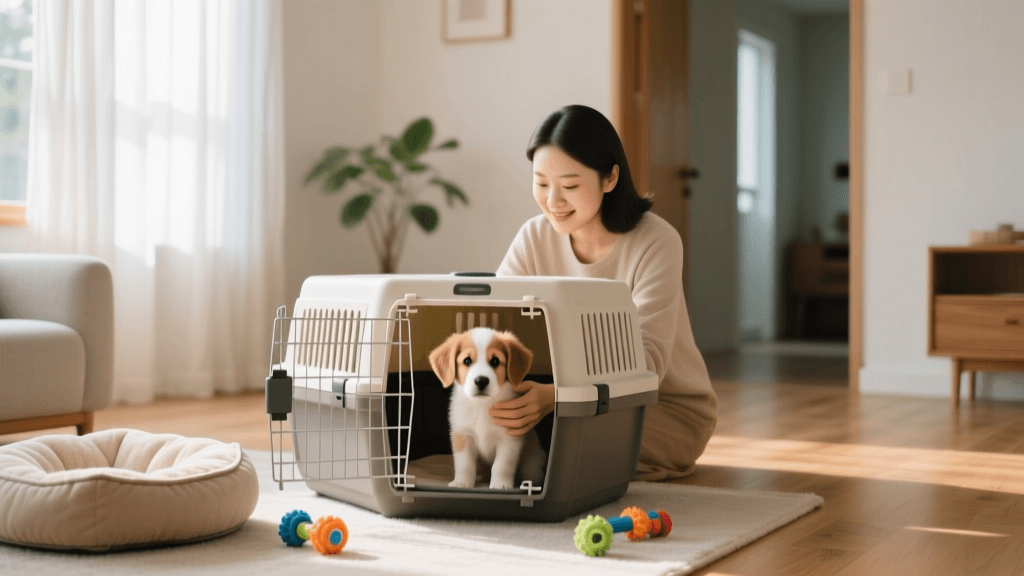
Invest in high-quality, hardware-mounted baby gates. Pressure-mounted gates are easily pushed over by medium or large dogs (or determined toddlers). Look for gates that are at least 36 inches tall to prevent jumping. Brands like Cardinal Gates or Regalo offer excellent hardware-mounted options. Furthermore, crate training is essential. The crate must be established as an absolute sanctuary. If the dog is in the crate, the rule is simple: the dog is invisible. Children are never allowed to reach into, throw toys at, or disturb a dog in its crate.
Age-Appropriate Interactions: A Developmental Guide
A child's ability to interact safely with a dog evolves as their cognitive and motor skills develop. Here is a breakdown of how to manage interactions based on your child's age:
- Toddlers (Ages 1-3): This is the highest-risk age group. Toddlers are unsteady on their feet, prone to falling, and explore the world by grabbing and pulling. Interactions must be 100% supervised by an adult who is actively watching the dog's body language, not just scrolling on a phone. Toddlers should not be allowed to pet the dog independently; instead, the adult can stroke the dog while the toddler watches, or the adult can guide the toddler's hand to stroke the dog's back (never the head or tail).
- Preschoolers (Ages 4-5): Children this age can begin to learn basic empathy and rules. They can participate in safe play by throwing fetch toys or tossing treats on the floor for the dog to find. They can be taught the "gentle touch" rule, practicing on a stuffed animal first before applying it to the family dog.
- School-Age (Ages 6-10): Older children can take on more responsibility, such as helping to fill the dog's water bowl, participating in basic training sessions (like teaching "sit" or "touch"), and going on supervised walks. However, they still need adult oversight to ensure they do not inadvertently engage in roughhousing or tease the dog.
The "Ask, Wait, Pet" Protocol
Teaching children how to approach a dog is critical, both for your family pet and for dogs you encounter in the neighborhood. The Humane Society of the United States strongly recommends teaching children to never run up to a dog unannounced. Implement the "Ask, Wait, Pet" protocol:
- Ask the Owner: Always ask the human first. If the owner says no, respect it immediately.
- Ask the Dog (Wait): Stand sideways, avoid direct eye contact, and let the dog approach the child. If the dog sniffs and leans in, it is a green light. If the dog stays put, looks away, or walks off, it is a red light. The child must accept the dog's "no" gracefully.
- Pet the Shoulder or Back: Children are naturally inclined to reach over a dog's head to pat them. To a dog, a hand coming over their head can be perceived as a threat. Teach kids to pet the dog's chest, shoulder, or side of the neck using slow, gentle strokes.
Why Hugging is a Hazard
One of the hardest lessons for parents to teach is that dogs do not like hugs. Humans are primates; we show affection by wrapping our arms around one another. Dogs are cursorial animals, meaning their primary defense mechanism is flight. When a child wraps their arms around a dog's neck, they are restricting the dog's ability to escape. This can trigger a claustrophobic panic response, leading to a bite to the face, which is often right next to the child's head during a hug. Teach your children to show affection through gentle petting, playing fetch, or doing trick training instead of squeezing the dog.
Managing Resources and High-Energy Enrichment
Resource guarding—when a dog becomes aggressive over food, toys, or bones—is a major trigger for bites involving children. Never allow a child to approach a dog while it is eating or chewing a high-value treat. Feed your dog in a separate room or behind a baby gate. If a child accidentally drops food near the dog, teach the child to back away and let an adult handle the situation.
To keep your dog mentally stimulated without involving the kids, utilize independent enrichment tools. A frozen KONG Classic stuffed with peanut butter and kibble, or an Outward Hound snuffle mat, can provide 20 to 30 minutes of quiet, focused activity for the dog. Lick mats (like the Hyper Pet IQ Treat Mat) spread with plain yogurt and frozen are also excellent for soothing an anxious dog during chaotic household moments, like when the kids are having a loud playdate.
Final Thoughts on Active Supervision
Ultimately, the key to a peaceful coexistence between kids and dogs is active, proactive supervision. This means being in the same room, paying attention to the dynamic, and intervening before a dog has to resort to growling or snapping to communicate its discomfort. By setting clear boundaries, decoding your dog's silent language, and teaching your children empathy and respect, you are not just preventing accidents—you are nurturing a profound, lifelong bond between your child and their best friend.
tom-renshaw
All our authors care for dogs every day — read more of their work on the authors page.