Introducing a new puppy to an older dog
The first two weeks set the tone for years to come. A gentle, structured plan to help your older dog accept a new puppy.
Setting the Stage Before the New Puppy Arrives
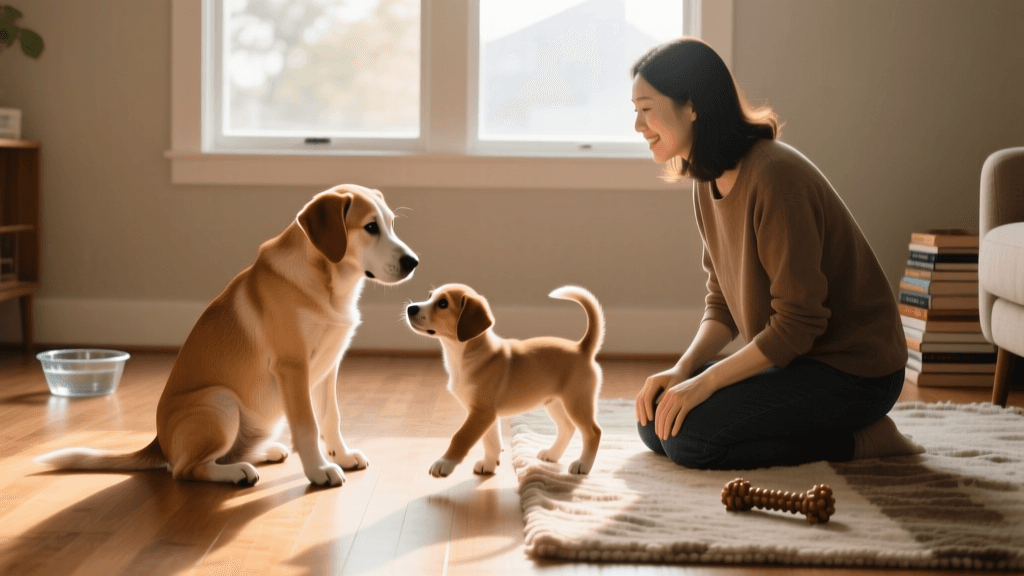
Bringing a puppy into a home where an older dog already rules the roost is one of the most rewarding — and potentially stressful — things you can do as a dog owner. Done right, you end up with two dogs who genuinely enjoy each other's company. Done carelessly, you risk triggering anxiety, resource guarding, and even aggression that can take months to undo. The good news is that preparation makes an enormous difference, and most of it happens before the puppy ever sets a paw through your front door.
Start by auditing your space. Your resident dog needs at least one area that is entirely off-limits to the newcomer — a crate, a gated room, or even just a raised bed the puppy cannot reach. The American Kennel Club (AKC, 2023) recommends giving senior or established dogs a "safe zone" where they can decompress without being pestered, noting that resource-related tension is the leading cause of inter-dog conflict in multi-dog households. Even a simple baby gate from a brand like Carlson Pet Products or Regalo can create that critical boundary for under $40.
Scent introduction is your first practical step. About a week before the puppy comes home, bring a blanket or soft toy that carries the puppy's scent and let your older dog investigate it at his own pace. Do the same in reverse — send something carrying your resident dog's scent to the puppy's current environment. This low-stakes sniff session primes both dogs' brains before any face-to-face meeting occurs.
The First Meeting: Neutral Ground Is Non-Negotiable
Never introduce a new puppy directly inside your home. Your older dog considers the house, the yard, and everything in it his territory. Walking into that space with a strange puppy is an immediate provocation. Instead, choose a neutral location — a nearby park, an empty parking lot, or a quiet street neither dog has visited regularly.
Keep both dogs on loose leashes and let them approach in a curved, arc-shaped path rather than head-on. Direct face-to-face greetings are confrontational in dog body language. Allow a brief sniff — ideally three to five seconds — then calmly redirect both dogs to walk parallel to each other. This parallel walking technique, widely taught at facilities like the San Francisco SPCA's behavior department, mimics how dogs naturally build familiarity in the wild.
Reading Body Language During the Introduction
Knowing what to look for prevents a tense moment from escalating. Loose, wiggly body posture, play bows, and relaxed tails are green lights. Stiff posture, a hard stare, raised hackles, or a tail held rigidly high are yellow or red flags that mean you need to increase distance and slow things down.
A 2022 study published by the British Veterinary Association found that misread canine body language during introductions was a contributing factor in approximately 68% of reported inter-dog bite incidents in multi-pet households. Taking a single session with a certified professional dog trainer (CPDT-KA credential) before the puppy arrives is money well spent — many trainers offer 60-minute consultations for $75–$120.
What to Do If the Older Dog Growls
A growl is communication, not aggression. Your older dog is saying "I'm uncomfortable — back off." The worst thing you can do is punish the growl, because you remove the warning signal without removing the discomfort. Instead, calmly separate the dogs, give your older dog space, and make a note of what triggered the reaction. Was the puppy too bouncy? Did it approach while the older dog was eating? That information tells you exactly what to manage more carefully going forward.
If growling is frequent or escalates to snapping within the first two weeks, contact the Association of Professional Dog Trainers (APDT) to find a force-free trainer in your area. Early intervention is far easier than rehabilitating an established conflict pattern.
Managing the Home Environment in the First 30 Days
The first month is the most critical window. Routines, boundaries, and supervision habits established now will shape the relationship for years. Think of yourself less as a referee and more as a thoughtful stage manager — arranging the environment so that positive interactions happen naturally and friction points are minimized.
- Feed separately, always. Place food bowls in different rooms or use a gate to divide the space at mealtimes. Even dogs who are otherwise friendly can guard food.
- Pick up high-value items. Bones, bully sticks, and favorite toys should be given only when the dogs are separated. Introduce shared toy time gradually after several weeks of positive coexistence.
- Supervise all interactions for the first 4–6 weeks. Unsupervised time together should be earned, not assumed.
- Give your older dog one-on-one time every day. A 15-minute solo walk or a quiet training session reinforces that his relationship with you hasn't been replaced.
- Crate the puppy when you cannot watch. A crate is not punishment — it is a management tool that prevents the puppy from pestering your older dog into a confrontation.
Choosing the Right Crate Setup
For most puppies, a wire crate with a divider panel works best because you can expand it as the puppy grows. The MidWest Homes for Pets iCrate is a popular choice among trainers, available in sizes from 24 inches (suitable for dogs up to 25 lbs) to 48 inches (for dogs up to 90 lbs). Place the crate in a room where the puppy can see and smell the household activity but where your older dog is not forced to walk past it constantly — that proximity can create low-level stress for both animals.
Real Owner Experiences: What Actually Happens
Sarah Okonkwo, a dog owner in Austin, Texas, adopted a 10-week-old Labrador mix named Biscuit while her 7-year-old Beagle, Pepper, was already settled in the home. "The first week was rough," she recalls. "Pepper would just leave the room every time Biscuit came near. I was worried they'd never bond." Sarah worked with a trainer from the Austin Humane Society who advised her to stop forcing interactions and instead let Pepper set the pace entirely. By week three, Pepper was initiating play. By week six, they were sleeping in the same dog bed.
Marcus Delgado in Portland, Oregon, had a different experience with his 9-year-old German Shepherd, Rex, and a new Border Collie puppy named Finn. Rex had never lived with another dog and showed significant stress signals — panting, pacing, and refusing food — for the first ten days. Marcus consulted the behavior team at the Oregon Humane Society, who recommended a structured two-week protocol of parallel walks twice daily and zero forced interaction inside the home. "It felt slow and frustrating," Marcus says, "but by day 18, Rex was actually sniffing Finn voluntarily. That was the turning point."
Both stories share a common thread: patience and letting the older dog lead the relationship-building process. Rushing the timeline is the single most common mistake new multi-dog owners make.
Nutrition and Health Considerations for a Two-Dog Household
Puppies and adult dogs have fundamentally different nutritional needs, and feeding them the same food is a mistake that can affect both animals' long-term health. Puppies require higher levels of protein, calcium, and phosphorus to support rapid growth. Large-breed puppies in particular need carefully controlled calcium-to-phosphorus ratios — the Association of American Feed Control Officials (AAFCO, 2024) specifies that puppy food must contain a minimum of 22.5% crude protein on a dry matter basis, compared to 18% for adult maintenance formulas.
Feeding your older dog puppy food long-term can contribute to weight gain and, in some breeds, exacerbate joint issues. Conversely, feeding a puppy adult food can lead to developmental deficiencies. The practical solution is to feed in separate rooms with the door closed, then pick up bowls immediately after meals so there is no opportunity for cross-feeding.
| Life Stage | Min. Crude Protein (AAFCO) | Min. Crude Fat (AAFCO) | Feeding Frequency |
|---|---|---|---|
| Puppy (under 12 months) | 22.5% | 8.5% | 3–4 times daily |
| Adult dog (1–7 years) | 18% | 5.5% | 2 times daily |
| Senior dog (7+ years) | 18% | 5.5% | 2 times daily (adjusted calories) |
Schedule a vet visit for your older dog around the same time the puppy comes home — not because anything is wrong, but to establish a baseline and discuss whether the added stimulation of a puppy might affect any existing health conditions. Dogs with arthritis, for example, may need a pain management review if a bouncy puppy is going to be jumping on them regularly.
Building a Positive Long-Term Relationship
Once the initial adjustment period passes — typically somewhere between four and twelve weeks depending on the individual dogs — you can begin building shared positive experiences. Joint training sessions where both dogs earn treats for calm behavior near each other are particularly effective. Keep sessions short: five to seven minutes is enough to reinforce good associations without tipping either dog into overstimulation.
Structured play is better than free-for-all wrestling, especially in the early months. A puppy's energy level can genuinely exhaust and irritate an older dog. Aim for two or three short, supervised play sessions of five to ten minutes each day rather than letting them go until someone snaps. Watch for the older dog giving "cut-off" signals — turning away, licking lips, or moving to a different spot — and honor those signals by redirecting the puppy immediately.
Over time, most dogs find their own rhythm. The older dog often becomes a surprisingly effective teacher, communicating canine social rules in ways no human trainer can replicate. Puppies who grow up with a well-adjusted older dog tend to develop better bite inhibition, calmer greetings, and stronger social skills than puppies raised without that canine mentorship. The investment of those first difficult weeks pays dividends for the entire life of both dogs.
- Complete the neutral-ground introduction before bringing the puppy inside.
- Establish separate feeding stations and sleeping areas from day one.
- Give your older dog daily one-on-one time throughout the transition period.
- Consult a certified trainer if you see repeated growling, snapping, or stress signals within the first two weeks.
- Allow the relationship to develop at the older dog's pace — four to twelve weeks is a normal adjustment window.
The path from two strangers to genuine companions is rarely a straight line, but with consistent management, realistic expectations, and respect for both dogs' emotional needs, it is a path almost every household can walk successfully.
Beth Carrasco
All our authors care for dogs every day — read more of their work on the authors page.