Keeping A Dog Entertained When You Work From Home
Learn about keeping a dog entertained when you work from home with expert tips and data-backed advice.
The Reality of Working From Home With a Dog
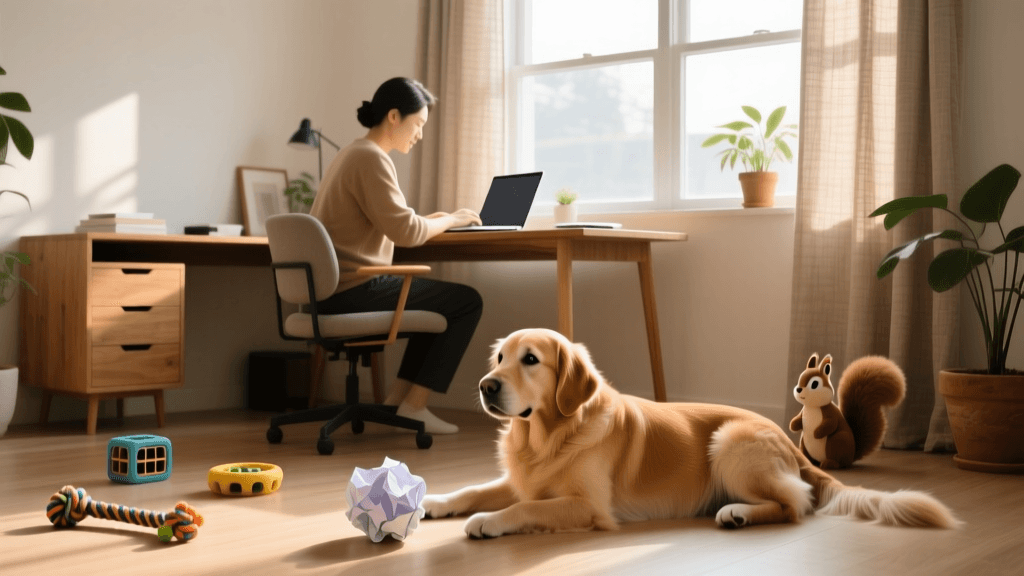
Working from home sounds like a dream for dog owners — no more guilt about leaving your dog alone all day, no more rushing back at lunchtime, and plenty of opportunities for mid-morning cuddles. But the reality is often more complicated. Many dogs who were previously fine being left alone for several hours find the new arrangement confusing, even stressful. Your presence at home raises their expectations. They want interaction, play, and attention — and when you're deep in a video call or trying to hit a deadline, that persistent nudging of a wet nose against your elbow can feel less endearing than it sounds.
The challenge isn't just about keeping your dog quiet. It's about meeting their genuine behavioural and physical needs while also protecting your own productivity. Dogs are social animals with real cognitive and sensory requirements, and a bored dog doesn't simply sit quietly waiting for you to finish work. They chew furniture, bark at every sound, develop anxious habits, or simply become increasingly demanding. Getting this balance right takes planning, consistency, and a willingness to adapt your routine.
Understanding What Your Dog Actually Needs Each Day
Before you can build a workday routine that works for both of you, it helps to understand what dogs genuinely need — not just in terms of walks, but across all dimensions of their wellbeing. The Dogs Trust recommends that dogs receive both physical exercise and mental stimulation every day, noting that mental enrichment can be just as tiring as physical activity. A dog who has spent 20 minutes working through a puzzle feeder is often calmer and more settled than one who has had a brisk 15-minute walk with no cognitive engagement.
According to the RSPCA's animal welfare guidelines (2023), dogs need opportunities to express normal behaviours including sniffing, chewing, exploring, and social interaction. These aren't optional extras — they're fundamental to a dog's psychological health. When those needs go unmet, problem behaviours emerge. Understanding this reframes the task: you're not just trying to keep your dog occupied so you can work. You're trying to ensure they have a genuinely good day.
The amount of exercise a dog needs varies significantly by breed, age, and individual temperament. A Border Collie may need 2 or more hours of vigorous activity daily, while a Basset Hound might be content with 45 minutes of moderate walking. Most adult dogs of medium breeds need between 1 and 2 hours of exercise per day, split across multiple outings. Puppies under 5 months should follow the general guideline of 5 minutes of exercise per month of age, twice daily — so a 4-month-old puppy needs no more than 20 minutes per session.
The Difference Between Physical and Mental Tiredness
One of the most useful things to understand is that physical and mental tiredness feel different to a dog, and produce different results. A dog who has run for an hour may still be alert, excitable, and looking for stimulation. A dog who has spent 30 minutes working through a series of enrichment activities — sniffing out hidden treats, solving a puzzle toy, learning a new command — is often genuinely ready to rest. This is why enrichment is such a powerful tool for work-from-home dog owners: it delivers tiredness efficiently, without requiring you to leave your desk for extended periods.
Research from the University of Agricultural Sciences in Sweden found that dogs who engaged in regular nose work activities showed reduced stress indicators and were more likely to settle calmly after sessions. Sniffing is cognitively demanding for dogs — their olfactory cortex is proportionally 40 times larger than a human's — and activities that engage this sense are particularly effective at producing calm, settled behaviour.
Reading Your Dog's Signals
Learning to read when your dog is genuinely content versus when they're suppressing frustration is a skill that takes time. A dog lying quietly near your desk might be relaxed, or they might be in a state of learned helplessness — having given up on getting attention. Signs of genuine contentment include soft body posture, slow breathing, relaxed facial muscles, and the ability to settle without repeatedly checking on you. Signs of suppressed frustration or anxiety include excessive yawning, lip licking, pacing, inability to settle for more than a few minutes, and attention-seeking behaviours that escalate when ignored.
Building a Workday Routine That Works for Both of You
Dogs thrive on predictability. Knowing when walks happen, when meals arrive, and when interaction is available reduces anxiety and helps dogs settle more easily during work periods. The goal is to create a structure your dog can learn to anticipate, so that quiet periods feel safe rather than uncertain.
A practical framework for a standard workday might look like this:
- 7:00–7:30am: Morning walk — ideally 30–45 minutes with off-lead time if possible, allowing sniffing and exploration rather than just brisk walking
- 8:00am: Breakfast served in a puzzle feeder or Kong rather than a bowl, extending mealtime engagement to 10–15 minutes
- 8:30am–12:30pm: Core work block — dog settles in their designated rest area with a long-lasting chew
- 12:30–1:00pm: Midday break — short walk or garden time, brief training session (5–10 minutes), then lunch
- 1:00–4:30pm: Afternoon work block — enrichment activity provided at the start of this period
- 4:30pm onwards: End-of-day walk, play, and social time
This structure isn't rigid — it will need adapting to your dog's age, breed, and individual needs. But the principle of anchoring the day with predictable activity and rest periods is sound for most dogs.
Creating a Dedicated Rest Space
Where your dog rests during work periods matters more than many owners realise. A dog who can see you constantly but cannot access you is in a state of low-level frustration. Some dogs do better in a separate room with a comfortable bed and background noise — a radio or white noise machine can help mask the sounds of your keyboard and phone calls that might otherwise trigger alertness. Others settle well in the same room if they have a clearly defined space, such as a crate or a specific bed, that they associate with rest.
The Dogs Trust recommends crate training as a positive tool for giving dogs a safe, den-like space — not as a punishment or containment measure. A dog who has been properly crate trained from puppyhood will often choose to retreat to their crate voluntarily during busy periods. If your dog isn't crate trained, a comfortable bed in a low-traffic area of your home can serve a similar function.
Enrichment Activities That Fit Around a Work Schedule
The enrichment market has expanded enormously in recent years, and there are now products and activities to suit every budget, breed, and living situation. The key is matching the activity to your dog's individual preferences and abilities — not every dog is motivated by food puzzles, and not every dog enjoys the same type of stimulation.
"Enrichment isn't about keeping dogs busy — it's about giving them opportunities to be dogs. Sniffing, chewing, foraging, and problem-solving are all natural behaviours that dogs are motivated to perform. When we provide outlets for these behaviours, we're not just preventing boredom; we're actively supporting their psychological wellbeing."
— Dogs Trust Canine Behaviour Team, 2022
Here are some of the most effective enrichment options for work-from-home scenarios, along with realistic time investments:
| Activity | Prep Time | Engagement Duration | Best For |
|---|---|---|---|
| Stuffed Kong (frozen) | 5 minutes (prep night before) | 20–45 minutes | Most dogs, especially anxious ones |
| Snuffle mat | 2 minutes | 10–20 minutes | Scent-driven dogs, older dogs |
| Licki mat with peanut butter | 2 minutes | 10–15 minutes | Dogs who need calming, post-walk settling |
| Puzzle feeder (Level 2–3) | 3 minutes | 15–30 minutes | Food-motivated, intelligent breeds |
| Bully stick or natural chew | 0 minutes | 30–90 minutes | Dogs who need sustained occupation |
| Scatter feeding in garden | 1 minute | 15–25 minutes | Dogs with outdoor access |
Rotating activities is important — dogs habituate quickly to the same puzzle or chew, and novelty is a significant part of what makes enrichment engaging. Keeping a rotation of 6–8 different activities and cycling through them prevents your dog from losing interest.
When Your Dog Needs More Than You Can Provide
Even with the best routine and enrichment strategy, some dogs need more social interaction and stimulation than a solo work-from-home owner can realistically provide. This is particularly true for high-energy breeds, young dogs under 2 years old, and dogs who have developed separation-related behaviours. Recognising this isn't a failure — it's responsible ownership.
Several options exist for supplementing your dog's day. Dog walkers can provide a midday break that breaks up long rest periods and provides social interaction with other dogs and humans. In London, professional dog walkers typically charge between £12 and £20 for a 30-minute walk, or £18 to £30 for a full hour, depending on location and whether it's a solo or group walk. Doggy daycare is a more intensive option, with full-day places at reputable facilities such as Barking Mad or local independent daycares typically costing between £25 and £45 per day.
For dogs who struggle with being alone even when you're in the house — a phenomenon sometimes called "velcro dog" behaviour — working with a qualified behaviourist may be worthwhile. The Association of Pet Behaviour Counsellors (APBC) maintains a register of accredited practitioners across the UK. A behaviourist can assess whether your dog's clinginess is a normal personality trait or a sign of underlying anxiety that needs structured intervention.
It's also worth considering whether your dog would benefit from regular socialisation with other dogs. Dogs who spend most of their time with one person can become over-attached and under-socialised. Local training classes, such as those run by the Kennel Club Good Citizen scheme at venues across the UK, provide structured socialisation alongside skill-building — and give you a weekly commitment that gets both of you out of the house.
- Assess your dog's baseline needs honestly — breed, age, and temperament all affect how much stimulation they require daily
- Build a consistent daily structure with predictable walk times, meal times, and rest periods
- Invest in a rotation of enrichment activities that engage your dog's natural behaviours, particularly sniffing and chewing
- Create a designated rest space your dog associates with calm and safety
- Supplement with professional support — dog walkers, daycare, or a behaviourist — if your dog's needs exceed what you can provide alone
- Monitor your dog's behaviour over time and adjust the routine when you notice signs of frustration, anxiety, or boredom
Working from home with a dog is genuinely one of the better arrangements for canine welfare — far preferable to long daily absences. But it requires active management rather than passive coexistence. The dogs who thrive in home-office environments are those whose owners have taken the time to understand their individual needs and built a daily structure that meets them. That investment pays off in a calmer, happier dog — and, not incidentally, a more productive working day for you.
Beth Carrasco
All our authors care for dogs every day — read more of their work on the authors page.