How To Train A Dog To Stay Calm Around Other Dogs
Learn about how to train a dog to stay calm around other dogs with expert tips and data-backed advice.
Understanding Reactivity Before You Begin
A dog that lunges, barks, or freezes at the sight of another dog is not being aggressive for the sake of it. In most cases, the behaviour stems from either fear, frustration, or an excess of arousal that the dog has no other outlet for. Before you can change the behaviour, you need to understand what is driving it. The Association of Professional Dog Trainers (APDT, 2022) defines reactivity as "an exaggerated response to a stimulus that is out of proportion to the actual threat level," and distinguishes it clearly from true aggression, which involves intent to cause harm.
This distinction matters because the training approach differs. A fearful dog needs distance and safety. A frustrated greeter — one that desperately wants to reach other dogs but cannot — needs impulse control work. Identifying which category your dog falls into will shape every decision you make about distance, reward timing, and session length.
Start by observing your dog's body language before the reaction peaks. Stiffening, a high tail, whale eye, or a low crouching posture are all early warning signals. The moment you can reliably spot these signals, you have found your dog's threshold — the distance at which the stimulus registers but the dog has not yet tipped into full reactivity. All effective training happens below that threshold.
The Science Behind Calm Behaviour
Classical and operant conditioning are the two pillars of modern, evidence-based dog training. Classical conditioning, first described by Ivan Pavlov, works by pairing a neutral or negative stimulus with something the dog already values, gradually changing the emotional response. Operant conditioning, developed through the work of B.F. Skinner and later applied to animal training by Karen Pryor at the Oceanic Institute in Hawaii during the 1960s, works by reinforcing behaviours the trainer wants to see more of.
When training a dog to stay calm around other dogs, you are primarily using classical counter-conditioning to change how the dog feels, and operant conditioning to teach specific calm behaviours. The two approaches work together. A dog that feels less anxious is far more capable of performing a trained behaviour, and a dog that has a reliable trained behaviour has something to do with its arousal rather than exploding into reactivity.
Counter-Conditioning and Desensitisation
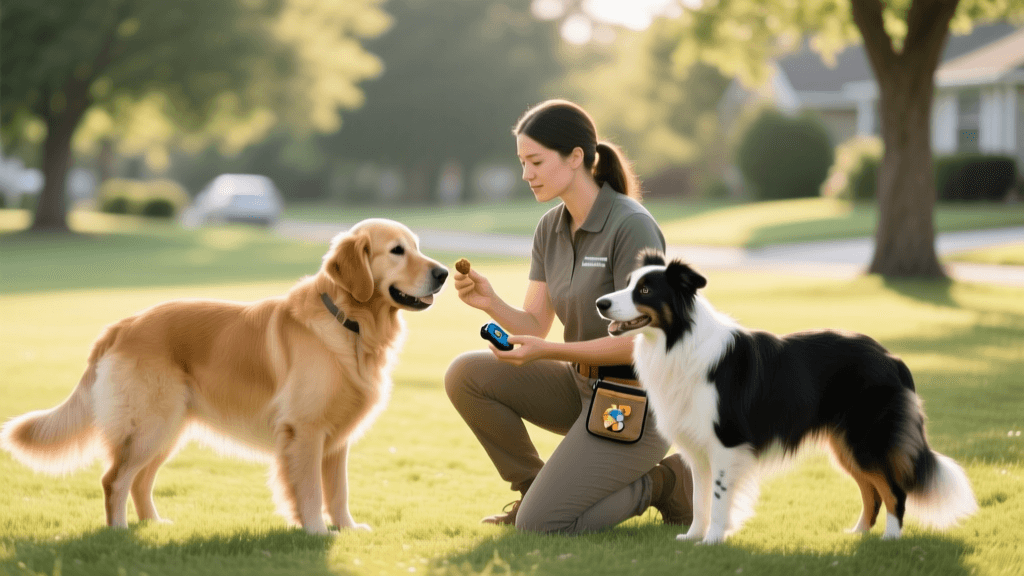
Counter-conditioning (CC) and desensitisation (DS) are almost always used together, which is why practitioners refer to the combined protocol as CC&DS. Desensitisation means exposing the dog to the trigger at an intensity low enough that no fear or arousal response occurs. Counter-conditioning means pairing that low-level exposure with something highly positive — typically a high-value food reward — so the dog begins to associate the trigger with good things.
A practical starting point: if your dog reacts at 10 metres, begin working at 20 metres. The moment your dog notices the other dog, mark with a clicker or a verbal marker such as "yes," and deliver a treat within 1.3 seconds. That timing window is critical. Research cited by the Certification Council for Professional Dog Trainers (CCPDT, 2021) indicates that a reinforcer delivered more than 1.5 seconds after the target behaviour loses much of its associative power, particularly in early training stages.
The Look at That Game
Developed by Leslie McDevitt and described in her book Control Unleashed, the Look at That (LAT) game teaches dogs to orient toward a trigger and then voluntarily look back at the handler. The sequence is simple: dog looks at the other dog, handler marks and rewards, dog looks back at handler to collect the reward. Over 15 to 20 repetitions across multiple sessions, the dog learns that noticing another dog is the behaviour that earns reinforcement, which fundamentally changes the emotional valence of the trigger.
The LAT game is particularly effective because it gives the dog agency. Rather than being forced to ignore something that feels significant, the dog is allowed to acknowledge it and is rewarded for doing so calmly. Most dogs show measurable improvement — reduced muscle tension, softer eyes, voluntary check-ins with the handler — within 3 to 5 sessions of 5 minutes each when the distance is correctly managed.
Building a Foundation of Calm Behaviours
Reactive training is not only about managing the trigger. It also requires building a repertoire of calm, incompatible behaviours that the dog can perform instead of reacting. The three most useful foundation behaviours are a reliable sit-stay, a hand target, and a default eye contact behaviour.
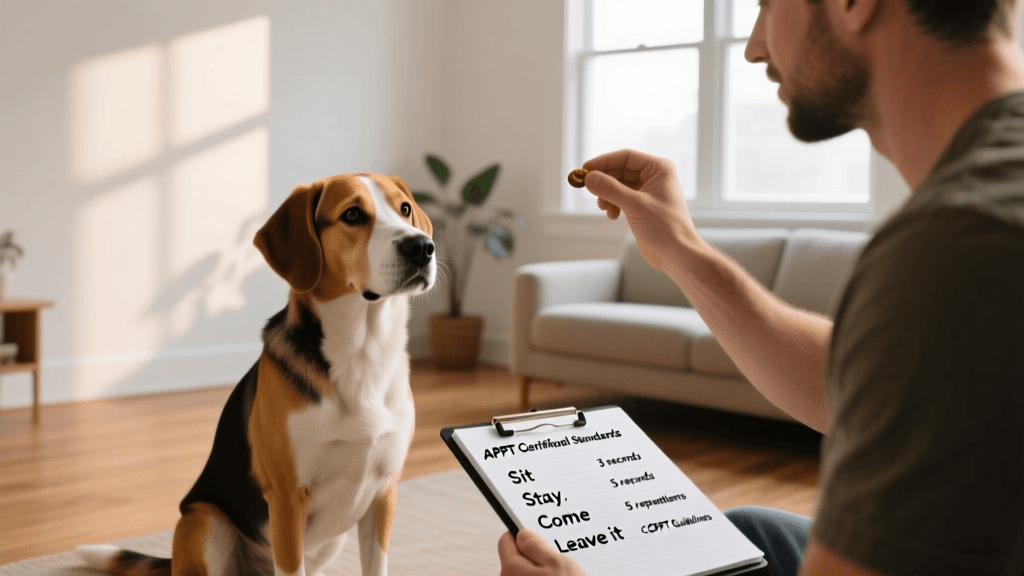
- Sit-stay: Train in low-distraction environments first. Build duration in 3-second increments, rewarding at the end of each interval. Aim for a 30-second sit-stay in a quiet room before introducing any dog-related distractions.
- Hand target (touch): Hold your flat palm 5 to 10 centimetres from your dog's nose. When the dog touches it, mark and reward. This behaviour is useful for redirecting attention mid-walk and can interrupt the early stages of a reactive response.
- Default eye contact: Reward any moment your dog voluntarily looks at your face. Over time, this becomes the dog's default response to uncertainty — look at the human rather than fixate on the trigger.
- Relaxation protocol: Dr. Karen Overall's Relaxation Protocol, developed at the University of Pennsylvania's School of Veterinary Medicine, uses a structured series of 15 daily tasks to teach dogs to remain calm while the handler moves, makes noise, or introduces mild distractions. It is freely available and widely recommended by certified trainers.
- Loose-leash walking: A tight leash communicates tension to the dog and physically prevents the natural calming signals dogs use with each other. Train loose-leash walking as a separate skill before attempting to walk past other dogs.
Timing and Repetition Guidelines
Consistency in timing and session structure is what separates training that works from training that stalls. Keep sessions short — 5 minutes is sufficient for reactive dogs, as arousal accumulates across a session and a dog that is over-threshold cannot learn. Aim for 2 to 3 sessions per day rather than one long session. Research from the Animal Behaviour and Cognition journal (2019) found that dogs trained in multiple short sessions showed 34% faster acquisition of new behaviours compared to dogs trained in single longer sessions of equivalent total duration.
End every session on a success. If your dog is struggling, reduce the difficulty — increase distance, reduce the number of dogs visible, or switch to a simpler behaviour. A session that ends with the dog calm and engaged is far more valuable than one that ends in a reactive outburst.
Practical Training Protocols for Real-World Situations
Controlled training environments are essential in the early stages, but the goal is always generalisation to real-world contexts. The following table outlines a progressive training plan across four stages, with approximate timelines and criteria for moving forward.
"Behaviour change is not linear. Dogs will have good days and bad days, and a single difficult walk does not erase weeks of progress. The trainer's job is to manage the environment well enough that difficult walks happen as rarely as possible." — Dr. Sophia Yin, Veterinary Behaviourist, Low Stress Handling University
| Stage | Environment | Distance from Trigger | Criterion to Progress | Typical Duration |
|---|---|---|---|---|
| 1 — Foundation | Home, garden | No dogs present | Reliable sit-stay (30 sec), hand target, eye contact | 1–2 weeks |
| 2 — Sub-threshold exposure | Quiet park, low traffic | 20+ metres | Dog notices trigger, looks back at handler without prompting, 8/10 trials | 2–4 weeks |
| 3 — Closer proximity | Moderate traffic area | 10–15 metres | Loose leash maintained, no vocalisation, 8/10 trials | 3–6 weeks |
| 4 — Generalisation | Varied environments | 5–10 metres | Dog can pass another dog on a loose leash with a single cue | Ongoing |
Moving through these stages too quickly is the most common mistake owners make. If your dog fails the criterion for a stage more than twice in a row, return to the previous stage rather than pushing forward. Flooding — forcing a dog to remain in the presence of a trigger until it stops reacting — is not only ineffective but can significantly worsen reactivity and damage the dog-owner relationship. The APDT explicitly advises against flooding and any training method that relies on fear, pain, or intimidation.
Managing the Environment Between Sessions
Training sessions are only part of the picture. What happens between sessions — every walk, every encounter, every moment your dog is exposed to other dogs — either reinforces your training or undermines it. Management is not a failure of training; it is a necessary component of it.
Use physical distance as your primary management tool. Cross the street, turn around, or step behind a parked car when another dog appears unexpectedly. A yellow ribbon or bandana on the leash, part of the Yellow Dog Project initiative, signals to other owners that your dog needs space. While not universally recognised, it reduces the number of well-meaning strangers who allow their dogs to rush yours.
Avoid dog parks entirely during the training process. Dog parks are high-arousal, unpredictable environments where you have no control over the distance or behaviour of other dogs. A single bad experience in a dog park can set back weeks of careful counter-conditioning work. The Battersea Dogs and Cats Home in London, one of the UK's most respected animal welfare organisations, recommends that reactive dogs avoid off-leash dog parks until they have demonstrated reliable calm behaviour in controlled settings for a minimum of 8 weeks.
- Walk during off-peak hours — early morning or late evening — when fewer dogs are likely to be present.
- Choose routes with good sightlines so you can spot other dogs at a distance and create space before your dog notices them.
- Carry high-value treats on every walk, not just during formal training sessions. Consistency is what builds the association.
- Communicate with other owners. A simple "my dog is in training, please give us space" is usually enough to prevent unwanted approaches.
- Use a well-fitted front-clip harness rather than a collar or back-clip harness. Front-clip harnesses reduce pulling by approximately 50% in most dogs, according to a 2018 study published in the Journal of Veterinary Behavior, and prevent the tracheal pressure that can increase arousal and stress.
When to Seek Professional Help
Self-directed training works well for mild to moderate reactivity, but some dogs need professional support. If your dog has made contact with another dog and caused injury, if the reactivity is escalating despite consistent training, or if you are feeling unsafe on walks, consult a certified professional. Look for trainers who hold credentials from the CCPDT (Certified Professional Dog Trainer — Knowledge and Skills Assessed) or the International Association of Animal Behavior Consultants (IAABC). Both organisations require demonstrated knowledge of learning theory and adherence to a code of ethics that prohibits the use of aversive methods.
A veterinary behaviourist — a veterinarian with a board-certified speciality in behaviour — may also be appropriate if there is a possibility that the reactivity has a medical component. Thyroid dysfunction, chronic pain, and neurological conditions can all manifest as increased reactivity or aggression. The American College of Veterinary Behaviorists (ACVB) maintains a directory of board-certified specialists across the United States and can be a useful starting point for owners whose dogs have not responded to standard training approaches.
Progress in reactive dog training is measured in months, not days. The dogs that make the most lasting improvement are those whose owners commit to consistent, low-pressure training, manage the environment carefully between sessions, and resist the urge to rush the process. Every calm moment your dog experiences around another dog is a deposit in a long-term account — and over time, those deposits add up to a dog that can move through the world with confidence rather than fear.
Aaron Whyte
All our authors care for dogs every day — read more of their work on the authors page.