How To Teach A Dog To Sit And Stay
Learn about how to teach a dog to sit and stay with expert tips and data-backed advice.
The Science Behind Sit and Stay
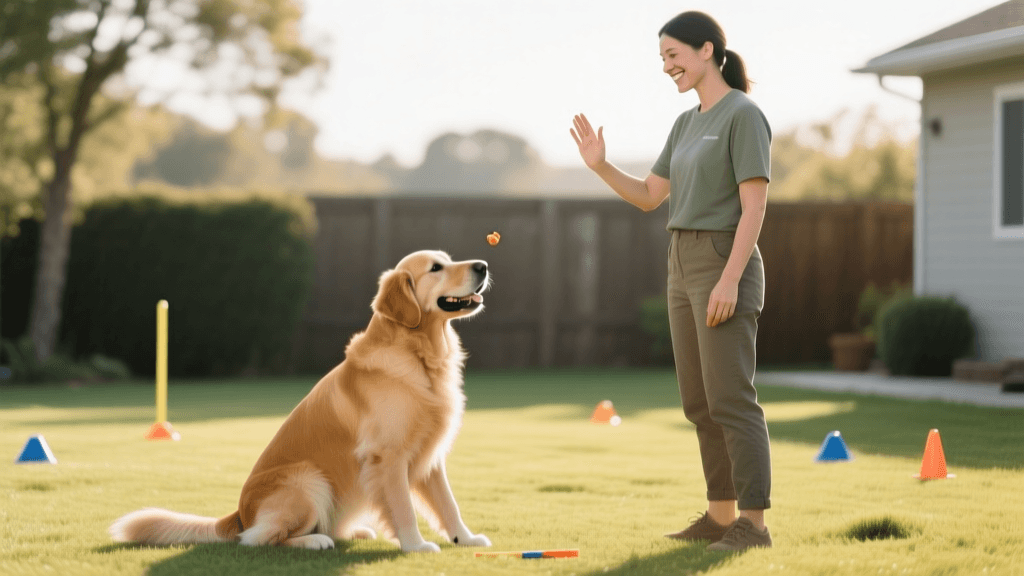
Teaching a dog to sit and stay on cue is one of the most practical skills you can build with your pet. These two behaviours form the foundation of impulse control and are prerequisites for dozens of more advanced exercises. More importantly, they keep dogs safe — a reliable stay can prevent a dog from bolting into traffic or jumping on a child. The good news is that the underlying science is well understood, and with consistent application of positive reinforcement principles, most dogs can learn a solid sit-stay within two to three weeks of daily practice.
Operant conditioning, first described systematically by B.F. Skinner at Harvard University in the 1930s and 1940s, explains how animals learn through consequences. When a behaviour is followed by something the animal values — food, play, praise — that behaviour becomes more likely to occur again. This is positive reinforcement, and it is the mechanism behind every technique described here. The Association of Pet Dog Trainers (APDT), founded in 1993, and the Certification Council for Professional Dog Trainers (CCPDT), established in 2001, both endorse reward-based methods as the most effective and humane approach to companion dog training.
Equipment and Preparation
Before your first session, gather a few essentials. You need small, soft, high-value treats — pieces no larger than 0.5 cm (roughly the size of a pea) work best because they are consumed quickly and do not distract the dog for long. A clicker or a consistent verbal marker such as "yes" will help you communicate the exact moment the correct behaviour occurs. A flat collar or well-fitted harness and a standard 1.8-metre (6-foot) lead complete the kit.
Choose a low-distraction environment for early sessions. Your living room or a quiet garden is ideal. Dogs generalise poorly at first — a behaviour learned in the kitchen may not transfer immediately to the park, which is why the CCPDT's Handbook for Professional Dog Trainers (2022) recommends beginning all new behaviours in the least stimulating environment available before gradually adding distractions.
Keep sessions short. Research published by the Animal Cognition journal suggests that dogs show diminishing returns in learning tasks after approximately 5 minutes of continuous training. Aim for three to five sessions per day, each lasting no more than 3 to 5 minutes, rather than one long session.
Teaching the Sit
The Lure Method
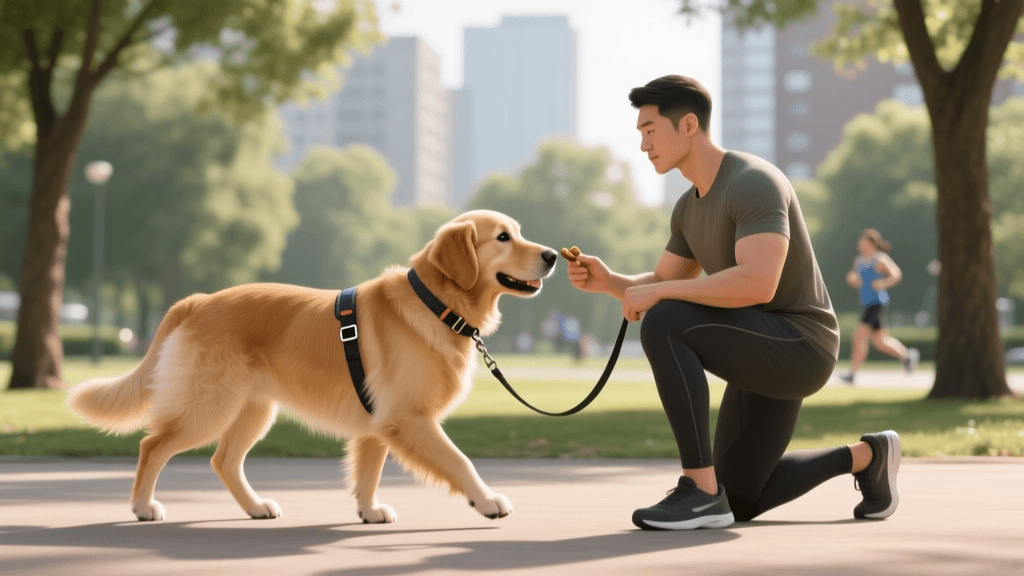
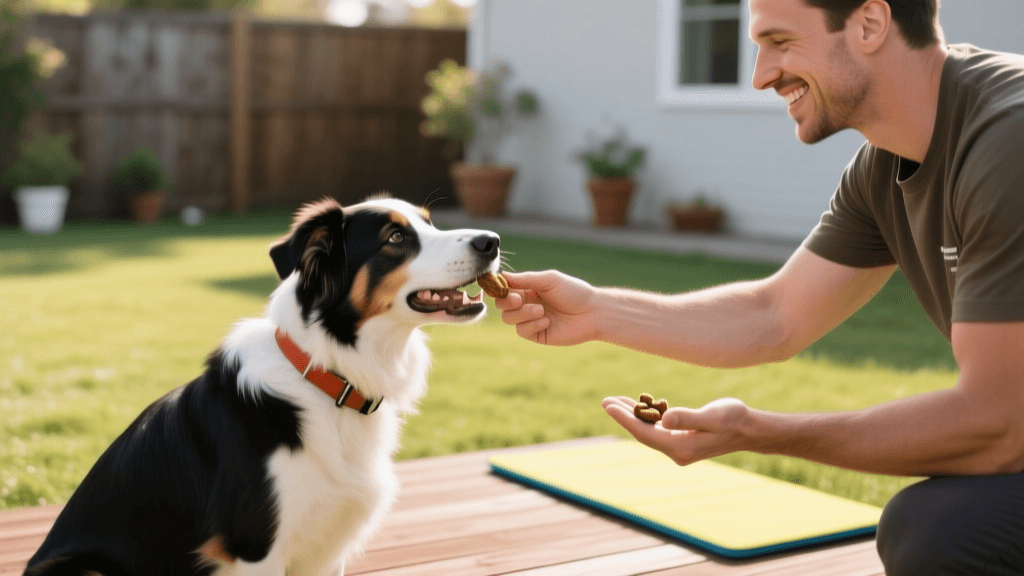
Hold a treat between your thumb and forefinger and let your dog sniff it. Slowly move the treat from the dog's nose upward and slightly back over the top of the head. As the nose follows the treat upward, the hindquarters naturally lower toward the floor. The moment the dog's bottom touches the ground, mark the behaviour with your clicker or verbal marker and immediately deliver the treat.
Repeat this sequence 5 to 10 times per session. Most dogs begin to anticipate the movement and sit faster with each repetition. Once the dog is sitting reliably on the lure — typically within 2 to 3 sessions — begin fading the food from your hand. Make the same hand gesture but with an empty hand, and reward from your other hand or a treat pouch after the sit occurs.
Adding the Verbal Cue
Introduce the word "sit" only after the dog is performing the behaviour consistently in response to the hand signal. Say "sit" once, in a calm, clear tone, just before you give the hand signal. Over 10 to 15 repetitions, the dog begins to associate the word with the action. Avoid repeating the cue multiple times — saying "sit, sit, sit" teaches the dog that the first cue can be ignored.
A common benchmark used by trainers affiliated with the APDT is the 80 percent rule: once a dog responds correctly 8 out of 10 trials in a given environment, the behaviour is considered reliable enough to move to the next stage or a new environment.
Troubleshooting Common Sit Problems
If your dog jumps up instead of sitting when you raise the treat, you are likely holding the treat too high. Keep it just 2 to 3 cm above the dog's nose. If the dog backs up rather than sitting, practise with the dog's hindquarters near a wall or sofa so there is nowhere to retreat. If the dog sits but immediately pops back up, you are probably delivering the treat too slowly — work on your timing so the reward arrives within 1 second of the sit.
Building the Stay
Stay is not a separate behaviour so much as an extension of sit. You are teaching the dog that "sit" means "sit until I release you," and "stay" is a reminder cue that reinforces that expectation. The three components of a reliable stay are duration (how long), distance (how far away you move), and distraction (what is happening in the environment). Train each component separately before combining them.
Begin with duration. Ask for a sit, wait 1 second, mark and reward. Then ask for a sit, wait 2 seconds, mark and reward. Build in increments of 1 to 2 seconds over multiple sessions. A realistic goal for the end of the first week is a 10-second stay with you standing directly in front of the dog. By the end of week two, most dogs can hold a stay for 30 seconds.
Once you have a 10-second stay, introduce the verbal cue "stay" as you take one small step backward. Return to the dog, mark, and reward. Do not call the dog to you at this stage — always return to the dog to deliver the reward. This prevents the dog from anticipating a recall and breaking the stay early.
Distance, Duration, and Distraction: The Three D's
The Three D's framework is widely taught at institutions including the Karen Pryor Academy in Sunshine, Maryland, and forms the backbone of stay training curricula at many CCPDT-certified training programmes. The key rule is: never increase more than one D at a time.
| Training Stage | Duration Target | Distance Target | Distraction Level |
|---|---|---|---|
| Week 1 | 10 seconds | 0 metres (handler beside dog) | None (quiet indoor space) |
| Week 2 | 30 seconds | 1–2 metres | Mild (handler moving around) |
| Week 3 | 60 seconds | 3–5 metres | Moderate (another person in room) |
| Week 4+ | 2+ minutes | Out of sight briefly | High (outdoor environments) |
If the dog breaks the stay at any point, calmly return to the last distance and duration at which the dog was successful. Do not punish the break — simply reset and make the exercise easier. Breaking the stay is information: it tells you that you increased difficulty too quickly.
Proofing and Generalisation
A stay that only works in your living room is of limited practical value. Proofing means systematically exposing the dog to new environments, people, sounds, and movement while maintaining the stay behaviour. Start with mild distractions — a family member walking through the room — before progressing to outdoor settings like a quiet car park, then a busy park.
The Victoria Stilwell Academy for Dog Training and Behaviour, based in Atlanta, Georgia, recommends what trainers call "set-ups": deliberately engineered scenarios that mimic real-life distractions in a controlled way. For example, have a helper drop a toy 3 metres away while the dog holds a stay. If the dog remains in position, jackpot reward with 5 to 10 small treats delivered rapidly. If the dog breaks, note the distraction level and work below it next time.
Generalisation also means practising with different people giving the cues. A dog that only responds to one handler has not fully learned the behaviour — it has learned to respond to that specific person. Ask family members, friends, and eventually strangers (in controlled settings) to ask for sits and stays so the dog learns the cues are universal.
Reinforcement Schedules and Long-Term Maintenance
Once a behaviour is well established, you do not need to reward every single repetition. Switching to a variable ratio reinforcement schedule — rewarding unpredictably, sometimes after 1 repetition, sometimes after 5 — actually makes behaviours more resistant to extinction. Slot machines operate on this principle, and it works equally well in dog training.
That said, never let a behaviour go unrewarded for so long that it deteriorates. A practical approach is to reward every sit-stay during formal training sessions but use life rewards — opening a door, putting on a lead, releasing to play — as reinforcement during everyday interactions. Asking for a sit before meals, before going outside, and before greeting visitors keeps the behaviour sharp without requiring a treat pouch at all times.
- Reward every correct response during the initial learning phase (first 1 to 2 weeks).
- Transition to rewarding approximately 70 percent of correct responses once the behaviour is reliable.
- Use life rewards (access to things the dog wants) as reinforcement in daily routines.
- Return to a higher rate of reinforcement any time you increase difficulty or change environments.
- Conduct a brief "refresher" session once a week even after the behaviour is fully proofed.
According to the APDT's Position Statement on Humane and Effective Training (2019), trainers should use "the least intrusive, minimally aversive" techniques that are effective. Positive reinforcement not only meets this standard but produces dogs that are more engaged, more willing to offer behaviours, and less likely to develop anxiety or aggression compared to dogs trained with punishment-based methods.
Common Mistakes and How to Avoid Them
One of the most frequent errors is asking for a stay and then calling the dog out of it. This teaches the dog that "stay" predicts a recall, which causes anticipatory breaking. Always return to the dog to end the stay, at least during the learning phase. Once the stay is solid, you can occasionally release the dog with a recall, but keep this unpredictable so the dog does not begin to anticipate it.
Another mistake is using the stay cue as a punishment — telling the dog to "stay" in a frustrated tone when it is being difficult. Cues should always predict good things. If you find yourself using "stay" in an irritated voice, take a break and return to training when you are calm.
- Repeating cues: Say the cue once and wait. If the dog does not respond, assess whether the environment is too distracting or the behaviour needs more practice, rather than repeating the word.
- Increasing difficulty too fast: Follow the Three D's rule and only change one variable at a time.
- Ending sessions on failure: If the dog makes an error, simplify the task so you can end on a successful repetition.
- Inconsistent release cues: Choose one release word — "free," "okay," or "release" — and use it consistently so the dog knows exactly when the stay is over.
- Skipping generalisation: A behaviour is not truly learned until it works in multiple environments with multiple handlers.
Training sit and stay is ultimately about building a shared language with your dog. Every successful repetition strengthens the neural pathways associated with the behaviour, and every calm, patient session deepens the trust between you and your animal. The investment of 15 minutes a day across three to four weeks produces a dog that is safer, calmer, and genuinely more enjoyable to live with — and that is a return worth every treat in the bag.
Priya Sutaria
All our authors care for dogs every day — read more of their work on the authors page.