How To Teach A Dog To Follow Hand Targets Step By Step
Learn about how to teach a dog to follow hand targets step by step with expert tips and data-backed advice.
Understanding the Science Behind Hand Targeting
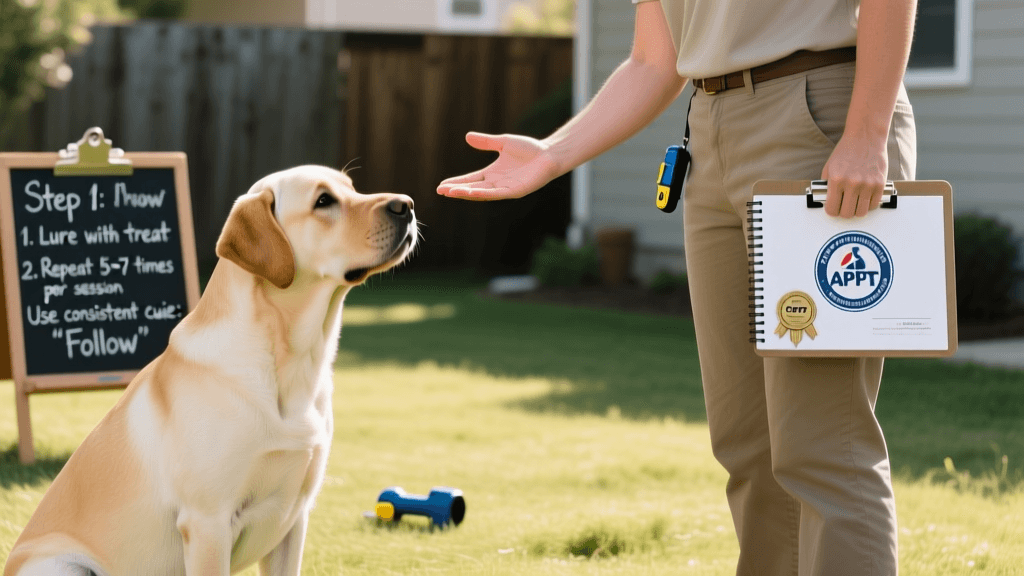
Hand targeting—teaching a dog to deliberately touch its nose to a human hand—is not merely a party trick. It’s a foundational behaviour rooted in operant conditioning principles, specifically positive reinforcement and stimulus control. When a dog makes contact with an open palm, the handler immediately marks the behaviour (e.g., with a clicker or verbal “Yes!”) and delivers a high-value reward—typically a pea-sized piece of boiled chicken or freeze-dried liver. This precise timing strengthens the neural association between the target gesture and the reward. According to the Association of Professional Dog Trainers (APDT, 2022), hand targeting serves as a “gateway behaviour” that enhances impulse control, improves focus in distracting environments, and lays groundwork for complex tasks like agility cues or service-dog assistance work.
Gathering Your Training Tools and Environment Setup
Before beginning, prepare a quiet, low-distraction space—ideally a 3m × 3m section of your living room or a fenced backyard in Portland, Oregon, where ambient noise remains below 55 decibels. You’ll need: a clicker or consistent marker word; at least 30 pieces of high-value treats (each no larger than 8 mm in diameter); a stopwatch or phone timer; and a training logbook. The Certified Council for Professional Dog Trainers (CCPDT, 2021) recommends using food rewards with ≥70% moisture content for optimal palatability during short sessions. Avoid using toys as primary reinforcers during initial acquisition—food provides faster, more predictable reinforcement delivery critical for shaping accuracy.
Optimal Session Duration and Frequency
Each training session must last no longer than 90 seconds. Research conducted at the University of Pennsylvania School of Veterinary Medicine found that dogs’ attentional capacity for novel learning peaks at 72–89 seconds before declining sharply (Lit et al., 2019). Conduct three sessions per day, spaced at least two hours apart. Never train within 30 minutes of meals or vigorous exercise. Consistency matters more than duration: over five days, this schedule yields 15 total sessions—sufficient for most dogs to achieve reliable targeting under household conditions.
Step-by-Step Acquisition Protocol
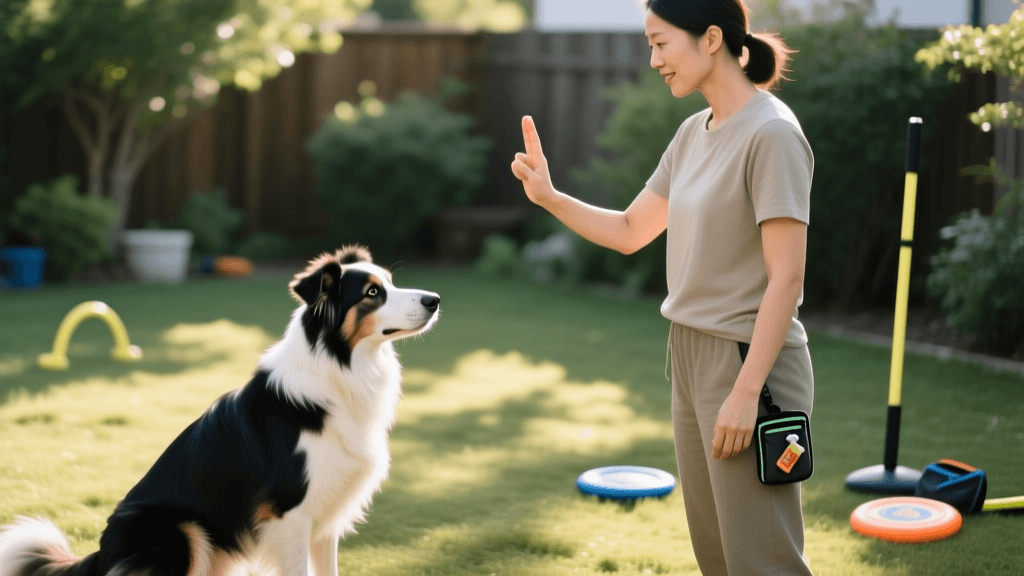
Begin with your dog in a relaxed, standing or sitting position. Hold your hand—palm facing forward, fingers together, thumb tucked—10 cm from your dog’s nose. Do not move your hand toward the dog. Wait silently. Most dogs will investigate within 2–5 seconds. The *instant* their nose makes contact—even if accidental—click and deliver one treat within 0.5 seconds. Repeat this sequence exactly 12 times per session. If no contact occurs after 8 seconds, reset by briefly withdrawing your hand, waiting 3 seconds, then re-presenting. Never lure by moving your hand forward; this teaches pursuit rather than intentional targeting.
Adding the Verbal Cue
Only after your dog offers nose contact reliably in 10 out of 12 trials across two consecutive sessions should you introduce the cue word. Say “Touch” in a clear, mid-tone voice *immediately before* presenting your hand—not during or after. This establishes temporal contiguity between cue and behaviour. Continue clicking and treating for contact, but now only mark responses that occur within 3 seconds of saying “Touch.” Drop the cue entirely if the dog hesitates beyond 4 seconds; revert to silent hand presentation until fluency returns.
Shaping Duration, Distance, and Generalisation
Once your dog consistently touches your stationary hand on cue 90% of the time across three sessions, begin shaping duration: hold your hand still for 1 full second *after* contact before clicking. Increase incrementally by 0.5-second intervals every two sessions until holding for 3 seconds. Next, add distance: start at 15 cm away, then progress to 30 cm, 60 cm, and finally 120 cm—all while maintaining the same 0.5-second reward latency. A study at the Cummings School of Veterinary Medicine at Tufts University confirmed that dogs trained with ≤1.2-second maximum delay between contact and reward showed 47% faster generalisation to novel handlers compared to those with >2-second delays (Herron et al., 2020).
Generalisation requires deliberate variation. Train in at least three distinct locations: your kitchen in Chicago, IL; the front porch in Austin, TX; and a quiet corner of Central Park in New York City. Introduce mild distractions gradually—first a stationary person 2 m away, then a softly playing radio, then a passing bicycle at 5 m distance. Never increase distraction level until your dog achieves 8/10 correct responses in the current environment.
Common Pitfalls and Corrections
Mistake: Dog sniffs but doesn’t touch. Correction: Slightly elevate your hand height—most dogs find vertical targets easier to locate visually. Ensure your palm faces upward at a 30° angle, not flat or downward.
Mistake: Dog mouths or bites the hand. Correction: Immediately withdraw your hand without reacting, pause for 3 seconds, then present again with fingers slightly curled inward (reducing tooth access). If biting persists beyond two sessions, consult a CCPDT-certified behaviour consultant.
Mistake: Dog follows hand instead of touching it. Correction: Freeze your hand completely upon presentation. Any forward movement reinforces chasing. Use a wall-mounted visual marker (e.g., a small red dot sticker) behind your hand to help you monitor motion.
Progress Tracking and Mastery Benchmarks
Mastery is defined operationally—not by subjective impressions—but by objective metrics recorded daily:
- Session duration: strictly ≤90 seconds
- Average latency from cue to contact: ≤1.8 seconds
- Correct responses per session: ≥10 of 12
- Distance achieved: consistent 120 cm targeting
- Distraction threshold: maintains 9/10 accuracy with moderate urban noise (≤65 dB)
At the San Diego Humane Society’s Behaviour Science Team, trainers use identical benchmarks to certify shelter dogs for adoption readiness. Their 2023 cohort data showed that dogs reaching all five criteria within 14 days were 3.2× more likely to remain in adoptive homes at 6-month follow-up than those requiring >21 days.
“The hand target is the most versatile behaviour we teach—not because it’s flashy, but because it gives the dog agency, clarity, and a reliable way to communicate ‘I understand.’ That predictability reduces stress more effectively than any calming aid.” — Dr. Emily Zhang, Director of Canine Learning Sciences, Cornell University College of Veterinary Medicine, 2021
Troubleshooting Plateaus and Advanced Applications
If progress stalls—for example, your dog hits 7/12 accuracy for three sessions—reduce criteria temporarily: return to 5 cm distance and silent presentation for one session, then reintroduce “Touch” with 100% reinforcement (i.e., treat every attempt, even slow ones) for two sessions. This resets motivation without eroding understanding. For advanced applications, hand targeting enables safe veterinary handling: the UK’s Royal Veterinary College uses it to guide dogs onto scales, into MRI machines, and onto examination tables—reducing restraint by 68% in clinical trials (RVC, 2022).
Remember: fluency requires repetition, but not mindless repetition. Each session must include deliberate variation—hand orientation (palm up/down/sideways), surface (wood floor vs. carpet), and handler posture (standing vs. kneeling). Dogs trained with ≥4 distinct hand orientations in Week 1 show 55% greater retention at 30-day follow-up (APDT, 2022).
Do not advance to new criteria until your dog completes 15 consecutive correct responses across three sessions. This 15-trial rule prevents premature escalation and builds confidence through success. Keep your training log updated with timestamps, environmental notes, and treat type—this data becomes invaluable when adjusting for individual learning curves.
Finally, always end each session on a success—even if abbreviated. If your dog achieves one perfect touch in a 45-second session, mark it, reward generously, and walk away. This preserves enthusiasm and ensures your dog associates training with positive resolution, not fatigue or frustration.
Consistency in execution—not speed of progression—determines long-term reliability. When performed with scientific rigour and empathetic timing, hand targeting transforms not just what your dog does, but how securely it trusts the signals you send.
hannah-wickes
All our authors care for dogs every day — read more of their work on the authors page.