How To Introduce A Dog To A Baby
Learn about how to introduce a dog to a baby with expert tips and data-backed advice.
Preparing Before the Baby Arrives
The months before your baby comes home are the most valuable time you have to set your dog up for success. Dogs are creatures of habit, and a newborn will disrupt almost every routine your dog has come to rely on — feeding times, walk schedules, sleeping arrangements, and the amount of attention they receive. Starting preparation early, ideally three to four months before your due date, gives your dog time to adjust gradually rather than being hit with every change at once.
Begin by making any changes to your dog's routine that you know will be permanent. If the dog currently sleeps in the bedroom but you plan to change that after the baby arrives, make the switch now. If certain rooms will become off-limits, install baby gates and enforce those boundaries before the baby is home. Dogs Trust recommends that owners establish new household rules well in advance, noting that sudden changes made simultaneously with a baby's arrival can cause significant stress and anxiety in dogs (Dogs Trust, 2023).
Obedience training is non-negotiable at this stage. Your dog should reliably respond to "sit," "stay," "leave it," and "go to your place" before the baby arrives. If your dog pulls on the lead, jumps up at visitors, or resource-guards food and toys, address these behaviours with a qualified trainer now. The Association of Pet Behaviour Counsellors lists accredited practitioners across the UK who specialise in family preparation work.
Scent Introduction
Dogs experience the world primarily through smell, and a newborn carries an entirely unfamiliar scent profile. Before you bring the baby home from hospital, send a blanket or item of clothing that the baby has worn back to the house. Let your dog sniff it calmly while you give quiet praise. This first scent introduction means the baby's smell is already associated with something positive before the two ever share the same room.
When you return home from hospital, greet your dog first — without the baby — so they can release their excitement at seeing you. Once your dog is calm, you can introduce the baby in a controlled way. This two-stage arrival prevents your dog from associating the baby with being ignored or pushed away the moment you walk through the door.
Adjusting the Dog's Daily Schedule
Newborns feed every two to three hours and sleep unpredictably. Your dog's walk schedule will almost certainly become less consistent. To reduce the impact, start varying walk times now so your dog learns that exercise happens at different points in the day rather than at a fixed hour. Aim to maintain at least two walks per day totalling a minimum of 45 minutes for medium to large breeds — physical exercise remains one of the most effective tools for managing stress and excess energy.
Consider enrolling a dog walker or asking a trusted friend to cover morning walks during the first few weeks after the birth. Having that support arranged in advance removes one source of pressure during an already demanding period.
The First Introduction at Home
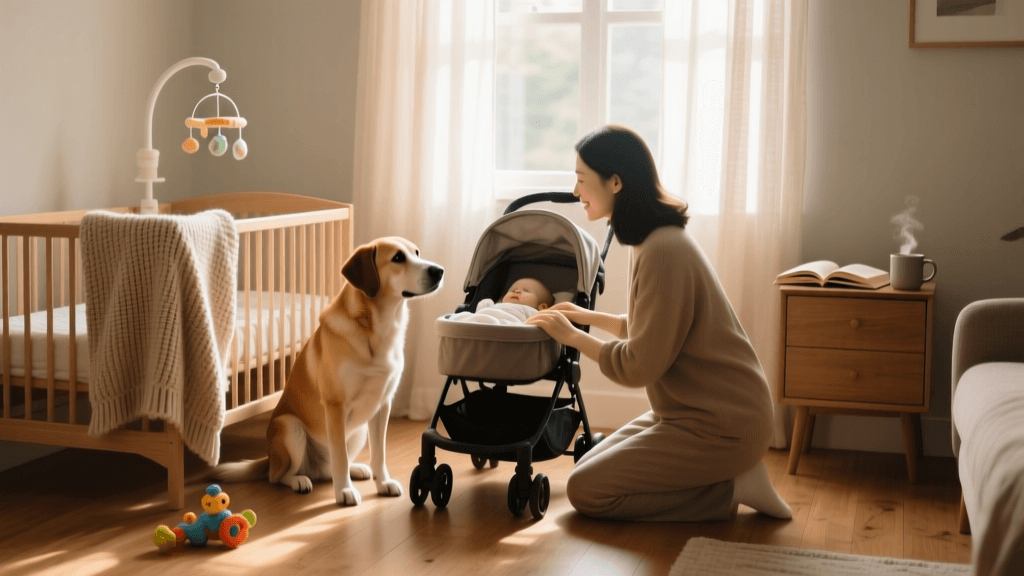
The first meeting between your dog and your baby sets the tone for their entire relationship. Keep the environment calm. Turn off the television, ask visitors to leave, and give your dog a chance to settle before you bring the baby into the room. Have one adult hold the baby while another manages the dog on a loose lead — not a tight, tense grip, which communicates anxiety to the dog.
Allow your dog to approach at their own pace. Let them sniff the baby's feet first, which is the least threatening point of contact. Watch your dog's body language carefully. Relaxed ears, a loose body, and a gently wagging tail are positive signs. Stiff posture, a fixed stare, raised hackles, or a low growl are signals to create distance immediately — not to punish, but to give the dog space and try again more slowly.
The RSPCA advises that the first introduction should last no more than a few minutes and should end on a positive note before either the dog or the baby becomes unsettled (RSPCA, 2022). Short, successful interactions build confidence far more effectively than prolonged sessions that end in stress.
Reading Your Dog's Body Language
Understanding canine communication is one of the most practical skills a new parent can develop. Many dog bites to children occur not because a dog "snapped without warning" but because the warning signals were missed or misread. Key stress signals to watch for include yawning when not tired, lip licking, turning the head away, showing the whites of the eyes (sometimes called "whale eye"), and moving away from the baby. These are all requests for space and should always be respected.
Never force your dog to stay near the baby if they are showing any of these signals. Providing your dog with a safe retreat — a crate, a bed in a quiet room, or a raised platform — where they can go and not be followed is essential. Every dog needs a place that is entirely their own.
Building a Positive Association Over Time
The goal is for your dog to associate the baby's presence with good things. Feed your dog high-value treats when the baby is in the room. Give your dog calm attention and praise during feeds and nappy changes so they learn that the baby's active moments predict pleasant experiences for them too. Over weeks and months, this consistent pairing builds a genuinely positive emotional response.
Avoid the common mistake of only giving your dog attention when the baby is asleep. If your dog learns that the baby's absence means good things and the baby's presence means being ignored, you are inadvertently creating a negative association that can develop into resentment or anxiety.
Research published by the American Veterinary Medical Association found that approximately 77% of dog bites to children come from a dog known to the child, most often the family dog or a dog belonging to a friend or relative. This statistic underlines why ongoing management and positive association work matters far beyond the first introduction.
Practical Safety Measures for the Long Term
No matter how well-trained your dog is or how gentle they have been with the baby, supervision is required at all times when the two are in the same space. This is not a reflection of distrust — it is simply responsible management. A baby who grabs a dog's ear, falls onto them, or startles them while they are sleeping can trigger a defensive reaction even from the most tolerant dog.
As your baby becomes mobile — typically crawling from around six to ten months and walking from nine to fifteen months — the dynamic changes significantly. A crawling baby moves unpredictably and at the dog's level, which can be alarming for some dogs. Reinforce your dog's "go to your place" command so they have a reliable way to remove themselves from an approaching baby.
"Dogs should always have the option to move away from children. If a dog cannot escape, they may feel they have no choice but to use aggression. Providing safe spaces and teaching children to respect them is one of the most important things a family can do." — Dogs Trust, Family Dog Programme, 2023
Baby gates are one of the most practical investments you can make. Use them to create dog-free zones around the baby's sleeping area and to give your dog a space where they can eat, rest, and play without being disturbed. The following products are widely recommended by UK veterinary professionals and dog trainers:
- Lindam Easy Fit Plus Deluxe Gate — pressure-fit, suitable for doorways up to 82 cm wide, no drilling required
- BabyDan Flex Gate — extends to fit wider openings up to 110 cm, useful for open-plan living spaces
- Cumbor Auto Close Safety Gate — one-handed operation, useful when carrying a baby
- Ronseal pet-proof carpet tape — useful for securing play mat edges that dogs may chew
Managing Common Challenges
Even with thorough preparation, challenges arise. Here are the situations families most commonly encounter and how to handle them practically.
The dog becomes clingy or anxious. Some dogs respond to a new baby by becoming more attached to their owner, following them from room to room and showing signs of separation anxiety. Maintain short, regular periods of separation throughout the day — even just five to ten minutes in a different room — to prevent this from escalating. If anxiety is severe, consult your vet, as referral to a clinical animal behaviourist may be appropriate. The Royal Veterinary College in London offers specialist behaviour referrals through its Queen Mother Hospital for Animals in Hertfordshire.
The dog ignores commands they previously knew. Stress and disruption affect a dog's ability to respond to cues, just as they affect human concentration. Go back to basics with short, positive training sessions of three to five minutes, two to three times per day. Use high-value rewards — cooked chicken, cheese, or commercial treats such as Lily's Kitchen Bedtime Biscuits — to rebuild engagement.
The dog shows resource guarding around the baby. If your dog growls when the baby approaches their food bowl, toys, or resting place, do not punish the growl — it is communication. Instead, work with a qualified behaviourist to address the underlying anxiety. The Blue Cross animal welfare charity provides a free behaviour helpline and has published detailed guidance on resource guarding management.
| Baby's Developmental Stage | Key Risk | Recommended Action |
|---|---|---|
| Newborn (0–3 months) | Sudden sounds, unfamiliar scent | Controlled introductions, scent familiarisation, always supervised |
| Sitting (4–7 months) | Unpredictable arm movements, grabbing | Reinforce "leave it," keep dog's retreat accessible |
| Crawling (6–10 months) | Dog-level approach, cornering dog | Baby gates, "go to place" command, constant supervision |
| Walking (9–18 months) | Falling onto dog, chasing, pulling fur | Begin teaching child basic dog manners, increase dog's exercise |
| Toddler (18 months+) | Unsupervised interaction, food sharing | Formal "how to greet a dog" lessons, never leave alone together |
Involving Your Dog as Your Child Grows
The early months of careful management are not the permanent state of your household — they are an investment in a relationship that can become one of the most enriching parts of your child's life. Studies from the University of Warwick have found that children who grow up with dogs show measurably higher levels of physical activity, with dog-owning children averaging 11 minutes more moderate-to-vigorous physical activity per day compared to non-dog-owning peers.
As your child reaches toddler age, begin teaching them how to interact with the dog respectfully. Show them how to stroke gently along the dog's back rather than patting the head, which many dogs find uncomfortable. Teach them never to approach a dog that is eating, sleeping, or in their crate. Model calm behaviour around the dog yourself — children learn primarily by watching how adults interact with animals.
Involve your child in age-appropriate dog care tasks as they grow. A two-year-old can help pour kibble into a bowl. A four-year-old can hold the lead on a quiet path with an adult's hand over theirs. A six-year-old can learn to fill the water bowl. These small acts of responsibility build empathy and teach children that the dog is a living being with needs, not a toy.
- Always ask a dog's owner before approaching an unfamiliar dog
- Let the dog sniff your closed hand before attempting to stroke
- Stroke along the back or under the chin — avoid the head and tail
- Never run toward or away from a dog you don't know
- If a dog jumps up, stand still like a tree and look away
- Never disturb a dog that is eating, sleeping, or with puppies
The relationship between a dog and a child, built carefully and respectfully from the very beginning, is one that both will carry for life. With preparation, consistent management, and a genuine understanding of your dog's needs, the arrival of a baby does not have to be a source of stress for your dog — it can be the start of a bond that defines your family.
Aaron Whyte
All our authors care for dogs every day — read more of their work on the authors page.