How To Check Your Dog For Lumps And Bumps
Learn about how to check your dog for lumps and bumps with expert tips and data-backed advice.
Getting Started With Regular Lump Checks
Finding an unexpected lump on your dog can be alarming, but the good news is that many lumps and bumps are entirely benign. Lipomas, cysts, and warts are among the most common skin growths in dogs, and the majority cause no harm at all. That said, early detection of any abnormal growth gives your vet the best possible chance of successful treatment if something more serious is present. Building a monthly checking routine into your dog's life is one of the most practical things you can do for their long-term health.
The British Small Animal Veterinary Association (BSAVA, 2022) notes that skin tumours account for approximately 30–40% of all tumours diagnosed in dogs, making them the single most common tumour type seen in small animal practice. Of those, roughly half are malignant, which underscores the importance of not dismissing any new growth without professional assessment.
What You Are Looking For
Before you begin a physical check, it helps to understand what you are actually trying to find. Lumps and bumps on dogs fall into several broad categories: fatty lumps (lipomas), sebaceous cysts, warts (papillomas), abscesses, haematomas, and tumours — both benign and malignant. You cannot reliably distinguish between these by touch alone, but you can identify that something is present and track whether it changes over time.
Key characteristics to note when you find a lump include its size (measure in millimetres if possible), its location on the body, whether it moves freely under the skin or feels fixed to underlying tissue, its texture (soft, firm, or hard), whether the skin over it looks normal or is discoloured, and whether your dog reacts when you touch it. A lump that is fixed, hard, irregular in shape, or growing rapidly warrants prompt veterinary attention.
Normal Versus Abnormal Findings
Not every bump you feel will be a cause for concern. Dogs commonly develop small sebaceous cysts — blocked oil glands — that feel like firm peas just beneath the skin. Older dogs frequently develop lipomas, soft fatty deposits that move easily when pressed. The PDSA (2023) reports that lipomas are most prevalent in dogs over seven years of age and in overweight individuals, with Labrador Retrievers, Dobermanns, and Miniature Schnauzers among the breeds most commonly affected.
Abnormal findings that should prompt a same-week vet visit include any lump larger than 1 cm that was not present a month ago, any growth that has doubled in size within four weeks, ulcerated or bleeding skin over a lump, and any swelling around a lymph node — particularly under the jaw, in front of the shoulder, or behind the knee.
Lymph Node Locations To Know
Swollen lymph nodes can indicate infection, inflammation, or lymphoma. Familiarising yourself with where your dog's superficial lymph nodes sit makes it much easier to notice when one is enlarged. The main accessible nodes are:
- Submandibular nodes — beneath the lower jaw on each side
- Prescapular nodes — in front of each shoulder blade
- Axillary nodes — in the armpit area
- Inguinal nodes — in the groin, on the inner thigh
- Popliteal nodes — behind each knee joint
A healthy lymph node is small, smooth, and barely detectable. If you can feel one easily, or if it is larger than approximately 1–2 cm, mention it to your vet at the next opportunity — or sooner if your dog seems unwell.
How To Perform A Full Body Check
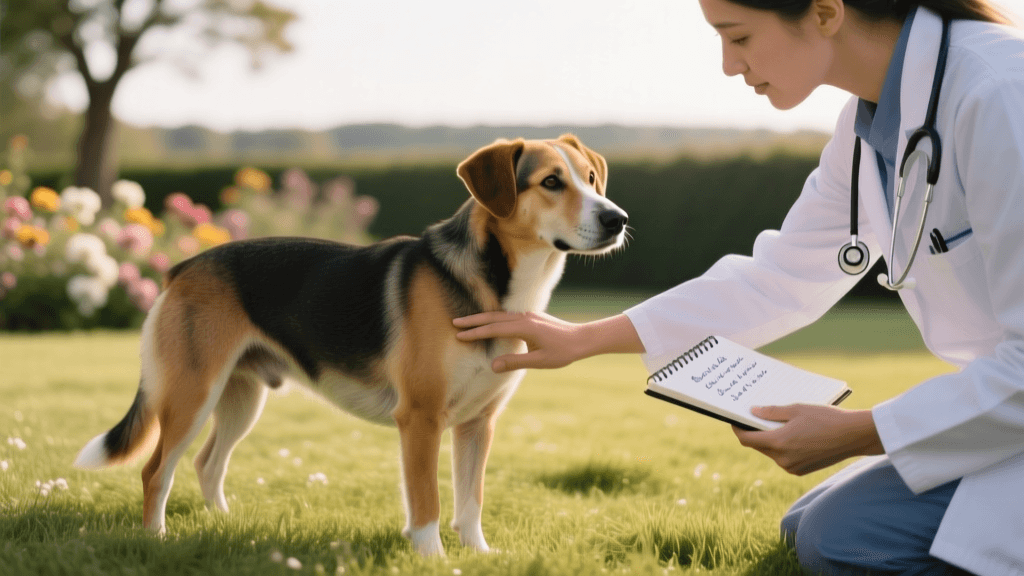
Choose a time when your dog is calm and relaxed — after a walk or a meal works well for most dogs. Sit on the floor with them or place a small dog on a non-slip surface at a comfortable height. Work systematically from nose to tail so you do not miss any area. The whole process should take around five to ten minutes once you are familiar with it.
Use the flat of your fingers rather than your fingertips, applying gentle but firm pressure. You are feeling for anything that was not there before: raised areas, thickened skin, soft pockets of fluid, or hard nodules. Part the fur as you go, especially in areas where the coat is thick, such as around the neck, chest, and hindquarters.
Step-By-Step Checking Sequence
- Head and neck: Run your hands over the muzzle, cheeks, and top of the skull. Feel along the jaw and check the submandibular lymph nodes. Gently palpate the throat and neck.
- Shoulders and front legs: Work down each leg from the shoulder to the paw, including between the toes and around the nail beds. Check the prescapular and axillary lymph nodes.
- Chest and abdomen: With your dog standing, run both hands along the ribcage and then the belly. Note any asymmetry or areas of firmness.
- Back and flanks: Stroke firmly along the spine and down each side. Pay attention to the skin over the hips, which is a common site for lipomas in older dogs.
- Hindquarters and back legs: Check the inguinal and popliteal lymph nodes. Feel down each back leg to the paw, again checking between the toes.
- Tail and perianal area: Run your hand along the tail and check the skin around the base. Perianal adenomas are relatively common in older unneutered male dogs.
Finish by checking inside the ears for any unusual swellings and lifting the lips to look at the gums and cheeks. Oral tumours are among the more frequently missed growths because owners rarely look inside the mouth during routine handling.
Recording What You Find
A written or photographic record is invaluable. When you find a lump, note the date, its location (use a simple body diagram if helpful), its approximate size in millimetres, and its texture. Photograph it if it is visible through the coat. Recheck it in two to four weeks. If it has grown by more than 20% in that time, contact your vet rather than waiting for the next routine appointment.
"Any new lump or bump should be assessed by a vet rather than monitored at home indefinitely. The only reliable way to determine whether a growth is benign or malignant is cytology or histopathology — visual inspection and palpation alone are not sufficient for diagnosis."
— BSAVA Guide to Skin Tumours in Dogs, 2022
Many veterinary practices, including those affiliated with the Royal Veterinary College in Hertfordshire and the University of Edinburgh's Royal (Dick) School of Veterinary Studies, offer nurse-led lump clinics where a veterinary nurse will assess a growth and advise whether it needs immediate investigation. These appointments are often shorter and less expensive than a full consultation and are an excellent first step if you are unsure whether a lump warrants concern.
What Happens At The Vet
When you bring your dog in for a lump assessment, the vet will first take a history — how long the lump has been present, whether it has changed, and whether your dog has shown any other symptoms such as weight loss, reduced appetite, or lethargy. They will then palpate the lump and the surrounding tissue.
The most common next step is a fine needle aspirate (FNA). This involves inserting a small needle into the lump to collect a sample of cells, which are then examined under a microscope. The procedure takes only a few seconds, requires no anaesthetic in most cases, and can provide a diagnosis on the same day if the practice has in-house cytology equipment. According to data published by the Veterinary Cancer Society, FNA provides a definitive or strongly suggestive diagnosis in approximately 70–80% of cases.
If the FNA result is inconclusive, or if the lump's characteristics suggest a more aggressive tumour, the vet may recommend surgical removal followed by histopathology — laboratory analysis of the excised tissue. This gives a definitive diagnosis and, crucially, confirms whether the surgical margins are clear, meaning whether all abnormal cells have been removed.
Breed-Specific Considerations And Risk Factors
Certain breeds carry a statistically higher risk of specific tumour types. Boxers, Boston Terriers, and Bull Mastiffs have elevated rates of mast cell tumours, which can appear as innocuous-looking raised bumps but behave unpredictably. Golden Retrievers have a lifetime cancer risk estimated at around 60%, significantly higher than the canine average of approximately 25–30%, according to the Morris Animal Foundation's Golden Retriever Lifetime Study (2023). Bernese Mountain Dogs are predisposed to histiocytic sarcoma, a particularly aggressive cancer.
Age is also a significant factor. Dogs over eight years old should be checked monthly without exception. Neutering status matters too: intact male dogs have a higher risk of perianal adenomas and testicular tumours, while intact females have an elevated risk of mammary tumours — a risk that drops substantially if spaying is performed before the second season.
| Lump Type | Typical Appearance | Common Breeds / Age Group | Urgency |
|---|---|---|---|
| Lipoma | Soft, moveable, smooth | Middle-aged to older dogs; Labradors, Schnauzers | Routine vet check |
| Sebaceous cyst | Firm, pea-sized, may discharge white material | Any breed; common in Cocker Spaniels | Routine vet check |
| Mast cell tumour | Variable; can look like any other lump | Boxers, Bull Terriers, Golden Retrievers | Prompt assessment within days |
| Abscess | Warm, painful, may be fluctuant | Any dog; often follows a bite or wound | Same-week vet visit |
| Mammary tumour | Firm nodule along mammary chain | Intact or late-spayed females over 6 years | Prompt assessment within days |
If your dog belongs to a high-risk breed, discuss a proactive monitoring plan with your vet. Some practices recommend six-monthly health checks rather than annual ones for dogs over seven, and this is a reasonable approach given the speed at which some tumours can progress.
The most important habit you can build is consistency. A monthly check that takes ten minutes is far more valuable than an occasional, thorough examination. You know your dog's body better than anyone, and that familiarity is your most powerful diagnostic tool. When something feels different, trust that instinct and get it checked.
Priya Sutaria
All our authors care for dogs every day — read more of their work on the authors page.