Top Trainable Puppy Breeds for Remote Workers in 2026
Discover the best trainable puppy breeds for remote workers in 2026. Learn home-office obedience, Zoom-call quiet cues, and desk-settle techniques.
The landscape of remote work has firmly evolved in 2026, with hybrid schedules and permanent work-from-home setups becoming the global standard. For dog lovers, this means the home office is now shared with a four-legged colleague. However, not every puppy is naturally suited for the quiet, focused environment of a home office. High-drive working breeds might demand attention during your most important virtual meetings, while vocal breeds can disrupt conference calls.
Choosing a highly trainable, adaptable breed—and implementing specific home-office obedience protocols—is the secret to maintaining productivity and keeping your puppy happy. In this guide, we explore the most trainable puppy breeds for remote workers and break down the exact behavioral conditioning techniques you need to master in 2026.
Why Breed Trainability Dictates Home Office Harmony
When you work from home, your dog's primary job is to 'settle.' Trainability in this context does not just mean the ability to learn flashy tricks; it refers to a dog's biddability (willingness to please), impulse control, and capacity for independent relaxation. Breeds that excel in home-office environments are those that can quickly grasp the 'Place' command, tolerate long periods of low stimulation, and remain quiet when the doorbell rings or a delivery drone drops off a package.
Furthermore, remote workers face a unique behavioral trap: separation anxiety. Because you are home 90% of the time, puppies can easily develop hyper-attachment. When you eventually need to return to a corporate office or run errands, this lack of independence training can lead to destructive behaviors. Therefore, the best breeds for remote workers are those that respond well to structured independence conditioning.
The Top 3 Most Trainable Breeds for Remote Professionals
1. Cavalier King Charles Spaniel (The Desk Companion)
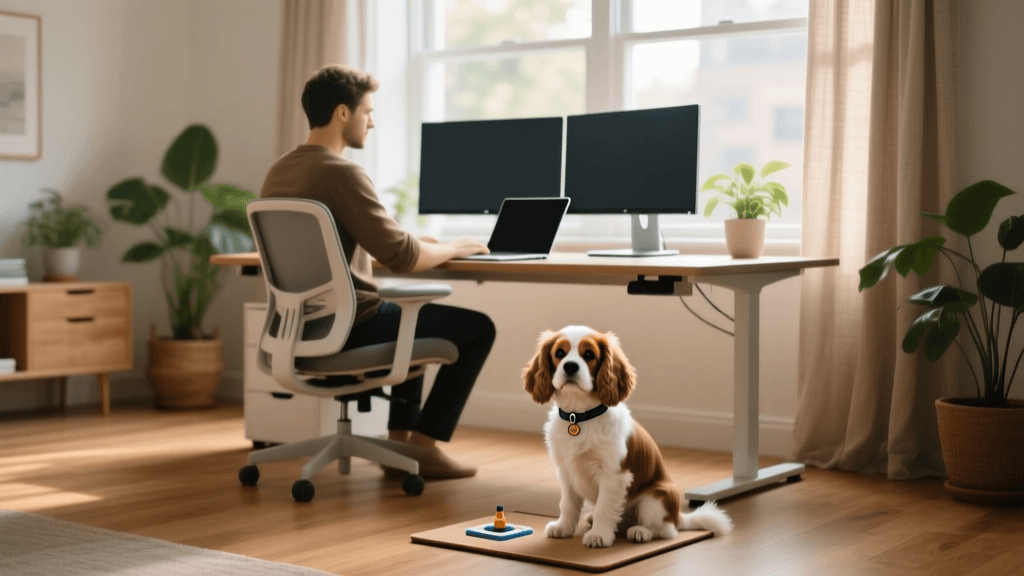
The Cavalier King Charles Spaniel is widely considered the ultimate lap dog, but their true superpower for remote workers is their eagerness to please and low baseline energy. Cavaliers are highly food-motivated, making them exceptionally easy to train for 'mat work' (staying on a designated bed under your desk). They rarely exhibit nuisance barking, provided they receive their daily 30-minute walk. Their primary training focus should be on boundary training to keep them from weaving underfoot during standing desk sessions.
2. Miniature Poodle (The Quick Study)
Do not let the fancy haircuts fool you; the Miniature Poodle is one of the most intelligent and trainable breeds on the planet. For remote workers who want a dog that can learn complex routines, the Miniature Poodle is ideal. You can easily train them to fetch specific items, ring a bell to go outside, or perform quiet puzzle-toy routines while you are on camera. Their high intelligence means they require mental stimulation, so incorporating 15 minutes of scent-work training before your workday begins will ensure they sleep peacefully under your desk all morning.
3. Japanese Chin (The Silent Observer)
Often described as cat-like, the Japanese Chin is an ancient companion breed that thrives in indoor environments. They are notoriously quiet, making them perfect for professionals who spend hours on Zoom or voice calls. While they can be slightly more stubborn than a Poodle, their trainability shines when using positive reinforcement and short, engaging sessions. They excel at 'settle' training and are naturally inclined to observe rather than react to household noises.
Core Home-Office Training Protocols for 2026
Selecting the right breed is only the first step. To ensure your puppy becomes the perfect co-worker, you must implement these three foundational training protocols.
Protocol 1: The 'Under the Desk' Place Command
The 'Place' command teaches your dog to go to a specific mat or bed and remain there until released. This is crucial for keeping your puppy safe from rolling office chairs and out of the camera's frame.
- Step 1 (Lure and Mark): Place a high-value treat on the mat. When all four paws step onto it, use a marker word like 'Yes!' and reward.
- Step 2 (Add the Cue): Say 'Place' right before your dog steps onto the mat. Reward heavily for compliance.
- Step 3 (Duration): Delay the reward. Ask your dog to stay on the mat for 5 seconds, then 10, then 30, rewarding intermittently.
- Step 4 (Distance and Distraction): Take a step back. Return and reward. Gradually increase the distance and introduce mild distractions, like typing loudly or moving your chair.
Protocol 2: Zoom-Call 'Quiet' Conditioning
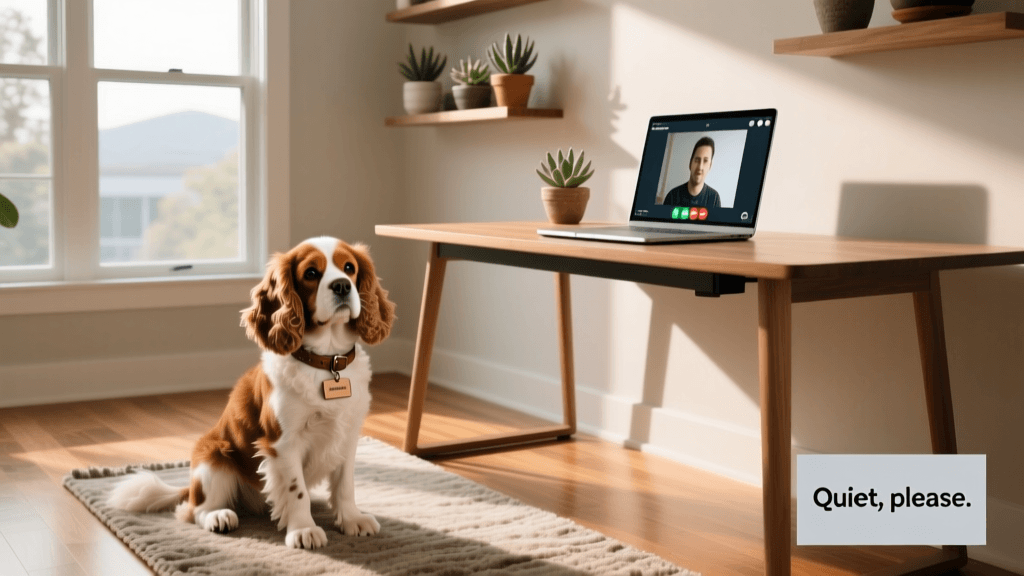
In 2026, smart doorbells and delivery notifications are constant triggers for puppy barking. You must desensitize your puppy to these sounds.
- Record the sound of your specific doorbell or a common notification chime on your phone.
- Play the sound at a very low volume while feeding your puppy high-value treats (like boiled chicken or freeze-dried liver).
- Gradually increase the volume over several weeks.
- Once the puppy associates the sound with treats rather than an 'intruder,' they will look to you for a reward instead of barking when a real package arrives.
Protocol 3: Hybrid-Schedule Independence Training
According to the ASPCA's guidelines on separation anxiety, dogs left alone without prior conditioning can develop severe stress behaviors. Remote workers must actively train their puppies to be alone, even when they are working in the next room.
Pro Tip: Use a baby gate or a playpen to separate yourself from your puppy for 30-minute blocks during the workday. Provide a long-lasting chew, like a stuffed frozen KONG, so they learn that being apart from you is a rewarding, relaxing experience.
Recommended 2026 Home-Office Training Gear
Modern pet technology and specialized enrichment tools can drastically improve your home-office training success. Here are the top investments for this year:
- West Paw Toppl: An interlocking puzzle toy that keeps intelligent breeds like the Miniature Poodle occupied for up to an hour without making noise.
- Snuffle Mats: Perfect for morning scent-work sessions. Hiding kibble in a snuffle mat tires out a puppy's brain, promoting deep sleep during your morning meetings.
- AI-Powered Pet Cameras: Devices like the latest Furbo or Wyze pet cameras now feature AI bark alerts and automatic treat tossing, allowing you to reward your puppy for quiet settling from your smartphone while you are on a call.
Breed Comparison Chart: Office Compatibility
| Breed | Trainability Score | Bark Tendency | Best Office Training Focus |
|---|---|---|---|
| Cavalier King Charles Spaniel | High | Low | Mat training and boundary respect |
| Miniature Poodle | Very High | Moderate | Mental enrichment and quiet cues |
| Japanese Chin | Moderate | Very Low | Socialization and independent settling |
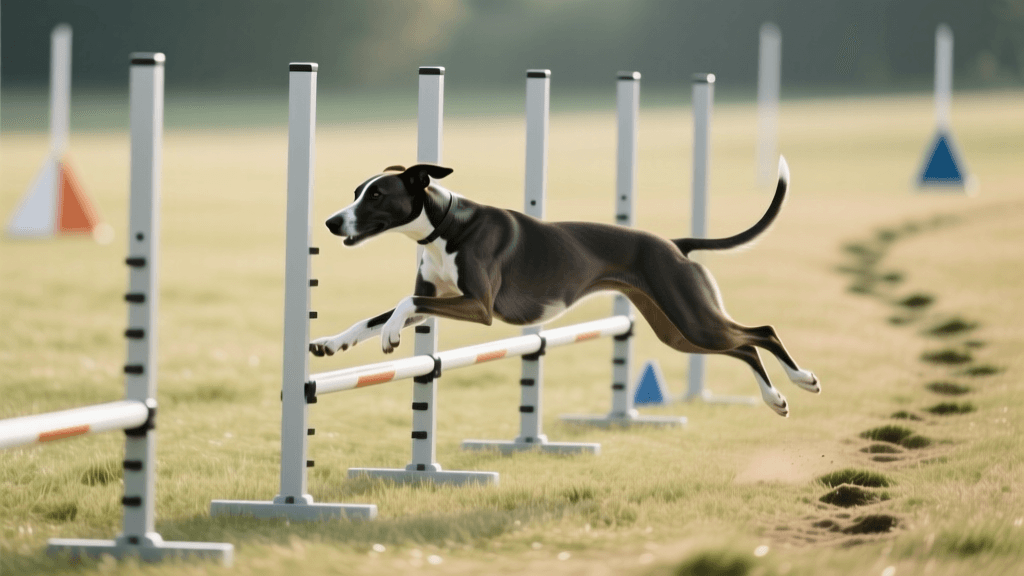
| Greyhound | Moderate | Low | Leash manners and 'settle' commands |
Final Thoughts on Home Office Harmony
Working from home with a puppy in 2026 is a rewarding experience, provided you set clear expectations from day one. By choosing a trainable, adaptable breed like the Cavalier King Charles Spaniel or Miniature Poodle, and committing to structured place-training and independence protocols, you can cultivate a peaceful, productive environment. Remember, a well-trained office dog is not born; they are shaped through consistent, positive reinforcement and a deep understanding of their breed-specific needs.
tom-renshaw
All our authors care for dogs every day — read more of their work on the authors page.