14-Day Hand-Feeding Bonding Protocol For New Puppies In 2026
Discover the 14-day hand-feeding and engagement protocol to build deep trust, focus, and a lifelong bond with your new puppy in their first weeks home.
The Shift to Engagement-Based Puppy Rearing in 2026
Bringing a new puppy home is one of life’s greatest joys, but the first few weeks dictate the foundation of your lifelong relationship. As we navigate puppy rearing in 2026, modern canine behavioral science has overwhelmingly shifted away from outdated, dominance-based training models. Instead, top veterinary behaviorists and certified trainers emphasize engagement-based bonding. The most powerful tool in your arsenal for building deep trust, focus, and a secure attachment during your puppy's critical developmental window isn't a fancy gadget—it is the 14-Day Hand-Feeding Protocol.
By temporarily removing the food bowl and becoming the sole provider of your puppy's daily caloric intake, you transform mundane mealtimes into high-value bonding sessions. This guide will walk you through the exact daily steps, nutritional allocations, and troubleshooting techniques to establish yourself as a trusted partner rather than just a roommate.
The Science Behind Canine-Human Attachment
Why does hand-feeding work so effectively? The answer lies in classical conditioning and neurobiology. When you hand-feed, your puppy’s brain begins to associate your presence, your scent, and your hands with the dopamine release associated with eating. Furthermore, mutual gaze and positive interactions during feeding stimulate the release of oxytocin—the "love hormone"—in both humans and dogs. According to the American Kennel Club (AKC), leveraging positive reinforcement during the critical socialization period (weeks 8 to 16) is paramount for preventing fear-based behaviors and fostering a confident, well-adjusted adult dog.
The 14-Day Hand-Feeding and Engagement Protocol
Before beginning, measure your puppy’s daily recommended kibble intake based on their current weight and the manufacturer's 2026 feeding guidelines. Divide this into three or four daily training sessions. What isn't earned during training can be scattered in a snuffle mat or puzzle toy for mental enrichment.
Phase 1 (Days 1–4): Establishing the Human as the Resource
Goal: Build baseline trust and eliminate hand-shyness.
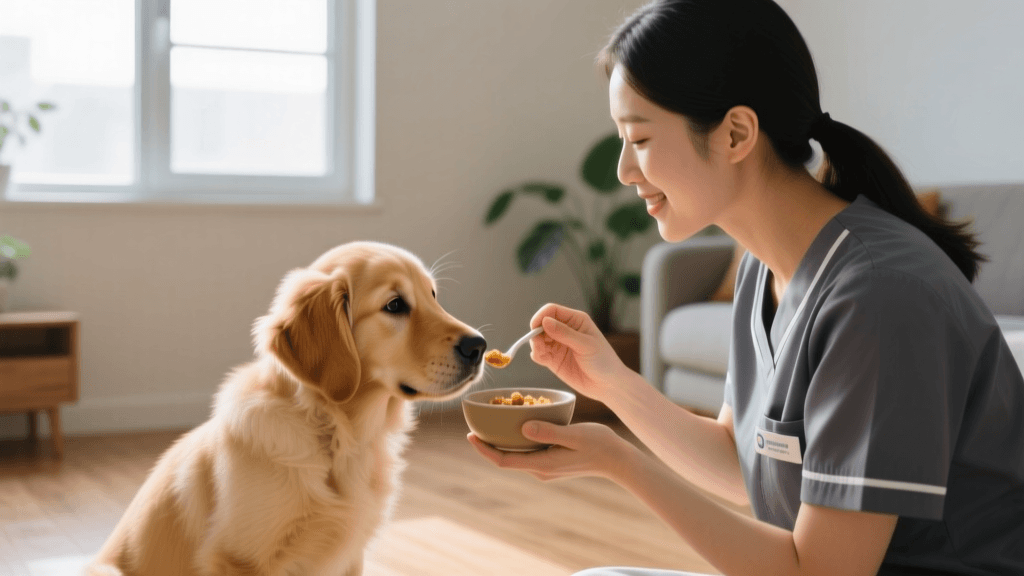
Method: Sit on the floor with your puppy in a quiet, low-distraction room. Offer individual pieces of kibble from an open, flat palm. Do not demand eye contact or a "sit" command yet. Simply allow the puppy to approach, eat, and retreat. If your puppy is timid, toss the kibble gently toward them, gradually decreasing the distance over the four days. This phase teaches the puppy that hands approaching their face predict good things, which is the first step in preventing resource guarding.
Phase 2 (Days 5–9): Building Focus and the "Name Game"
Goal: Develop active engagement and name recognition.
Method: Now, we introduce criteria. Hold a piece of kibble near your face. Say your puppy’s name clearly. The moment they make eye contact, use a marker word like "Yes!" and give them the kibble. Repeat this 10 to 15 times per session. By Day 9, your puppy should be offering eye contact automatically when they hear their name, realizing that checking in with you is the key to unlocking resources. This builds the foundation for a reliable recall later in life.
Phase 3 (Days 10–14): Movement, Recall, and Impulse Control
Goal: Translate static focus into dynamic movement.
Method: Toss a piece of kibble a few feet away. Once the puppy eats it and turns back toward you, say their name and take a step backward. When they follow you, mark "Yes!" and feed them right at your side. This introduces the mechanics of a recall. To introduce impulse control, hold the kibble in a closed fist. Wait for the puppy to stop pawing and sniffing, and the second they pull their nose back an inch, open your hand and reward. This teaches the vital 2026 modern training concept: patience yields rewards, but demanding yields nothing.
14-Day Kibble Allocation and Training Schedule
Managing your puppy's daily caloric intake is crucial to prevent overfeeding while utilizing food motivation. Below is a structured schedule to help you manage your daily kibble budget.
| Day Range | Primary Goal | Meal Delivery Method | Training Focus |
|---|---|---|---|
| Days 1–4 | Baseline Trust | 100% Hand-Fed (Open Palm) | Desensitization to hands, approach confidence |
| Days 5–9 | Active Engagement | 80% Hand-Fed, 20% Snuffle Mat | Name recognition, eye contact, marker words |
| Days 10–14 | Dynamic Focus | 70% Hand-Fed, 30% Puzzle Toys | Recall basics, closed-fist impulse control |
Recommended High-Value Training Foods and Gear for 2026
While standard kibble works for low-distraction environments, you will occasionally need higher-value rewards for challenging tasks or outdoor socialization. In 2026, single-ingredient, freeze-dried proteins remain the gold standard for puppy training treats due to their high palatability and digestibility.
- Ziwi Peak Air-Dried Venison: Excellent for puppies with sensitive stomachs or poultry allergies. The soft texture allows for rapid consumption, keeping training momentum high.
- K9 Natural Freeze-Dried Beef Liver: A high-value "jackpot" reward reserved exclusively for major breakthroughs, such as a successful recall away from a distraction.
- Ruffwear Treat Trader (2026 Edition): A waist-worn treat pouch with a magnetic closure. It allows for hands-free treat delivery, which is essential when you are also managing a leash and clicker.
Troubleshooting Common Bonding Hurdles
Even with a structured protocol, puppyhood is unpredictable. Here is how to handle the two most common issues encountered during hand-feeding.
Puppy Biting and "Shark Teeth"
Puppies explore the world with their mouths, and fingers holding food are prime targets. If your puppy’s teeth make hard contact with your skin, immediately say a neutral "Oops," withdraw your hand completely, and stand up for three seconds. This implements a brief negative punishment (removal of the desired resource). Resume by offering the kibble in a flat palm. Consistent boundary setting in 2026 puppy training relies on clear, non-intimidating consequences rather than physical corrections.
Early Signs of Resource Guarding
Some puppies may freeze, gulp, or growl when you approach them while they are eating a puzzle toy or chewing a bully stick. The ASPCA's guidelines on food guarding emphasize that owners should never punish a growl, as this suppresses the warning sign and can lead to a dog that bites without warning. Instead, play the "Trading Game." Approach your puppy, toss a piece of high-value freeze-dried liver near their bowl or toy, and walk away. Teach them that a human approaching means something better is arriving, effectively neutralizing the guarding instinct before it solidifies.
Integrating Socialization with Bonding
The bond you build through hand-feeding serves as a secure base from which your puppy can explore the world. The American Veterinary Society of Animal Behavior (AVSAB) strongly advocates for early, positive socialization before a puppy is fully vaccinated. By taking your hand-feeding sessions to different environments—the driveway, a quiet park bench, or a friend's living room—you teach your puppy that engagement with you is possible regardless of environmental distractions. This builds a resilient, confident dog who views you as their safe harbor in a chaotic world.
Conclusion
The 14-Day Hand-Feeding Protocol is more than just a feeding strategy; it is a profound relationship-building exercise. By investing just 20 minutes a day into structured engagement during your puppy's first weeks home, you are laying the neurological and behavioral groundwork for a decade or more of mutual trust, joy, and seamless communication. Put away the food bowl, grab your treat pouch, and start building the bond of a lifetime today.
anouk-beaumont
All our authors care for dogs every day — read more of their work on the authors page.