Greyhound vs Beagle: Understanding Prey Drive Instincts
Discover how sighthound and scenthound instincts shape behavior. Compare Greyhounds and Beagles to manage prey drive and train off-leash recall.
The Psychology of the Hunt: Decoding Canine Prey Drive
When selecting a dog, many prospective owners focus on size, coat type, and general temperament. However, understanding the deep-seated psychological instincts of a breed is crucial for long-term harmony. Prey drive is an innate survival mechanism that dictates how a dog interacts with moving objects, wildlife, and even other pets. While all dogs possess some level of prey drive, the way it manifests varies wildly depending on their ancestral breeding purpose.
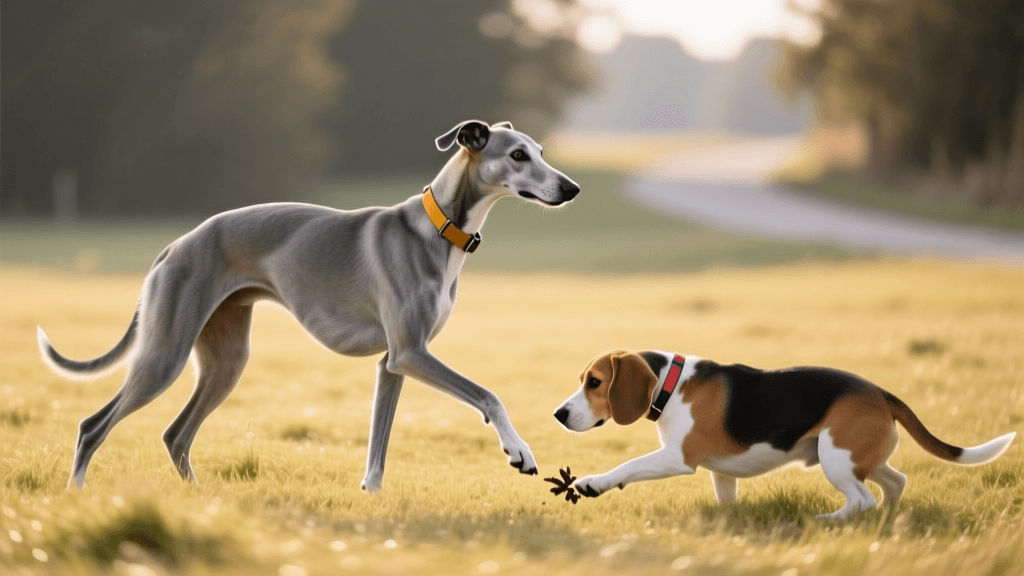
To truly comprehend these behavioral differences, we must look at the predatory motor sequence: search, stalk, chase, bite, kill, and consume. Selective breeding has amplified or suppressed specific parts of this sequence. By comparing a classic sighthound—the Greyhound—with a quintessential scenthound—the Beagle—we can uncover how sensory triggers dictate canine behavior and learn actionable strategies to manage these powerful instincts.
The Predatory Motor Sequence Explained
Before diving into breed-specific behaviors, it is essential to understand the biological framework of prey drive. According to veterinary behaviorists, the predatory sequence is a hardwired neurological loop. In wild canids, this sequence is necessary for survival. In domestic dogs, humans have artificially selected for specific fragments of this loop to create specialized working breeds.
- Herding Breeds: Amplify the search, stalk, and chase, but suppress the bite and kill.
- Terriers: Amplify the chase, bite, kill, and consume, making them relentless pest controllers.
- Sighthounds: Rely heavily on the visual search and the explosive chase.
- Scenthounds: Rely on the olfactory search, trailing, and vocalization to alert human hunters.
Greyhound Instincts: The Visual Trigger
Greyhounds are sighthounds, meaning their primary sensory input for triggering prey drive is visual movement. According to the American Kennel Club's Greyhound Breed Profile, these dogs were historically bred to spot distant, fast-moving game like hares and deer across open terrain. Their eyes possess a unique structure, including a high concentration of rod cells, granting them exceptional peripheral vision and the ability to detect motion up to half a mile away.
When a Greyhound spots a squirrel darting across a park, the 'chase' portion of their predatory sequence is instantly activated. This results in an explosive burst of speed, often reaching up to 45 miles per hour within just a few strides. During this chase state, the Greyhound experiences a massive adrenaline dump and sensory tunneling. They become entirely deaf to verbal commands, including a well-practiced recall. This is not a sign of disobedience or a lack of love for their owner; it is a profound neurological override.
Because their trigger is visual, Greyhounds can often be managed in environments with low movement. A sleeping cat in the same room may be entirely ignored, but a cat that suddenly bolts will instantly trigger the chase instinct. Therefore, off-leash reliability in unfenced areas is exceptionally rare and highly dangerous for this breed.
Beagle Instincts: The Olfactory Obsession
In stark contrast, the Beagle is a scenthound. While a Greyhound looks to the horizon, a Beagle looks to the dirt. The American Kennel Club's Beagle Breed Standard notes that these dogs were bred to track small game like rabbits over long distances, utilizing their incredible olfactory receptors—numbering over 220 million. A Beagle's prey drive is triggered by scent molecules, not visual movement.
When a Beagle catches an interesting scent trail, their behavior shifts dramatically. Their head drops, their tail goes up, and they begin to 'baying'—a distinct, booming vocalization designed to echo through forests and guide human hunters on foot. Unlike the silent, explosive sprint of the Greyhound, the Beagle's pursuit is methodical, persistent, and loud.
The psychological challenge with Beagles is their single-minded olfactory focus. Once they lock onto a scent trail, they can follow it for miles, completely ignoring their surroundings. Furthermore, because their trigger is invisible to the human eye (scent), owners are often caught off guard when their Beagle suddenly bolts out the front door after a scent carried by the wind. Recall training is notoriously difficult because the reward of following the scent often outweighs the reward of returning to the owner.
Behavioral Comparison Chart: Managing the Chase
Understanding the nuances between these two breeds allows owners to tailor their management and training strategies. Below is a structured comparison of how these instincts manifest in a domestic environment.
| Behavioral Trait | Greyhound (Sighthound) | Beagle (Scenthound) |
|---|---|---|
| Primary Trigger | Visual movement (fast, distant) | Olfactory input (ground scents, wind) |
| Chase Style | Explosive sprint, silent pursuit | Methodical trailing, loud baying |
| Sensory Override | Tunnel vision, deaf to commands | Nose-blindness, deaf to commands |
| Fencing Needs | 6-foot fence (climbers/jumpers) | Secure base with dig-proofing |
| Recall Difficulty | Extreme when moving objects are present | Extreme when interesting scents are present |
| Indoor Demeanor | Often couch potatoes if exercised | Prone to counter-surfing and scavenging |
Actionable Training Strategies for High Prey Drive
Managing high prey drive requires a combination of environmental management, specialized gear, and targeted behavioral conditioning. According to the Humane Society's Guide to Recall Training, building a reliable recall in high-distraction environments requires starting in low-distraction areas and gradually increasing difficulty. However, with hardwired hunting breeds, a 100% reliable off-leash recall is never guaranteed.
1. Implement Emergency Whistle Training
Verbal commands can get lost in the wind or overpowered by a Beagle's baying. A high-frequency training whistle (such as the Acme 211.5, costing around $15) cuts through environmental noise. Condition the whistle by pairing it with ultra-high-value rewards like freeze-dried liver or boiled chicken. Blow the whistle, mark the behavior, and reward. Over six to eight weeks of daily 10-minute sessions, the sound of the whistle becomes an involuntary conditioned response to turn and run back to you.
2. The 'Leave It' and 'Watch Me' Protocols
For Greyhounds, teaching a solid 'Leave It' command using moving toys on a string can help build impulse control. For Beagles, the 'Watch Me' command is vital to break their olfactory trance. Hold a treat at your eye level, wait for eye contact, and reward. Gradually increase the duration of eye contact required before the reward is given. This builds a neurological pathway that prioritizes human engagement over environmental stimuli.
Environmental Management and Safety Gear
Because instincts cannot be entirely trained away, physical management is your first line of defense. Budgeting for the right equipment is a necessary part of responsible hound ownership.
- GPS Tracking Collars: If a hound escapes, time is of the essence. Invest in a GPS tracker like the Whistle GO or Fi Smart Collar. These devices cost between $100 and $150 upfront, plus a monthly subscription fee of $8 to $12. They provide real-time location tracking via cellular networks and can alert you if your dog leaves a designated safe geofence.
- Biothane Long Lines: To allow your dog to explore safely without the risk of them bolting, use a 15-foot to 30-foot Biothane long line. Biothane is waterproof, easy to clean, and does not tangle like nylon or cotton. Expect to spend $30 to $50 for a high-quality, custom-length line.
- Proper Muzzle Conditioning: For dogs with a high 'kill and consume' drive, muzzle training is a vital safety measure. The Baskerville Ultra Muzzle ($20 to $25) allows dogs to pant, drink, and take treats while preventing them from ingesting toxic wildlife or garbage. Introduce the muzzle using peanut butter smeared inside the basket, allowing the dog to push their nose in voluntarily over a period of two weeks.
- Secure Fencing Solutions: Greyhounds require a minimum 6-foot privacy fence to prevent them from seeing triggering movements outside. Beagles, conversely, require a fence that extends at least 12 inches into the ground, reinforced with hardware cloth or concrete footer, to prevent them from digging their way out to follow a subterranean scent trail.
Conclusion: Respecting the Blueprint
Selecting a dog based purely on appearance or a brief meet-and-greet in a shelter can lead to severe behavioral mismatches. The Greyhound and the Beagle represent two entirely different evolutionary blueprints. One is a silent, visual sprinter built for open plains; the other is a vocal, methodical tracker built for dense forests. By understanding the psychology behind their prey drive, owners can provide appropriate outlets, implement necessary safety gear, and foster a harmonious relationship built on mutual respect for the dog's innate nature.
marcus-aldridge
All our authors care for dogs every day — read more of their work on the authors page.