Golden Retriever vs. Lab Mobility Service Dogs in 2026
Compare Golden Retrievers and Labrador Retrievers for mobility service work in 2026. Discover breed traits, gear, costs, and home prep tips.
Choosing a Mobility Service Dog in 2026
As we navigate the evolving landscape of working and service dogs in 2026, the demand for mobility assistance dogs continues to rise. These highly trained canines provide life-changing support, helping handlers with tasks ranging from bracing for balance and retrieving dropped items to opening doors and pulling wheelchairs. When selecting a breed for mobility work, two giants consistently dominate the field: the Golden Retriever and the Labrador Retriever. Both breeds possess the intelligence, size, and biddability required for complex service work, but their distinct temperaments, physical traits, and care requirements make them suited for different types of handlers. In this comprehensive 2026 guide, we will break down the critical differences between these two breeds, explore the latest veterinary advances in joint health, and outline the essential gear and home modifications required for a successful mobility service dog team.
Breed Profile: The Golden Retriever
The Golden Retriever has long been celebrated for its empathetic nature and intense handler focus. In 2026, Goldens remain a top choice for dual-purpose service dogs, particularly for handlers who require both mobility support and psychiatric assistance. Their innate sensitivity allows them to read subtle shifts in a handler's body language and emotional state, making them exceptional at deep pressure therapy (DPT) and interruption tasks. Physically, male Golden Retrievers typically weigh between 65 and 75 pounds, providing adequate mass for light to moderate bracing and retrieval tasks. However, their luxurious double coats require significant maintenance. Handlers must be prepared for daily brushing to prevent matting and manage shedding, which can be a challenging fine-motor task for individuals with certain physical disabilities. Furthermore, Goldens are known for their 'soft' temperament; they can be sensitive to harsh corrections or chaotic environments, requiring a calm, structured training approach.
Breed Profile: The Labrador Retriever
The Labrador Retriever, specifically the English or 'show' line, is the quintessential mobility service dog. Labs are renowned for their resilience, high food drive, and robust physical build. A mature male Lab can easily weigh between 70 and 85 pounds, offering superior mass for wheelchair pulling and heavy bracing tasks. Unlike the Golden, the Labrador's short, dense coat is relatively low-maintenance, requiring only a weekly brushing with a rubber curry brush to manage shedding. This makes the Lab an ideal choice for handlers who may struggle with the physical demands of extensive grooming. Labs are also highly environmentally resilient; they tend to bounce back quickly from stressful public access environments and are less likely to shut down in loud or crowded spaces. However, their high food motivation and natural exuberance mean that impulse control training must be heavily emphasized during their first two years to ensure they do not become distracted by dropped food or environmental triggers while working.
2026 Breed Comparison Chart
| Trait / Feature | Golden Retriever | Labrador Retriever |
|---|---|---|
| Average Working Weight | 60 - 75 lbs | 70 - 85 lbs |
| Coat Maintenance | High (Daily brushing) | Moderate (Weekly brushing) |
| Primary Motivation | Praise and Handler Focus | Food and Toy Drive |
| Environmental Resilience | Moderate (Sensitive to chaos) | High (Adapts quickly) |
| Joint Health Risk Profile | Moderate-High | Moderate-High |
| 2026 Avg. Program Placement Cost | $38,000 - $48,000 | $35,000 - $45,000 |
Joint Health and 2026 Veterinary Advances
Because mobility dogs are essentially canine athletes, joint health is the most critical factor in their longevity and working lifespan. Both Golden Retrievers and Labrador Retrievers are predisposed to hip and elbow dysplasia. According to the Orthopedic Foundation for Animals, responsible breeders in 2026 must provide OFA or PennHIP certifications proving that the sire and dam have excellent joint conformation before breeding. When acquiring a prospect, always demand to see these official certificates, not just a veterinarian's casual assessment.
Fortunately, veterinary medicine has made massive strides in recent years. In 2026, the widespread adoption of anti-NGF (Nerve Growth Factor) monoclonal antibody injections, such as Librela, has revolutionized the management of canine osteoarthritis. These monthly injections significantly reduce joint pain without the liver and kidney side effects associated with traditional NSAIDs, allowing mobility dogs to work comfortably well into their senior years. Additionally, genomic testing panels now include specific markers for joint degradation, allowing handlers and trainers to predict and proactively manage a dog's orthopedic health from puppyhood.
Essential Mobility Gear for 2026
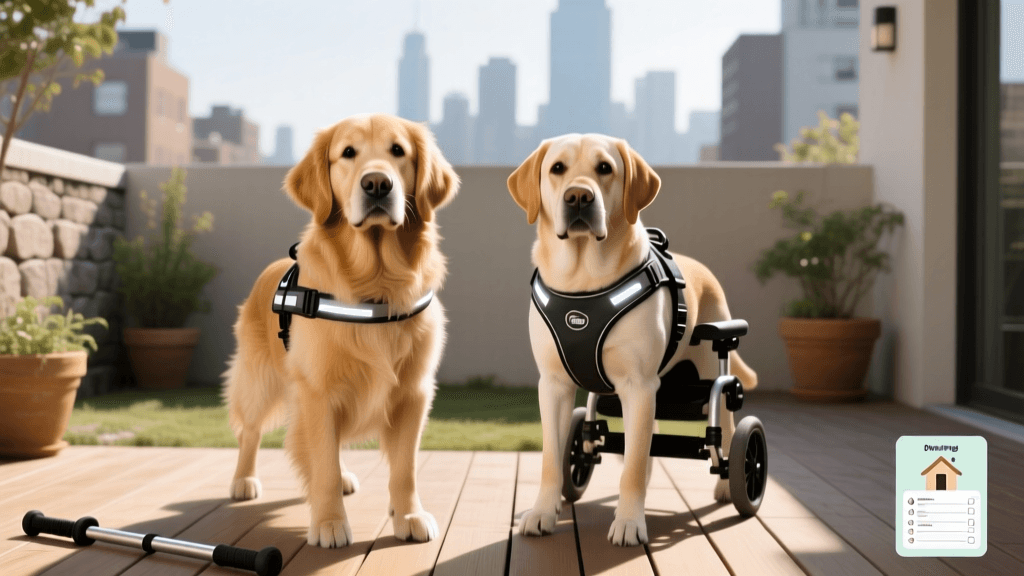
Equipping a mobility dog with the correct gear is non-negotiable for the safety of both the dog and the handler. A standard pet harness will cause severe spinal and shoulder injuries if used for pulling or bracing. In 2026, the industry standard for mobility work is a custom-fitted harness with a rigid handle and a breastplate that distributes weight evenly across the dog's sternum and ribcage.
Brands like Bold Lead Designs and Doggie Styl continue to dominate the market with their custom-molded mobility harnesses. When ordering, you must measure your dog's girth and chest precisely. The handle length is equally important; a 12-inch handle is standard for walkers, while a 14-inch or 16-inch handle is required for wheelchair users to ensure proper leverage and prevent the handler from leaning awkwardly. For handlers who require pulling assistance, a specialized drag-mush harness with a bungee tether system is recommended to absorb the shock of sudden stops, protecting the dog's spine.
Legal Standards and Public Access
Understanding your legal rights and responsibilities is a cornerstone of getting a service dog. As outlined by the ADA Service Animal Guidelines, mobility dogs are permitted to accompany their handlers anywhere the public is allowed to go. However, it is vital to remember that the ADA defines a service dog strictly by the tasks it is trained to perform to mitigate a disability. Emotional support, comfort, and companionship do not qualify as trained tasks.
In 2026, businesses are legally allowed to ask only two questions: (1) Is the dog a service animal required because of a disability? and (2) What work or task has the dog been trained to perform? Handlers should practice concise, confident answers to these questions. Furthermore, while the ADA does not require service dogs to wear vests or carry identification, utilizing a clearly marked vest from a reputable organization like Assistance Dogs International (ADI) can significantly reduce unwanted public interference and streamline your public access experiences.
Home Modifications for Mobility Teams
Preparing your home for a mobility service dog goes beyond buying food and water bowls. You must create an environment that allows the dog to work safely and comfortably. Start with your flooring; slippery surfaces like polished hardwood or smooth tile can lead to catastrophic joint injuries for a bracing dog. In 2026, luxury vinyl plank (LVP) flooring with a high slip-resistance rating and textured finish is the top recommendation for service dog homes. If replacing floors is not an option, interlocking foam mats or low-pile, non-slip area rugs should be placed in high-traffic working zones.
Next, evaluate your door hardware. Round doorknobs are nearly impossible for a dog to operate. Retrofitting your home with lever-style handles allows a mobility dog to open doors using a specialized tug strap. For exterior doors, integrating Matter-compatible smart locks that can be triggered via voice command or a low-profile ADA-compliant push button allows the dog to nudge the door open after the lock disengages. Finally, invest in a high-quality, non-slip ramp, such as the PetSTEP folding ramp, to help your dog safely enter and exit vehicles without jumping, which preserves their joints for working tasks.
Final Thoughts on Your 2026 Journey
Choosing between a Golden Retriever and a Labrador Retriever for mobility work ultimately comes down to your specific physical needs, lifestyle, and capacity for grooming and training. Goldens offer unparalleled emotional attunement and handler focus, making them ideal for dual-purpose roles, while Labs provide the robust physical resilience and low-maintenance care required for heavy, daily mobility tasks. Whichever breed you choose, prioritize ethical sourcing, rigorous joint health screening, and professional task-training. By investing in the right gear, modifying your home, and staying current with 2026 veterinary care, you will build a foundation for a long, safe, and deeply rewarding partnership with your mobility service dog.
aaron-whyte
All our authors care for dogs every day — read more of their work on the authors page.