Furbo 360 & Threshold Training for Doorbell Reactivity in 2026
Discover how to combine Furbo 360 treat tossing with threshold training to cure doorbell reactivity and separation anxiety in reactive dogs in 2026.
The Epidemic of Doorbell Reactivity in Urban Dogs
As we navigate the hybrid work landscape of 2026, many dog owners are finding that their pets struggle with the transition between home-alone time and sudden human arrivals. Doorbell reactivity—a potent mix of territorial barking, frantic pacing, and separation anxiety—has become one of the most common behavioral issues reported by urban and suburban dog owners. When a delivery driver or guest rings the bell, the sudden auditory trigger can send an anxious dog into a state of severe physiological arousal, spiking their cortisol levels and making it nearly impossible for them to process commands.
For reactive dogs, the doorbell is not just a sound; it is an alarm that signals an intrusion or the unpredictable return of their owner. Managing this behavior requires more than a simple 'quiet' command. It requires a systematic approach to desensitization and counterconditioning, paired with modern smart-home technology that allows owners to intervene even when they are not physically in the room.
Why Traditional Desensitization Falls Short
Historically, trainers have advised owners to record the sound of their doorbell, play it at a low volume, and reward the dog with high-value treats. While this foundational technique is scientifically sound, it has a major flaw in 2026: it requires the owner to be present. Dogs are highly contextual learners. If a dog learns that a muted doorbell chime on a smartphone predicts a treat from their owner, they may still panic when the actual physical doorbell rings while the owner is at the office or out running errands.
Furthermore, the separation anxiety and reactive behaviors exhibited by dogs are often deeply intertwined. The dog is not just reacting to the bell; they are reacting to the bell while in a state of isolation distress. To truly resolve the issue, we must introduce an automated, remote-controlled reward system that bridges the gap between the owner's absence and the environmental trigger.
Enter the Furbo 360: A 2026 Game-Changer for Reactive Dogs
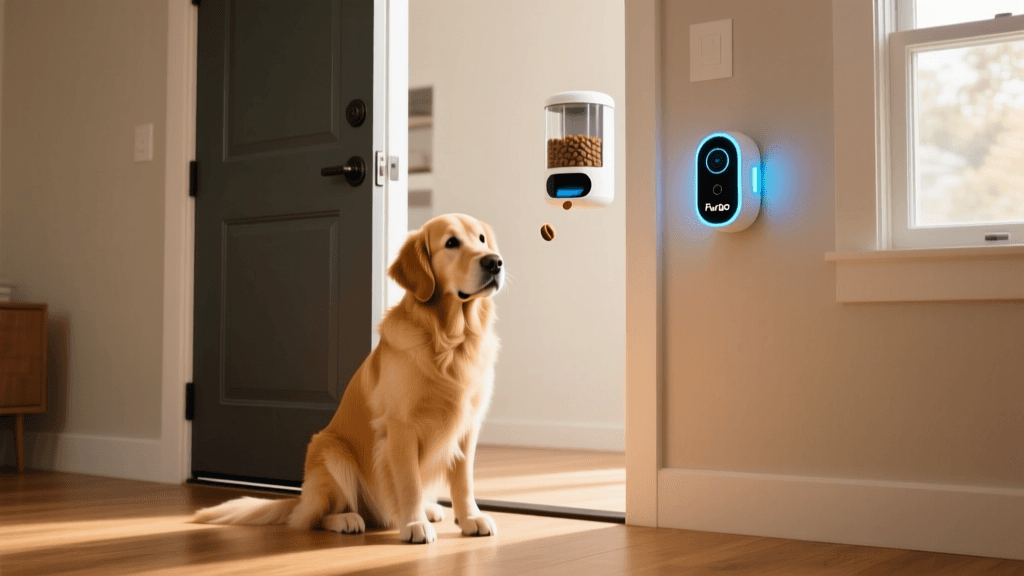
The 2026 iteration of the Furbo 360 Dog Camera has evolved from a simple pet monitor into a legitimate behavioral modification tool. Unlike fixed-lens cameras, the Furbo 360 features a motorized base that pans a full 360 degrees, allowing the camera to track your dog's movements and dispense treats in their exact direction. More importantly, its AI-driven 'Bark Alerts' and 'Auto-Treat' features can be integrated with smart home ecosystems to trigger positive reinforcement the moment a doorbell is rung.
Key Features for Anxious Dog Management
- 360-Degree Treat Tossing: Ensures the treat lands near the dog, even if they are hiding under a table or pacing in a corner, preventing frustration.
- Smart Chime Integration: Can be synced with smart doorbells to automatically dispense a treat when the doorbell rings, instantly changing the dog's emotional response from panic to anticipation of a reward.
- Two-Way Audio with Voice Cloning: The latest firmware updates allow for pre-recorded, calming owner voice cues to play automatically when the AI detects stress-pacing.
- Dog Activity Diary: Tracks the frequency and duration of barking episodes, giving owners and veterinary behaviorists hard data to measure the success of the training protocol.
The 4-Week Threshold Training Protocol Using Smart Dispensers
To effectively use the Furbo 360 for doorbell reactivity, you must follow a structured threshold training protocol. Threshold training involves keeping the dog under their 'reactivity threshold'—the point at which they can notice a trigger but remain calm enough to eat and learn. Below is a comprehensive 4-week guide to rewiring your dog's response to the doorbell.
Week 1: Muting the Trigger and Building Positive Associations
In the first week, your goal is to remove the auditory shock of the doorbell. Access your smart doorbell's settings (such as Ring or Nest) and change the chime to a soft, low-frequency tone, turning the volume down to 10%. Set your Furbo 360 up in the room where your dog naturally rests. Fill the dispenser with high-value, aromatic treats like freeze-dried beef liver or Zuke's Mini Naturals, cut into pea-sized pieces to prevent satiation.
Three times a day, manually trigger the muted chime via your smartphone app while watching through the Furbo camera. The second the soft chime plays, use the Furbo app to toss a treat. Do not use two-way audio during this week; let the machine do the work. You are building a classical conditioning loop: Soft Sound = Treat from the Sky.
Week 2: Introducing the Muted Chime and Spatial Shaping
Now, we use the 360-degree panning feature to shape the dog's location. Reactive dogs often rush the front door, practicing the very behavior we want to extinguish. Position the Furbo 360 in a designated 'mat spot' or bed that is at least 15 feet away from the front door. Trigger the muted chime and toss the treat directly onto the mat. If the dog leaves the mat to check the door, do not toss another treat. Wait for them to return to the mat, trigger the chime again, and reward. This teaches the dog that the doorbell is a cue to go to their safe space, not the front door.
Week 3: Real-World Simulation with Auto-Treat
In week three, return the doorbell chime to its normal volume and standard tone. This is where the Furbo's automation shines. Set up an automation routine in your smart home hub: 'When Doorbell Rings -> Trigger Furbo Auto-Treat'. Ask a friend or neighbor to ring the doorbell from the outside. The moment the loud, real-world chime echoes through the house, the Furbo will automatically toss a treat. The sudden shift from a high-stress trigger to an immediate, automated reward short-circuits the dog's adrenaline response. Repeat this 5 to 10 times per session, ensuring the person outside never actually enters the house during this phase.
Week 4: Generalization and Fading the Tech
Once your dog consistently runs to their mat and waits for the automated treat upon hearing the doorbell, it is time to generalize the behavior to real arrivals. Have your friend ring the bell, wait for the Furbo to dispense the treat, and then allow the guest to enter calmly. If the dog breaks their sit-stay and rushes the guest, the guest must immediately turn around and leave. This teaches the dog that calm behavior on the mat keeps the guest present, while rushing makes the guest disappear. Gradually reduce the frequency of the automated treats, moving from a continuous reinforcement schedule to a variable one.
Smart Camera Comparison Chart for Reactivity Training
While the Furbo 360 is the premier choice for this specific protocol, it is helpful to understand how it compares to other market leaders in 2026 for anxious dog management.
| Device | Treat Capacity | Camera View | AI Bark Alerts & Automation | Best For |
|---|---|---|---|---|
| Furbo 360 (2026 Model) | Up to 200 treats | 360° Motorized Panning | Yes, smart-home auto-toss integration | Severe doorbell reactivity & pacing |
| Petcube Bites 2 Lite | Up to 100 treats | Fixed 138° Wide Angle | Sound detection (manual toss only) | Mild anxiety in single-room setups |
| Wyze Cam Pan v3 | No dispenser | 360° Motorized Panning | Sound detection (no treat capability) | Visual monitoring only (no counterconditioning) |
Expert Insights on Canine Anxiety
According to veterinary behaviorists, the key to resolving reactivity is changing the dog's underlying emotional state, rather than just suppressing the outward symptom of barking. Using an automated dispenser removes the owner's emotional tension from the equation. Dogs are incredibly adept at reading their owner's micro-expressions and leash tension; when a doorbell rings and the owner tenses up, the dog feels justified in their panic. By outsourcing the treat delivery to a neutral, predictable machine, the dog learns to associate the trigger with a positive outcome, independent of the owner's anxiety.
'Behavioral modification is not about suppressing the bark; it is about changing the underlying emotional response to the trigger. When we use technology to deliver high-value reinforcers at the exact millisecond a trigger occurs, we bypass the owner's anxiety and speak directly to the dog's limbic system.'
Final Thoughts on Tech-Assisted Behavioral Modification
Managing a reactive and anxious dog in 2026 requires a blend of empathetic understanding, scientific training protocols, and smart technology. The Furbo 360 is not a magic wand that will cure your dog overnight, but when used as a precision tool within a structured threshold training protocol, it becomes an invaluable asset. By consistently pairing the doorbell trigger with automated, high-value rewards, you can transform your dog's panic into a predictable, calm routine, ultimately creating a more peaceful home for both you and your canine companion.
hannah-wickes
All our authors care for dogs every day — read more of their work on the authors page.