Best No Pull Puppy Harness Guide 2026: Stop Leash Pulling
Discover the best front-clip no pull dog harness for puppies in 2026. Learn expert fitting tips and leash training techniques to stop pulling safely.
The Critical First Year: Why Harnesses Matter Over Collars
Bringing a new puppy home is one of the most exciting milestones in a dog owner's life, and the anticipation of that very first walk is unmatched. However, as your puppy begins to explore the world, you will quickly realize that their natural instinct is to pull toward interesting scents, sounds, and sights. In 2026, veterinary behaviorists and canine biomechanics experts universally agree that traditional neck collars are not suitable for leash training young, growing dogs. Puppies have incredibly delicate tracheas, developing cervical spines, and fragile thyroid glands. When a puppy pulls on a flat collar, the concentrated pressure on their neck can lead to severe injuries, including tracheal collapse, restricted airflow, and long-term spinal issues.
According to the American Kennel Club (AKC), transitioning to a well-fitted harness distributes the force of a pull across the dog's chest and shoulders, completely bypassing the vulnerable neck area. For puppies specifically, a no pull dog harness with a front-clip attachment is the gold standard for early leash training. It provides you with the steering control needed to teach loose-leash walking without resorting to aversive, pain-based correction methods.
The Biomechanics of a Front-Clip No Pull Dog Harness
Why exactly does a front-clip harness work so well for stopping puppies from pulling? The secret lies in canine biomechanics and center of gravity. When a leash is attached to the back of a harness, it triggers a dog's natural 'opposition reflex.' This is the same instinct that makes sled dogs lean into a harness to pull heavy loads. If your puppy pulls forward on a back-clip harness, they are physically empowered to pull harder.
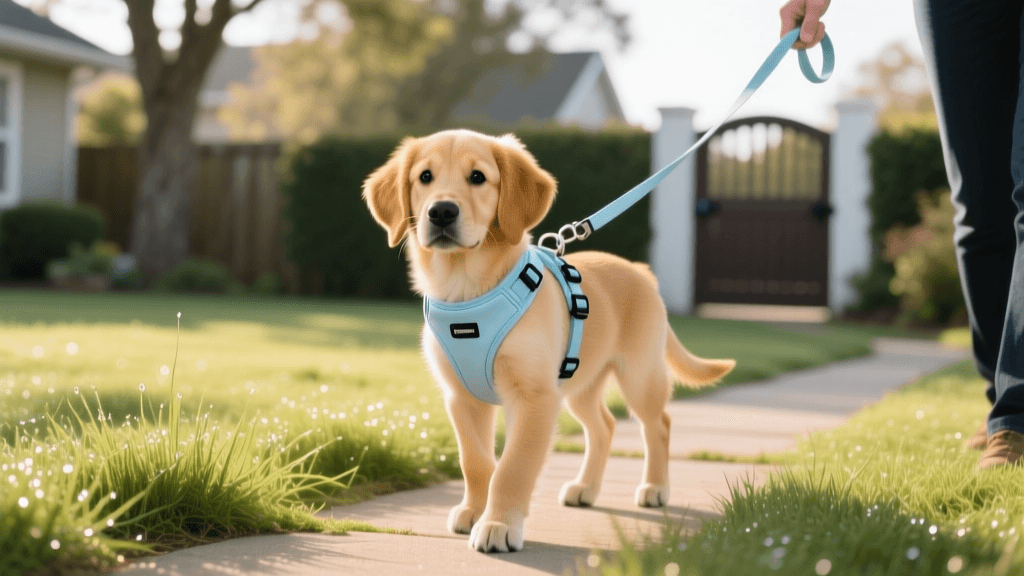
Conversely, a front-clip no pull dog harness features a D-ring located on the chest strap. When the puppy pulls forward and the leash goes taut, the front attachment gently pivots the puppy's chest and shoulders toward the handler. This redirection of momentum naturally breaks the puppy's forward stride and turns them back to face you. It does not cause pain or choke the dog; it simply makes pulling forward physically inefficient. This gentle redirection is highly recommended by the ASPCA as a foundational tool for force-free, positive reinforcement training.
2026 Buyer’s Guide: Features to Look For in a Puppy Harness
Not all harnesses are created equal, and buying a harness for a rapidly growing puppy requires specific considerations. When shopping for a no pull dog harness in 2026, prioritize the following features:
- Multi-Point Adjustability: Puppies grow in unpredictable spurts. Look for a harness with at least four adjustment points (two on the neck, two on the girth) to ensure a custom fit as their body proportions change.
- Breathable, Padded Mesh: Puppies cannot regulate their body temperature as efficiently as adult dogs. A harness with air-mesh padding prevents chafing on the armpits and prevents overheating during summer walks.
- Escape-Proof Belly Strap: Puppies are notorious for backing out of ill-fitting gear. A secure, quick-release belly buckle with a safety lock prevents your puppy from slipping out if they spook or lunge backward.
- Reflective Stitching: Early morning and late evening potty breaks are a reality of puppy ownership. High-visibility reflective threads ensure your puppy is seen by passing cyclists and vehicles.
- Lightweight Hardware: Heavy metal clips can weigh down a small puppy's chest. Opt for aerospace-grade aluminum or high-tensile reinforced nylon D-rings that are strong but lightweight.
Comparison Chart: Harness Clip Placements
Understanding the difference between harness styles is crucial for selecting the right tool for your puppy's developmental stage. Below is a comparison of the three main harness configurations available on the market today.
| Harness Type | Clip Location | Pulling Effect | Best For |
|---|---|---|---|
| Front-Clip No Pull | Chest / Sternum | Redirects forward momentum sideways, stopping the pull | Puppies learning loose-leash walking; strong pullers |
| Back-Clip Standard | Shoulders / Back | Encourages pulling via the opposition reflex | Brachycephalic breeds, car rides, already trained dogs |
| Dual-Clip Versatile | Chest and Back | Allows handler to switch between redirection and freedom | Adolescent dogs transitioning from training to casual walks |
How to Properly Measure and Fit Your Growing Puppy
A no pull dog harness is only effective and safe if it fits correctly. A harness that is too tight will restrict shoulder extension and alter your puppy's natural gait, potentially leading to joint issues. A harness that is too loose will chafe the armpits and allow the puppy to escape. Follow these steps to achieve the perfect fit:
- Measure the Girth: Using a soft fabric measuring tape, measure the widest part of your puppy's ribcage, usually just behind the front legs. Ensure the tape is snug but not tight.
- Measure the Neck: Measure the base of the neck where it meets the shoulders. This is crucial for overhead-style harnesses.
- The Two-Finger Rule: Once the harness is on, you should be able to comfortably slide exactly two fingers under any strap. If you can fit three or more, it is too loose. If you cannot fit two, it is too tight.
- Check Shoulder Mobility: Watch your puppy trot. The front straps should not cross over the shoulder joints or restrict the forward extension of their front legs. The chest plate should sit flat against the sternum.
Step-by-Step Leash Training Protocol for Puppies
Equipping your puppy with a front-clip no pull dog harness is only half the battle; the other half is consistent, positive reinforcement training. The AKC's expert training guidelines emphasize that puppies have short attention spans, meaning training sessions should be kept to 5-10 minutes, multiple times a day.
Step 1: Desensitization and Positive Association
Before ever attaching a leash, let your puppy wear the harness indoors. Feed them high-value treats (like boiled chicken or freeze-dried liver) while putting it on. Allow them to play and move freely so they associate the harness with positive experiences, not restriction.
Step 2: The 'Tree' Method for Pulling
When you step outside and your puppy inevitably pulls toward a bush or another dog, immediately stop walking. Become a 'tree.' Do not yank the leash, do not scold the puppy, and do not move forward. The moment the leash goes slack—even if the puppy just turns to look at you—mark the behavior with a 'Yes!' and reward them with a treat at your knee level.
Step 3: Rewarding the 'Sweet Spot'
The 'sweet spot' is the area right next to your leg, where the leash forms a loose 'J' shape. Every few steps that your puppy spends in this sweet spot, deliver a treat directly to their mouth while you are still moving. This teaches them that staying by your side is far more rewarding than pulling to the end of the leash.
Step 4: Changing Direction
If your puppy becomes fixated on a distraction and pulls, use the front-clip to gently guide them in the opposite direction. Say 'Let's go,' turn 180 degrees, and walk the other way. When they catch up to your side, reward them heavily. This builds engagement and teaches the puppy to check in with you rather than ignoring you.
Puppy Walking Milestones and Durations
During the first year of your puppy's life, their physical and mental capacity for walking changes dramatically. Over-exercising a young puppy can damage their open growth plates, while under-exercising can lead to destructive behavioral issues. Use this 2026 milestone guide to structure your walks:
- 8 to 12 Weeks (The Socialization Window): Walks should be extremely brief (5-10 minutes) and primarily focused on carrying the puppy in a sling or letting them explore a quiet, safe backyard while wearing their harness. Focus on desensitization to the harness and leash pressure.
- 3 to 4 Months (Vaccination Complete): You can begin structured neighborhood walks. Follow the '5 minutes per month of age' rule. A 4-month-old puppy should have walks lasting no more than 20 minutes, twice a day. This is the prime time to implement the 'Tree' method for pulling.
- 5 to 7 Months (The Fear Periods): Puppies may suddenly become spooked by objects they previously ignored (trash cans, fire hydrants). Use the front-clip harness to gently guide them away from triggers without forcing them to confront their fears. Keep walks to 25-35 minutes.
- 8 to 12 Months (Adolescent Rebellion): Expect a regression in leash training. Your puppy may suddenly pull harder and test boundaries as their hormones fluctuate. Revert to high-value treats and strict adherence to the front-clip redirection techniques. Walks can now extend to 45-60 minutes, incorporating sniffaris (sniff walks) to mentally tire them out.
Consistency is the cornerstone of loose-leash walking. A front-clip no pull dog harness is a brilliant management tool, but it must be paired with clear communication and high-value rewards to permanently alter your puppy's walking habits.
Conclusion
Investing in a high-quality, front-clip no pull dog harness is one of the best decisions you can make during your puppy's first year. It protects their developing anatomy, prevents the reinforcement of bad habits, and transforms stressful neighborhood tug-of-wars into enjoyable bonding experiences. By combining the right 2026 gear with patient, positive reinforcement training, you will set your puppy up for a lifetime of safe, happy, and polite walking.
aaron-whyte
All our authors care for dogs every day — read more of their work on the authors page.