Force-Free Dog Recall Training With GPS Collars 2026
Master force-free recall training in 2026 using positive reinforcement and smart GPS collars for safe, shock-free off-leash freedom.
The 2026 Paradigm Shift: Ditching the Shock Collar
For decades, the dog training world was divided on how to achieve a reliable off-leash recall. Many traditional trainers relied on electronic shock collars (e-collars) to enforce compliance through positive punishment. However, as we navigate the dog training landscape in 2026, the consensus among veterinary behaviorists and certified force-free trainers has overwhelmingly shifted. The modern approach to a bulletproof recall relies entirely on positive reinforcement, behavioral conditioning, and the integration of advanced GPS tracking technology to ensure safety without inflicting pain or fear.
According to the American Veterinary Society of Animal Behavior (AVSAB), aversive training methods can lead to increased stress, anxiety, and a breakdown of the human-animal bond. By combining high-value reward systems with the peace of mind provided by modern GPS collars, owners can now grant their dogs the ultimate freedom of off-leash exploration while maintaining total control and safety.
The Science Behind Force-Free Recall
A reliable recall is not about dominance or submission; it is about operant conditioning and motivation. When a dog hears their recall cue, they must instantly calculate whether returning to you is more rewarding than chasing a squirrel or sniffing a fascinating bush. To win this competition, we must utilize a Variable Ratio Reinforcement Schedule.
In 2026, canine cognitive studies continue to confirm that unpredictable, high-value rewards create the strongest behavioral persistence. If you give your dog a standard kibble piece every single time they come when called, the behavior will eventually extinguish when a higher-value distraction (like a deer) appears. However, if the dog never knows whether they will receive a simple pat on the head, a piece of hot dog, or a five-minute game of tug, the anticipation of a 'jackpot' reward keeps their recall speed lightning-fast.
Step-by-Step Force-Free Recall Protocol
Building a positive recall requires patience and a structured progression. Follow these phases to build a recall that holds up in the real world.
Phase 1: The Name Game and Engagement
Before your dog will come to you, they must want to look at you. Start in a low-distraction environment like your living room.
- Say your dog's name exactly once in a bright, happy tone.
- The exact second they make eye contact, mark the behavior with a clicker or a verbal marker like 'Yes!'
- Immediately deliver a high-value treat.
- Repeat this 20 times per session. You are wiring their brain to associate their name with immediate, fantastic consequences.
Phase 2: The Restrained Recall
This exercise builds immense drive and excitement for returning to you. You will need a partner or a secure anchor.
- Have your partner gently restrain your dog by their harness or chest.
- Show your dog a high-value reward (e.g., freeze-dried liver), then turn and run away enthusiastically for about 15 feet.
- Drop to your knees, open your arms, and call your dog using your chosen cue (e.g., 'Come!' or 'Here!').
- Your partner releases the dog. The dog will sprint to you to close the distance.
- When they arrive, deliver a 'jackpot' reward—three to five treats given one after the other, paired with enthusiastic praise.
Phase 3: Hide-and-Seek and Distance Building
Once the dog is reliably sprinting to you in the house and yard, it is time to add environmental complexity. Play hide-and-seek in your home or a fenced area. Call your dog from another room. When they find you, throw a massive reward party. This teaches the dog that searching for you and returning to you is the most fun game in the world.
Integrating GPS Tracking for Off-Leash Safety
The primary reason owners historically resorted to shock collars was the fear of losing their dog in an unfenced area. In 2026, this fear is entirely mitigated by advanced, lightweight GPS tracking collars. These devices do not correct the dog; instead, they provide the owner with real-time spatial awareness, allowing you to manage the environment and intervene before the dog gets out of range.
Why GPS Replaces the E-Collar in 2026
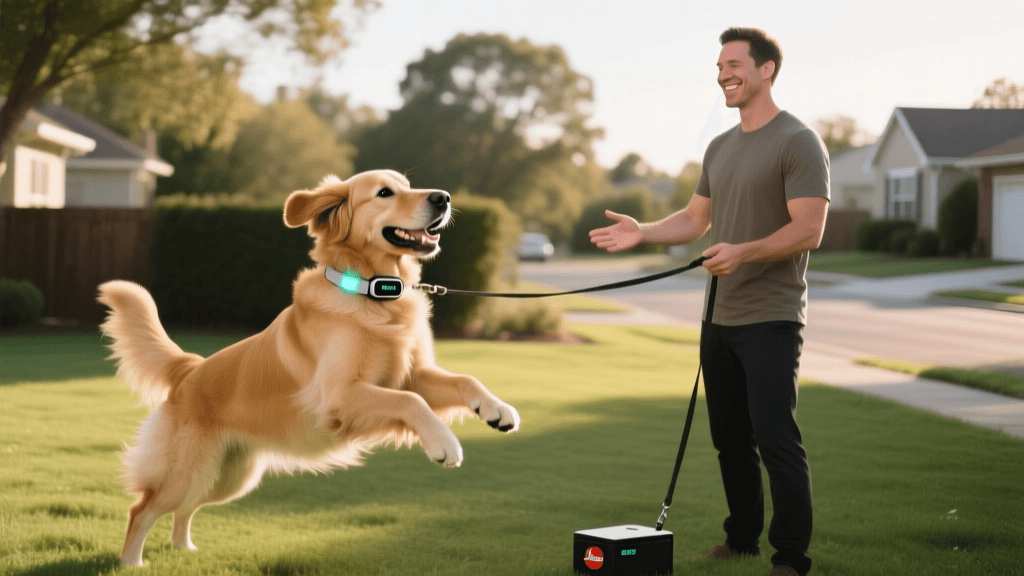
Modern GPS collars feature safe-zone geofencing, activity tracking, and even LED beacon lights for dusk and dawn recalls. If your dog breaks their recall and chases wildlife into the woods, you do not need to press a button to shock them back to you. You simply look at your smartphone, track their exact location, and calmly walk to them to reset the training scenario. This preserves the dog's emotional well-being and prevents the 'fallout' associated with aversive tools, such as the dog associating the shock with the wildlife or the environment, leading to reactivity.
Top GPS Collars for Force-Free Trainers
When selecting a tracker for positive reinforcement training, prioritize battery life, weight, and cellular coverage.
- Fi Series 4 (2026 Model): Weighing less than an ounce, the Fi Series 4 utilizes LTE-M technology for unparalleled battery life, often lasting up to 3 months on a single charge. Its 'Lost Dog Mode' updates location every second. Subscriptions average $8.25 per month.
- Tractive GPS 5: A fantastic budget-friendly option with a built-in LED light and sound beacon, which can be triggered from your phone to help your dog locate you in dense brush. Subscriptions start around $6.00 per month.
Comparison: Aversive Methods vs. GPS + Positive Reinforcement
Understanding the differences between these methodologies is crucial for modern dog owners. The American Kennel Club (AKC) heavily emphasizes positive, reward-based recall training as the foundation for a trusting relationship.
| Feature | E-Collar (Aversive) | GPS Tracker + Positive Reinforcement |
|---|---|---|
| Mechanism of Action | Compliance through pain/fear (Positive Punishment) | Motivation through rewards and environmental management |
| Canine Stress Levels | High; elevated cortisol linked to chronic anxiety | Low; dopamine-driven learning and joy |
| Long-Term Reliability | Fails if collar is removed or battery dies | Intrinsic behavior; dog chooses to return |
| Risk of Behavioral Fallout | High; can cause aggression toward wildlife/other dogs | Negligible; builds confidence and trust |
| 2026 Average Annual Cost | $150 - $300 (Hardware only) | $70 - $150 (Hardware + GPS Subscription) |
High-Value Rewards: Fueling the Recall
You cannot build a million-dollar recall on ten-cent treats. In 2026, the market for premium, species-appropriate training rewards is vast. Your recall treats must be easily chewable, highly aromatic, and nutritionally dense.
2026 Treat Recommendations
- Ziwi Peak Air-Dried Venison: Extremely high value and aromatic. Break into pea-sized pieces. (Approx. $40/lb)
- Stella & Chewy's Freeze-Dried Raw Duck: The freeze-drying process locks in the scent and flavor, making it irresistible to high-prey-drive dogs. (Approx. $32/lb)
- Earth Animal No-Hide Chews: Excellent for longer chewing sessions as a 'jackpot' reward when the dog returns from a particularly difficult distraction.
Always carry your treats in a dedicated, easy-to-access treat pouch. Brands like Ruffwear and Treat Planet offer silicone-lined pouches that allow for instant treat delivery without the mess of raw meat sticking to fabric.
Troubleshooting Common Recall Failures
Even with the best force-free methods, you may encounter hurdles. Here is how to troubleshoot them in 2026:
The Poisoned Cue
If you have repeatedly used the word 'Come' to call your dog for a bath, a nail trim, or to leave the dog park, you have 'poisoned' the cue. The dog now associates the word with the end of fun or an unpleasant experience. The Fix: Abandon the old cue entirely. Pick a new word like 'Here!', 'Touch!', or 'Recall!', and start the conditioning process from scratch using the phases outlined above.
The Sniffari Distraction
Hounds and terriers are notoriously difficult to recall when they catch an interesting scent. The Fix: Use the 'Premack Principle'. This principle states that a high-probability behavior (sniffing) can be used to reinforce a low-probability behavior (coming when called). Call your dog, reward them with a quick treat, and then immediately release them with a cue like 'Go Sniff!' to return to the bush. They learn that coming to you does not mean the fun ends; it just means they get a bonus before resuming their activity.
Final Thoughts
Training a reliable recall without force or intimidation is one of the most rewarding journeys you can undertake with your dog. By leveraging the science of positive reinforcement and utilizing 2026's advanced GPS tracking technology to manage safety, you empower your dog to explore the world confidently. You are not just teaching a command; you are building a lifelong partnership rooted in trust, joy, and mutual respect.
hannah-wickes
All our authors care for dogs every day — read more of their work on the authors page.