Force-Free Puppy Crate Training With West Paw Toppl (2026)
Discover how to force-free crate train your puppy in 2026 using the West Paw Toppl, positive reinforcement, and stress-free desensitization steps.
The Shift to Force-Free Crate Training in 2026
As we navigate puppy care in 2026, the veterinary and behavioral science communities have definitively moved away from outdated 'cry it out' or dominance-based crate training methods. Modern puppy care emphasizes emotional regulation, choice-based learning, and positive reinforcement. The crate should never be viewed as a tool for isolation or punishment; rather, it is your puppy's personal sanctuary, a den where they voluntarily choose to relax. According to the American Veterinary Society of Animal Behavior (AVSAB), humane, reward-based training is the gold standard for developing confident, well-adjusted dogs. Forcing a puppy into a crate and ignoring their distress can lead to long-term confinement anxiety, barrier frustration, and a breakdown of trust between you and your dog.
To achieve a genuine love for the crate, we must change the puppy's emotional response through classical conditioning. This means pairing the crate with high-value, irresistible experiences. In 2026, the most effective tool for this specific job is the West Paw Toppl, a modular, interactive treat toy that keeps puppies engaged, soothes teething gums, and creates a powerful positive association with their confinement area.
Why the West Paw Toppl is a 2026 Game-Changer
While traditional rubber stuffable toys have been around for decades, the West Paw Toppl has become the premier choice for force-free trainers and veterinary behaviorists in 2026. Priced at approximately $28 for the large size, the Toppl is made from West Paw's proprietary Zogoflex material, which is infinitely recyclable, non-toxic, and gentle on developing puppy teeth.
Key Advantages for Crate Training:
- Interlocking Design: You can plug the smaller Toppl into the larger one, creating a complex puzzle that extends engagement time, keeping your puppy happily occupied in the crate for longer durations.
- Side Hole and Inner Teeth: The unique side hole and internal 'teeth' trap soft treats and kibble, requiring the puppy to lick and forage. Licking is a naturally soothing, self-regulating behavior for dogs that lowers their heart rate and reduces anxiety.
- Easy Cleaning: Unlike deep, narrow toys that trap moldy food, the Toppl turns inside out, making it entirely dishwasher safe and highly hygienic for daily use.
Step-by-Step Force-Free Crate Desensitization
Crate training is not a weekend project; it is a progressive desensitization protocol. Here is how to use the Toppl to build a bulletproof positive association over your puppy's first few weeks home.
Phase 1: The Open Door Policy (Days 1-3)
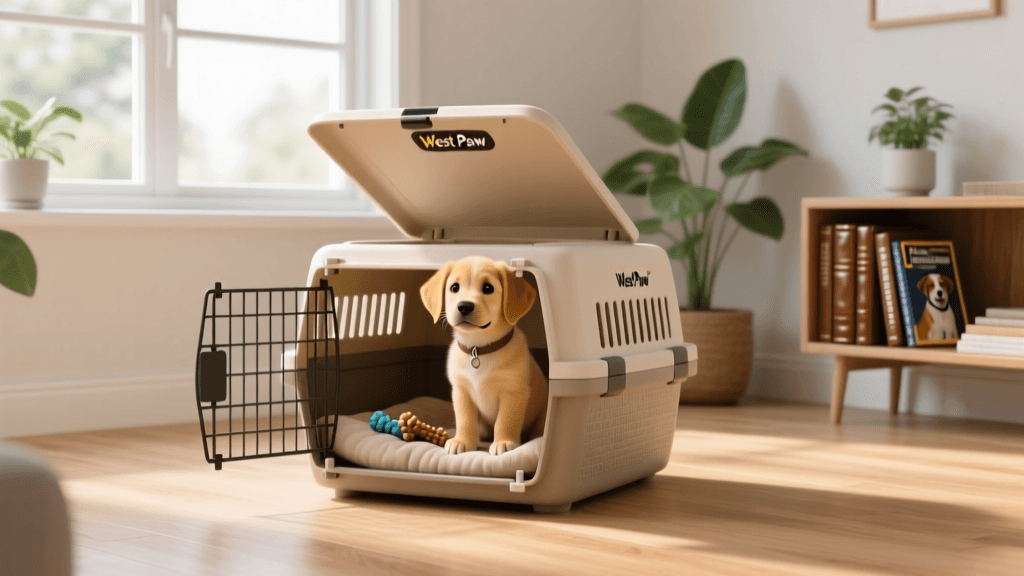
During the first few days, the crate door remains completely open or removed. Place the crate in a high-traffic area where the family spends time. Scatter a few high-value treats inside. When your puppy enters to eat them, offer calm verbal praise. Do not close the door. The goal is simply to teach the puppy that entering the crate predicts wonderful things.
Phase 2: Mealtime and Toppl Associations (Days 4-7)
Begin feeding all of your puppy's daily meals inside the crate. Place the bowl at the very back of the crate to encourage full-body entry. Once the puppy is comfortably eating meals inside, introduce the West Paw Toppl. Stuff the Toppl with a portion of their daily kibble mixed with a puppy-safe binder (like plain Greek yogurt or pumpkin puree) and freeze it. Give the frozen Toppl to your puppy inside the open crate. The cold soothes teething gums, and the licking action releases endorphins, cementing the crate as a 'happy place'.
Phase 3: Closing the Door and Micro-Durations (Days 8-14)
Once your puppy eagerly enters the crate for their Toppl, you can begin closing the door. Do not latch it yet. Simply hold the door closed with your hand while they work on the toy. The moment they finish or lose interest, open the door before they have a chance to whine. Gradually progress to latching the door for 30 seconds, then 1 minute, then 5 minutes, always providing a freshly stuffed Toppl. As outlined by the ASPCA's crate training guidelines, keeping the puppy under their stress threshold is critical; if they panic, you have moved too fast and must return to shorter durations.
High-Value Toppl Recipes for Puppies
To keep your puppy engaged in the crate, you need a variety of stuffings. Here are three force-free, puppy-safe recipes tailored for 2026 nutritional standards. Always ensure ingredients are dog-safe and account for the calories in your puppy's daily feeding allowance to prevent obesity.
| Recipe Name | Base Ingredient | Mix-ins & Toppers | Freeze Time | Best Used For |
|---|---|---|---|---|
| Puppy PB Delight | Plain Greek Yogurt | Dog-safe Peanut Butter, Blueberries | 2 Hours | First-time crate entry & short naps |
| Savory Chicken & Pumpkin | Mashed Pumpkin (Pure) | Shredded Boiled Chicken, Bone Broth | 4 Hours | Longer crate durations & separation practice |
| Teething Soother | Soaked Puppy Kibble | Goat Milk, Fresh Mint Leaves | 3 Hours | Teething discomfort & nighttime settling |
Nighttime Crate Training Routines
Nighttime is often the most challenging period for new puppy owners. Puppies have tiny bladders and are prone to separation anxiety when the house goes dark. Force-free nighttime training requires proactive management rather than reactive punishment.
Optimizing the Sleep Environment
Place the crate in your bedroom for the first few months. Puppies are social animals, and hearing your breathing and heartbeat reduces their nocturnal anxiety. Covering the top and sides of the crate with a breathable blanket creates a den-like atmosphere, blocking out visual stimuli that might trigger barking. Using a white noise machine or a heartbeat-simulating plush toy (like the Snuggle Puppy) can further mask startling household sounds.
The Midnight Potty Schedule
In 2026, we recognize that a puppy can generally hold their bladder for one hour per month of age, plus one. Therefore, an 8-week-old puppy needs a potty break every 2 to 3 hours. Set a silent alarm on your smartwatch or phone. Take the puppy out before they wake up and cry. This prevents the puppy from learning that whining is the mechanism that opens the crate door. Carry them outside to avoid playful detours, allow them to eliminate, reward heavily with a treat, and immediately return them to the crate with a small, unfrozen Toppl to encourage them back to sleep.
Troubleshooting Common Whining and Barking
Even with the best force-free methods, puppies will sometimes vocalize in the crate. How you respond dictates their future behavior.
- The 'Needs to Potty' Whine: If the puppy has been in the crate for a couple of hours and whines, assume they need to eliminate. Take them out on a leash, boring and business-like. If they potty, reward. If they don't, back in the crate.
- The 'FOMO' Bark: If the puppy barks because they hear you moving around, they are experiencing Fear Of Missing Out. Toss a few treats into the back of the crate to redirect their brain from barking to foraging.
- The Distress Cry: If the puppy is genuinely panicking (panting, drooling, throwing themselves at the door), do not leave them. This is not 'manipulation'; it is a genuine stress response. Open the door, soothe them, and reassess your training steps. You likely increased the duration or distance too quickly.
What to Avoid: Outdated Alpha and Dominance Myths
Despite the overwhelming scientific consensus supporting positive reinforcement, outdated advice still circulates on social media. To protect your puppy's mental health in 2026, strictly avoid the following aversive techniques:
Never use the crate as a time-out for bad behavior. If the crate becomes associated with punishment, your puppy will resist entering it, destroying your positive conditioning efforts.
- Do not shake cans of coins or use bark collars: These punishment-based methods suppress the symptom (the bark) but amplify the underlying emotion (fear and anxiety), leading to worse behavioral issues later in life.
- Do not force the puppy inside: Physically pushing or dragging a puppy into a crate triggers opposition reflex and panic. Always use lures, treats, and the Toppl to encourage voluntary entry.
- Do not ignore severe distress: The 'cry it out' method floods the puppy's nervous system with cortisol. Chronic stress in early development can permanently alter a dog's brain chemistry, making them more reactive and fearful as adults.
Conclusion
Force-free crate training is an investment in your puppy's lifelong emotional well-being. By utilizing modern tools like the West Paw Toppl, adhering to progressive desensitization protocols, and respecting your puppy's stress thresholds, you can transform the crate from a scary cage into a beloved sanctuary. Patience, high-value rewards, and empathy are your greatest assets in raising a confident, happy dog in 2026 and beyond.
robin-maitland
All our authors care for dogs every day — read more of their work on the authors page.