Force-Free Dog Nail Grinding: Cooperative Care 2026
Master force-free dog nail grinding in 2026 with cooperative care techniques. Learn step-by-step desensitization, tool picks, and stress-free routines.
The Shift to Force-Free Grooming in 2026
In the past, trimming a dog's nails often involved physical restraint, towel wrapping, and a high degree of stress for both the pet and the owner. However, as we navigate 2026, the veterinary and canine behavior communities have overwhelmingly shifted toward force-free, positive reinforcement methods. Physical restraint for routine grooming is no longer considered the standard of care. Instead, modern dog owners and certified behaviorists prioritize emotional welfare, utilizing cooperative care techniques that empower dogs to willingly participate in their own husbandry routines.
According to the ASPCA's official grooming guidelines, maintaining nail health is critical for a dog's orthopedic well-being, but the method of maintenance matters just as much as the result. Overgrown nails can alter a dog's posture, leading to long-term joint pain and arthritis. Yet, forcing a terrified dog through a nail trim can cause lasting psychological trauma and damage the human-animal bond. This comprehensive guide will walk you through the force-free approach to nail grinding using cooperative care, ensuring your dog remains relaxed, engaged, and completely stress-free.
What is Cooperative Care?
Cooperative care is a training philosophy rooted in positive reinforcement where the animal is given a choice to participate in a medical or grooming procedure. Rather than holding a dog down, we teach them a specific behavior—often called a 'start button'—that signals their consent. If the dog moves away, breaks the position, or shows signs of stress, the procedure immediately stops. This gives the dog agency and control, which paradoxically makes them far more willing to stay still.
Common start buttons for nail care include:
- The Chin Rest: The dog rests their chin on a designated target (like a yoga block or your lap).
- The Paw Target: The dog places their paw into a specific bucket or on a silicone mat.
- The Side Lie-Down: The dog voluntarily lies on their side on a specific grooming mat.
By utilizing these start buttons, you are communicating with your dog in a language they understand. When the chin rest is present, nail grinding happens. When the chin rest is removed, the session is over. This predictability drastically reduces canine anxiety.
Essential Tools for Stress-Free Nail Grinding
To succeed with force-free nail care in 2026, you need the right equipment. Traditional guillotine clippers or heavy-duty scissor clippers are often loud, apply immense pressure to the nail bed, and carry a high risk of 'quicking' the dog (cutting the sensitive blood vessel). Rotary tools (grinders) are the preferred choice for cooperative care.
1. The Right Rotary Tool
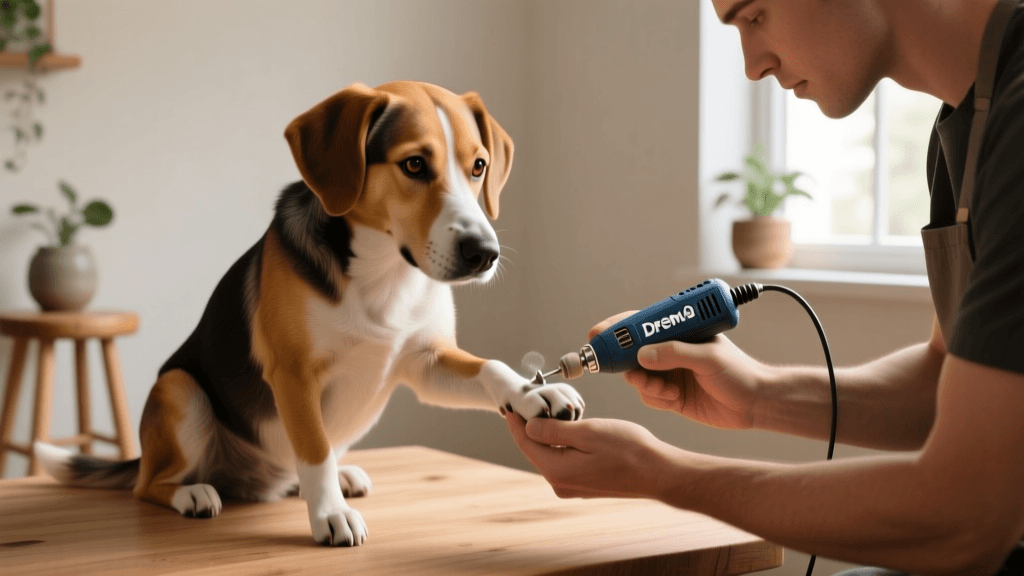
The Dremel PawControl 7760-PGK remains a top-tier choice for at-home force-free grooming. It features a 45-degree paw guide attachment that helps you safely angle the grinder and catch the nail dust. More importantly, it operates at a lower decibel level than standard hardware rotary tools, which is vital for noise-sensitive dogs. Ensure you are using a fine-grit sanding band (like a 120-grit) to prevent friction heat buildup on the nail.
2. High-Value Distraction and Reward Mats
Lick mats are an indispensable tool in the cooperative care arsenal. Licking releases endorphins in a dog's brain, naturally soothing and calming them. The Hyper Pet IQ Treat Spread Mat is an excellent option due to its durable, food-grade silicone and varied texture ridges. Spread high-value, dog-safe treats like plain Greek yogurt, mashed sweet potato, or peanut butter (xylitol-free) onto the mat and freeze it for 30 minutes before your session to create a long-lasting distraction.
The 4-Week Desensitization Protocol
Rushing the process is the most common mistake owners make. Desensitization and counter-conditioning (DS/CC) must happen at the dog's pace. Below is a structured, 4-week protocol to introduce the nail grinder using positive reinforcement.
Week 1: Sound and Sight Desensitization
Do not attempt to touch your dog with the grinder in Week 1. The goal is to change their emotional response to the sight and sound of the tool.
- Step 1: Place the turned-off grinder on the floor next to your dog's food bowl during mealtimes.
- Step 2: Hold the grinder in your hand while feeding high-value treats (like freeze-dried beef liver). Grinder appears = treats flow. Grinder disappears = treats stop.
- Step 3: Turn the grinder on in a different room while a family member feeds the dog treats. Gradually move closer to the dog over several days, only progressing if the dog remains relaxed and eager to eat.
Week 2: The Lick Mat Association
Introduce the lick mat as your primary 'start button' and distraction.
- Step 1: Present the frozen lick mat. Allow your dog to engage with it.
- Step 2: While the dog is licking, bring the turned-off grinder near their paws. Do not touch them.
- Step 3: If the dog stops licking or looks up, pause immediately. We want the dog to learn that focusing on the mat keeps the session going and the treats flowing.
Week 3: Touch and Vibration
Now we introduce physical sensation without grinding.
- Step 1: With the grinder turned OFF, gently touch the plastic guard of the tool to the dog's nail for one second, then mark with a 'Yes!' and deliver a treat.
- Step 2: Turn the grinder ON, but keep it an inch away from the nail so the dog feels the vibration and hears the motor up close.
- Step 3: Touch the *side* of the grinder (not the spinning sanding band) to the nail. Reward heavily.
Week 4: The First Grind
You are now ready to remove a microscopic amount of nail.
- Step 1: Present the lick mat. Wait for your dog to settle into their start button position (e.g., chin rest or paw target).
- Step 2: Gently hold the toe. Apply the spinning grinder to the tip of the nail for exactly ONE second.
- Step 3: Mark, praise, and allow the dog to continue licking. Repeat for a maximum of 3-5 nails per session. End on a positive note before the dog shows any signs of fatigue or frustration.
Dremel Speed Settings and Nail Types
Using the correct speed on your rotary tool is essential to prevent heat friction, which can cause pain and set your training back weeks. Refer to the table below for 2026 best practices regarding grinder speeds based on dog size and nail density.
| Dog Size / Breed Type | Nail Characteristics | Recommended Grinder Speed | Grinding Technique |
|---|---|---|---|
| Toy / Small Breeds (e.g., Chihuahua, Pomeranian) | Thin, brittle, fast-growing | Low (Speed 1 / 5,000 RPM) | Lightest touch, 1-second pulses to avoid heat. |
| Medium Breeds (e.g., Beagle, Cocker Spaniel) | Medium density, moderate quick | Medium (Speed 2 / 10,000 RPM) | Steady pressure, 2-second pulses, check temp frequently. |
| Large / Giant Breeds (e.g., Mastiff, German Shepherd) | Thick, dense, wide nail bed | Medium-High (Speed 3 / 15,000 RPM) | Bevel the edges first, then flatten the tip. Use 2-second pulses. |
| Terriers / Wire-Coated Breeds | Hard, calcified outer shell | Medium (Speed 2 / 10,000 RPM) | May require slightly longer contact, but monitor for heat. |
Understanding the Quick: Anatomy and Safety
The 'quick' is the living tissue inside the nail that contains blood vessels and nerves. Cutting or grinding into the quick is painful and will cause bleeding. According to the American Kennel Club's nail trimming advice, identifying the quick is easier on dogs with white or clear nails, where it appears as a pinkish-red core. For dogs with black nails, you must grind in tiny increments.
Pro-Tip for Black Nails: After each 1-second grind, look at the cross-section of the nail. When you see a dark, chalky white or grayish circle appear in the center, STOP immediately. The very next layer will be the quick. You can also look for a small dark dot in the center of the nail bed, which indicates you are approaching the blood supply.
Reading Canine Body Language
Force-free training requires fluency in canine body language. Your dog will tell you if they are becoming overwhelmed long before they pull away or snap. Watch for these subtle signs of stress:
- Lip Licking: Repeatedly flicking the tongue over the nose when no food is present.
- Whale Eye: Showing the whites of the eyes while turning the head away.
- Yawning: Out-of-context yawning is a major calming signal indicating internal stress.
- Freezing: A sudden cessation of movement or licking. If your dog freezes on the lick mat, the session has pushed past their threshold.
If you observe any of these signals, immediately remove the grinder, take away the lick mat, and give the dog a break. The next session should be easier, perhaps returning to the previous week's desensitization step.
Troubleshooting Common Setbacks
My dog pulls their paw away the moment the grinder turns on.
This indicates the sound or vibration is still triggering a fear response. Return to Week 1 and 2. Try turning the grinder on while the dog is engaged in a high-value activity, like eating their dinner from a snuffle mat, to build a stronger positive emotional response to the noise.
My dog won't use the lick mat.
Ensure the food spread is highly motivating. Kibble or dry treats won't work for a lick mat. Use aromatic, high-value spreads like pureed sardines, cottage cheese, or canned pumpkin. If the mat is frozen, let it thaw slightly so the dog can actually lick the reward off without getting frustrated.
We had a setback and I quicked my dog by accident.
Accidents happen. Have styptic powder (like Kwik Stop) on hand before every session. If you hit the quick, calmly apply the powder with gentle pressure, offer a massive jackpot of high-value treats (like real chicken or cheese), and end the session immediately. Do not attempt to 'finish' the nail. Wait at least a week before trying again, and start back at the desensitization phase to rebuild trust.
Conclusion
Embracing force-free, cooperative care for nail grinding is one of the most rewarding investments you can make in your dog's lifelong well-being. By prioritizing your dog's emotional state and utilizing positive reinforcement, you transform a historically dreaded chore into a bonding exercise. Remember that in 2026, patience and empathy are your most valuable grooming tools. Celebrate the small victories, respect your dog's boundaries, and enjoy the journey toward a happier, healthier, and stress-free life with your canine companion.
anouk-beaumont
All our authors care for dogs every day — read more of their work on the authors page.