Force-Free Bell Training For Puppy Potty 2026: Step-By-Step
Master force-free bell training for your puppy's potty routine in 2026. Learn positive reinforcement shaping, schedules, and reward-based milestones.
Why Force-Free Bell Training is the 2026 Gold Standard
Welcome to the modern era of puppy care. In 2026, the veterinary and behavioral communities are more unified than ever on one crucial fact: force-free, positive reinforcement methods are not just kinder, they are scientifically superior for long-term behavioral health. When it comes to potty training, outdated methods involving punishment, scolding, or rubbing a puppy's nose in an accident have been entirely debunked. Instead, positive reinforcement focuses on teaching the puppy exactly what we want them to do, rather than punishing them for what we don't.
Bell training is one of the most effective force-free communication tools available. By teaching your puppy to ring a bell to signal they need to go outside, you empower them to communicate their biological needs clearly, drastically reducing indoor accidents and owner frustration. This guide will walk you through the exact force-free shaping protocol, developmental milestones, and reward strategies to master potty bell training this year.
The Science Behind Shaping and Capturing
Force-free training relies heavily on operant conditioning, specifically the quadrants of positive reinforcement (adding something pleasant to increase a behavior) and negative punishment (removing something pleasant to decrease a behavior). We completely avoid positive punishment (adding an aversive) and negative reinforcement (removing an aversive).
According to the American Veterinary Society of Animal Behavior (AVSAB), reward-based training is the most effective method for addressing behavioral issues and teaching new skills. The AVSAB explicitly states that aversive methods can cause fear, anxiety, and aggression, which is why force-free shaping is the recommended standard for all puppy development in 2026. Shaping involves breaking down a complex behavior (ringing a bell to go potty) into tiny, achievable steps and rewarding each micro-success. Capturing involves waiting for the puppy to offer a behavior naturally and marking it with a reward. Both techniques build a confident, eager-to-learn puppy.
Essential 2026 Gear for Positive Potty Training
Setting up your environment for success is a cornerstone of force-free puppy care. You do not need shock collars, indoor electric fences, or bitter sprays. You need high-value motivation and proper management tools.
- Potty Bells: Choose a bell with a clear, distinct sound that isn't overly startling. The Mighty Paw Smart Bell (a popular 2026 wireless option) or traditional jingle bells on a nylon strap work excellently. Ensure the strap is adjustable to grow with your puppy.
- High-Value Rewards: Kibble rarely cuts it for potty training. You need single-ingredient, high-value treats like freeze-dried beef liver, Zuke's Mini Naturals, or Happy Howie's meat rolls. Keep pieces the size of a pea to avoid overfeeding.
- Enzymatic Cleaners: Accidents will happen. Force-free training requires removing the scent marker without punishing the dog. Use a high-quality enzymatic cleaner like Nature's Miracle or Rocco & Roxie to break down uric acid crystals, preventing the puppy from remarking the same spot.
- A Marker Word or Clicker: A mechanical clicker or a consistent verbal marker like "Yes!" bridges the gap between the behavior and the reward.
Comparison: Force-Free vs. Aversive Potty Methods
| Training Aspect | Force-Free (Recommended) | Aversive / Outdated |
|---|---|---|
| Accident Response | Interrupt calmly, take outside, clean with enzymes. | Yelling, nose-rubbing, or physical punishment. |
| Communication | Bell ringing shaped via positive reinforcement. | Waiting for the dog to "figure it out" or whine. |
| Reward Timing | Immediate treat delivery upon outdoor elimination. | Verbal praise only, or treats given too late indoors. |
| Crate Usage | Positive sanctuary, fed meals inside, never for timeout. | Used as a punishment zone for indoor accidents. |
The 4-Week Force-Free Bell Training Protocol
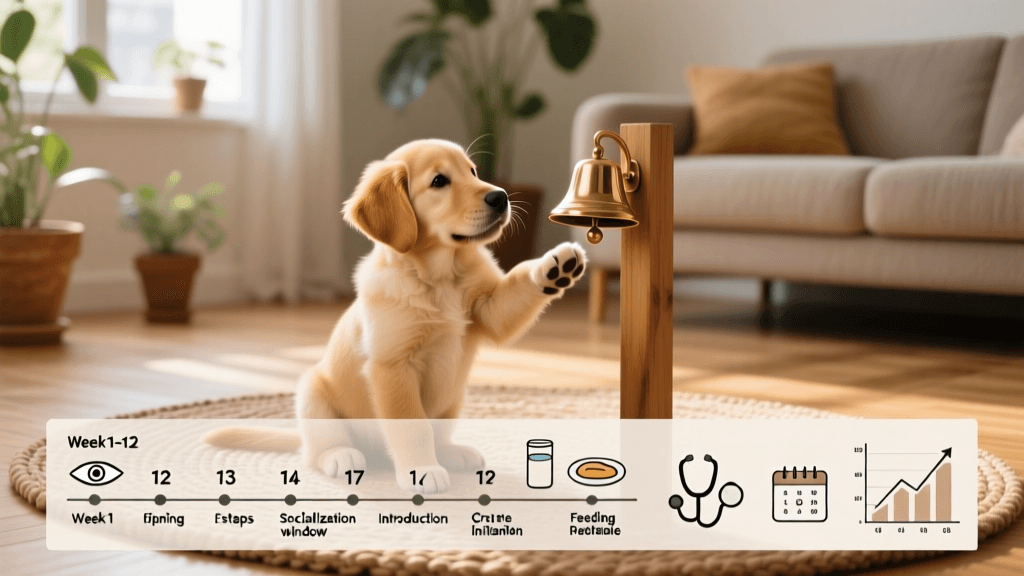
This step-by-step protocol uses shaping to teach your puppy to target the bell with their nose or paw. Keep training sessions short—about 3 to 5 minutes, two to three times a day, outside of actual potty breaks initially.
Week 1: Targeting the Bell
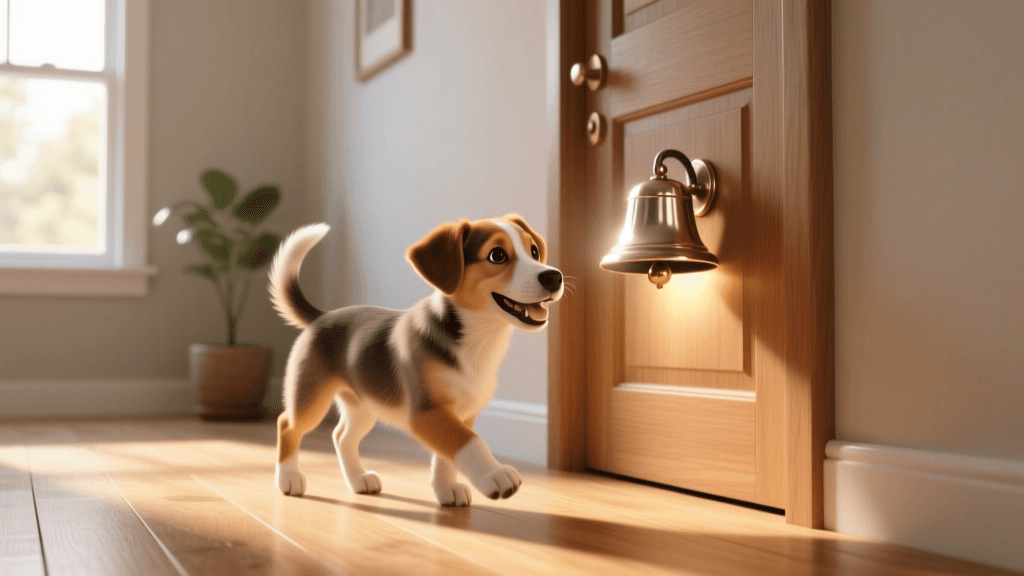
Hang the bell on the door handle at your puppy's nose level. Hold a high-value treat near the bell. When the puppy moves toward the treat and accidentally bumps the bell, immediately say "Yes!" or click, and give the treat. Repeat this until the puppy is intentionally nudging the bell to make it ring in order to get the treat. We are building a positive association with the sound of the bell.
Week 2: Pairing the Bell with the Door
Now, we add the door. When the puppy rings the bell, say "Yes!", open the door immediately, and toss a treat outside onto the grass. The puppy learns that ringing the bell makes the door open and leads to outdoor rewards. Do not require them to potty at this stage; we are simply linking the bell to the door opening.
Week 3: Adding the Potty Command
Begin incorporating the bell into your actual potty routine. When you know your puppy needs to eliminate (e.g., right after waking up or eating), gently guide them to the bell. If they ring it, open the door, walk them to their designated potty spot, and use your chosen verbal cue (e.g., "Go potty"). The moment they eliminate, throw a "potty party"—offer enthusiastic praise and three to five high-value treats in succession. According to ASPCA's house-training guidelines, immediate and substantial rewards for outdoor elimination are critical for cementing the habit.
Week 4: Fading the Lure and Proofing
Stop guiding the puppy to the bell. Wait for them to offer the behavior independently. If they ring the bell, take them out immediately on a leash. Stand quietly in the potty spot. If they eliminate, reward heavily. If they don't eliminate within five minutes, bring them back inside, place them in their crate or a small playpen for 10 minutes (this is management, not punishment), and try again. This prevents the puppy from learning that ringing the bell results in 20 minutes of unsupervised yard play.
Managing Accidents Without Punishment
In a force-free framework, an indoor accident is simply a data point indicating a failure in management or timing, not a failure in the puppy's morality. Puppies do not possess the cognitive ability to feel "guilt." The submissive postures they display when you are upset are appeasement behaviors meant to calm your anger, not an admission of wrongdoing.
If you catch your puppy in the act, clap your hands once or make a gentle "oops" sound to interrupt the flow. Immediately scoop them up or leash them and carry them outside to finish. If they finish outside, reward them. Clean the indoor spot thoroughly with an enzymatic cleaner. Never use ammonia-based cleaners, as ammonia smells like urine to a dog and will encourage remarking.
Puppy Bladder Milestones and Schedules
Understanding your puppy's physiological limitations is vital for setting realistic expectations. A general rule of thumb for bladder capacity is that a puppy can hold it for one hour per month of age, plus one. However, this only applies when they are resting or crated. Active puppies need to go out much more frequently.
- 8 to 10 Weeks: Potty every 1 to 2 hours, plus immediately after waking, eating, drinking, or playing. Crate training is highly recommended at night to prevent wandering and accidents.
- 11 to 14 Weeks: Bladder control improves. Potty every 2 to 3 hours. Bell training usually starts showing reliable results during this window.
- 15 to 20 Weeks: Potty every 3 to 4 hours. Puppies begin to understand the concept of "holding it" and will actively seek out the door or the bell.
- 6 Months and Beyond: Most puppies can hold it for 6 to 8 hours during the day, though you should still provide midday potty breaks for their physical comfort and mental well-being.
Troubleshooting Common Positive Reinforcement Hurdles
The Puppy Rings the Bell to Play, Not Potty: This is the most common issue. If your puppy rings the bell, you take them out, and they just want to play, you must implement the "boring potty trip" rule. Keep them on a leash, stand in one spot, and be entirely uninteresting. If they don't potty within 3 to 5 minutes, go back inside and restrict their freedom for 10 minutes before trying again. They will quickly learn that the bell only opens the door for business, not for a recreational romp.
The Puppy is Afraid of the Bell Sound: Some sensitive puppies find the jingle of metal bells startling. If your puppy retreats when the bell rings, you must desensitize them. Muffle the bell with a piece of cloth or tape so it makes a very soft thud. Reward the puppy for interacting with the muffled bell. Gradually remove the muffling over several days as the puppy's confidence grows, pairing every sound with a high-value treat like lickable peanut butter from a Kong.
Conclusion
Force-free bell training is an investment in your puppy's confidence and your mutual bond. By utilizing positive reinforcement, shaping, and high-value rewards, you are teaching your puppy that communicating with you is safe, rewarding, and effective. Stick to the 2026 behavioral standards, manage their environment to prevent accidents, and celebrate the small victories. Within a few weeks, you will have a puppy who politely rings a bell when nature calls, setting the stage for a lifetime of trust-based training.
robin-maitland
All our authors care for dogs every day — read more of their work on the authors page.