2026 Guide: Transitioning Your Puppy to a New Home
Expert tips for moving with a puppy in 2026. Learn to set up a safe space, manage potty training, and reduce stress during your new home transition.
The Psychological Impact of Moving on Puppies
Moving to a new home is a monumental life transition, not just for you, but for your growing puppy. While humans can conceptualize the reasons behind packing boxes and changing addresses, puppies experience the world through routine, scent mapping, and environmental stability. When you uproot a puppy from their familiar environment, you are essentially erasing their mental map of the world. In 2026, veterinary behaviorists emphasize that a puppy's stress response to relocation can manifest as regression in potty training, increased vocalization, or destructive chewing if not managed with intentional, proactive strategies.
According to the American Kennel Club (AKC), maintaining a predictable schedule amidst the chaos of moving is the single most effective way to mitigate canine anxiety. This comprehensive guide will walk you through the exact steps, modern tools, and behavioral techniques required to transition your puppy to a new home stress-free.
The 30-Day Pre-Move Preparation Checklist
The transition begins weeks before the moving truck arrives. Puppies are highly perceptive of changes in their owners' stress levels and the physical alteration of their environment. To keep your puppy grounded, implement the following pre-move protocols:
- Maintain the Core Routine: Feed, walk, and train your puppy at the exact same times every day. If your schedule becomes erratic due to packing, hire a local dog walker or utilize a trusted pet sitter to maintain their biological clock.
- Pack the Puppy's Items Last: Do not pack your puppy's bed, favorite toys, or primary food and water bowls until the absolute last moment. These items serve as 'scent anchors' that provide comfort.
- Introduce the Travel Crate Early: If your puppy will be traveling in a crate, ensure it is set up in the living room at least three weeks prior to the move. Feed them their meals inside the crate to build a positive association with confinement before the stress of travel.
- Update Microchip and GPS Data: Before you even step foot in the new home, update your puppy's microchip registry with your new address. In 2026, it is also highly recommended to equip your puppy with a modern GPS tracker, such as the Fi Series 4 GPS Collar, which offers real-time location tracking and escape alerts during the chaotic loading and unloading phases.
Designing the 2026 'Basecamp' Safe Room
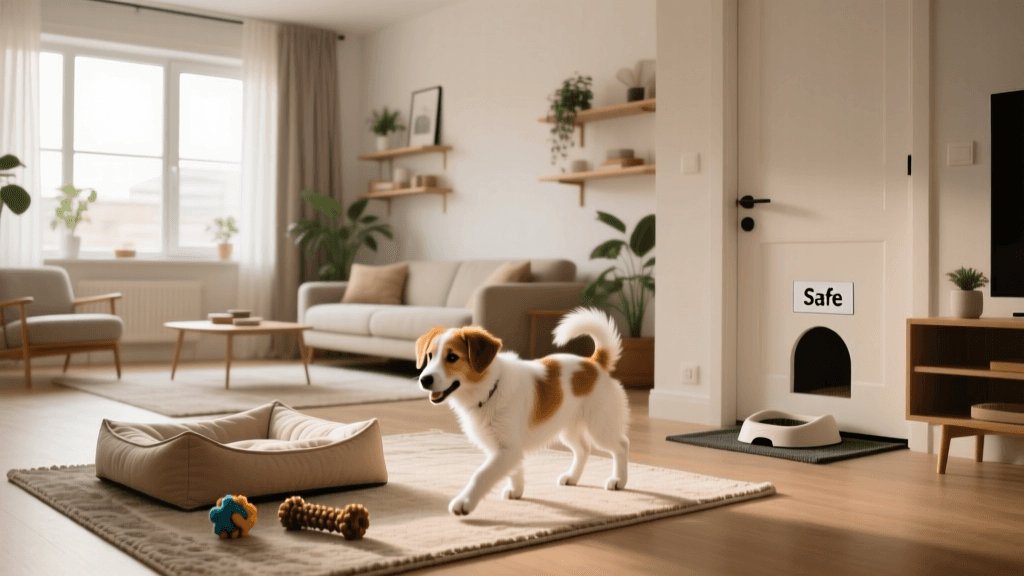
When you arrive at your new home, your puppy should not be given free roam of the space. The sudden influx of new smells, echoing acoustics, and unfamiliar layouts can cause sensory overload. Instead, establish a 'Basecamp' safe room.
Choosing and Setting Up the Room
Select a quiet room with a door that closes securely, such as a guest bedroom or a large bathroom. This room will serve as your puppy's sanctuary while movers are present and while you unpack the rest of the house.
- Scent Transfer: Bring an unwashed t-shirt you have worn recently and place it in their bed. Your scent is the ultimate calming agent.
- Acoustic Dampening: New homes often have different acoustics that can startle a puppy. Use a white noise machine or play classical music designed for canine relaxation to mask the sounds of moving boxes and unfamiliar neighborhood noise.
- The Comfort Kit: Include a SmartPet Snuggle Puppy (which mimics a heartbeat and provides warmth) and a K9 Ballistics Tough Crate Pad to ensure their resting area is indestructible and comforting.
'A puppy's safe room should not feel like a punishment zone. It must be a highly enriched, positive environment where they can decompress while the chaotic transition happens around them.' — Dr. Sarah Chen, Veterinary Behaviorist, 2026
Moving Day Logistics and Travel Safety
Moving day is inherently chaotic. Doors will be left open, strangers will be walking through the house, and the energy will be frantic. For the safety and sanity of your puppy, they must be secured away from the main action.
If you are hiring professional movers, confine your puppy to their crate in a closed room with a clear sign on the door that reads: 'DO NOT ENTER: SECURED PUPPY'. When it is time to transport your puppy to the new location, never allow them to ride loose in the vehicle. In 2026, crash-tested safety is paramount. Utilize a crash-tested harness like the Sleepypod Clickit Sport or a secured, hard-sided travel carrier. If you are undertaking a long-distance move, plan for a potty break every two to three hours, always using a secure, double-clipped leash system to prevent escape attempts in unfamiliar rest areas.
The Post-Move Potty Training Reset
One of the most common issues pet owners face after a life transition is potty training regression. A new yard, new flooring, and new neighborhood scents can completely confuse a puppy who was previously housebroken. The ASPCA recommends treating the first two weeks in a new home as if the puppy is completely untrained.
Strategies for the New Environment
- Scent Marking the New Yard: If you are moving to a house with a yard, bring a few of your puppy's soiled potty pads or a small amount of their waste from the old home and place it in the designated new potty area. This olfactory cue signals to the puppy where they are supposed to eliminate.
- Supervised Exploration: Do not let the puppy out into the new yard alone. Go out with them, keep them on a 15-foot training lead, and reward them heavily with high-value treats (like freeze-dried beef liver) the moment they eliminate in the correct spot.
- Indoor Potty Stations for Apartments: If you are transitioning from a house to a high-rise apartment in 2026, indoor potty solutions are more advanced than ever. Consider a smart indoor potty system or high-quality washable grass patches like the DoggieLawn Hydroponic System to bridge the gap between outdoor walks and indoor necessities during bad weather or high-floor living.
2026 Smart Home Tech for Transition Monitoring
Life transitions often require you to leave your puppy alone in the new home for short periods as you run errands, set up utilities, or return to a hybrid work schedule. Separation anxiety peaks during the first month in a new environment. Utilizing modern smart home technology allows you to monitor their stress levels and intervene remotely.
| Device Category | Top 2026 Model | Key Transition Feature | Avg. Cost (2026) |
|---|---|---|---|
| Interactive Camera | Furbo 4K Dog Camera | AI bark alerts and remote treat tossing to redirect anxiety-induced pacing. | $219 |
| Smart Puzzle Feeder | Petcube Bites 3 Lite | Scheduled treat dispensing to keep the puppy engaged while you unpack. | $149 |
| Biometric Health Monitor | Whistle Go 2026 Edition | Tracks sleep quality and stress-induced scratching in the new environment. | $99 |
| Automated Companion | Enabot EBO SE | Roaming floor robot that dispenses treats and allows two-way audio check-ins. | $299 |
Frequently Asked Questions
How long does it take for a puppy to adjust to a new home?
Most puppies begin to feel comfortable within 7 to 14 days, but full behavioral adjustment and the re-establishment of deep trust in the new environment can take up to 30 days. Patience and strict adherence to routine are critical during this window.
Should I introduce my puppy to the neighbors immediately?
No. For the first week, limit your puppy's social circle to your immediate household. Introducing them to neighbors, new dogs, and the broader neighborhood should be done gradually in the second week, ensuring they feel secure in their 'home base' before expanding their territory.
What if my puppy stops eating after the move?
A temporary decrease in appetite (24-48 hours) is a normal stress response. Ensure they are staying hydrated and offer highly palatable, warm foods like boiled chicken and rice. If the fasting extends beyond 48 hours, or is accompanied by lethargy or vomiting, consult your new local veterinarian immediately.
Conclusion
A life transition like moving to a new home is a significant milestone in your puppy's first year. By prioritizing their psychological need for routine, utilizing a designated Basecamp safe room, and leveraging 2026's advanced pet monitoring technology, you can transform a potentially traumatic event into an exciting new chapter. Remember, your calm energy is your puppy's greatest anchor. Take a deep breath, stick to the plan, and enjoy exploring your new neighborhood together.
hannah-wickes
All our authors care for dogs every day — read more of their work on the authors page.