First-Time Owner Guide To Puppy Potty Training Schedules
Master puppy potty training with our first-time owner guide. Learn exact schedules, crate setup tips, and accident cleanup for a stress-free start.
The Reality of Puppy Potty Training for First-Time Owners
Bringing home a new puppy is an exhilarating experience filled with cuddles, playtime, and adorable moments. However, for first-time dog owners, the honeymoon phase can quickly be interrupted by the daunting reality of potty training. Housebreaking a puppy requires immense patience, strict consistency, and a solid understanding of canine biology. If you are feeling overwhelmed by the constant watchfulness required to prevent indoor accidents, know that you are not alone. Potty training is consistently ranked as one of the most stressful aspects of early puppy care. The good news? With a structured schedule, the right tools, and positive reinforcement, you can successfully teach your puppy where to do their business. This comprehensive guide is designed specifically for first-time owners, breaking down the exact timelines, costs, and actionable steps you need to create a stress-free potty training routine.
The Biology of a Puppy Bladder
Understanding your puppy's physical limitations is the first step toward success. According to the American Kennel Club, puppies do not develop full bladder control until they are about four to six months old. Until then, their sphincter muscles are simply not strong enough to hold urine for extended periods. Expecting an eight-week-old puppy to hold it for eight hours while you sleep or work is biologically impossible and sets both of you up for failure.
The Golden Rule of Bladder Capacity
Veterinarians and professional dog trainers generally rely on a simple mathematical formula to estimate a puppy's maximum bladder capacity: the age of the puppy in months, plus one, equals the number of hours they can comfortably hold their bladder. For example, a two-month-old (eight-week) puppy can hold it for roughly three hours at the absolute maximum, though during active daytime play, they will need to go out much more frequently. This rule applies primarily to resting or crated puppies; active puppies metabolize water and food much faster and will need more frequent potty breaks.
The Ultimate First-Time Owner Potty Schedule
Consistency is your greatest ally in potty training. Puppies thrive on routine, and their internal clocks adapt quickly when fed and walked at the same times every day. Below is a structured guideline to help you anticipate your puppy's needs based on their developmental stage.
| Puppy Age | Max Bladder Hold Time | Daytime Potty Frequency | Nighttime Wakeups Needed |
|---|---|---|---|
| 8-10 Weeks | 1-2 Hours | Every 1-2 Hours | 2-3 Wakeups |
| 11-14 Weeks | 2-3 Hours | Every 2-3 Hours | 1-2 Wakeups |
| 15-16 Weeks | 3-4 Hours | Every 3-4 Hours | 0-1 Wakeups |
| 4-6 Months | 4-6 Hours | Every 4-5 Hours | 0 Wakeups |
Keep in mind that these are maximums. You should always take your puppy out immediately after they wake up from a nap, within 15 to 30 minutes after eating a meal, and immediately after an intense play session. These are the three critical trigger points for puppy elimination.
Essential Gear and Costs for Success
You do not need to spend a fortune to potty train a puppy, but investing in the right tools will save you hours of frustration and hundreds of dollars in ruined rugs. Here is what every first-time owner needs in their arsenal.
1. The Right-Sized Crate with a Divider
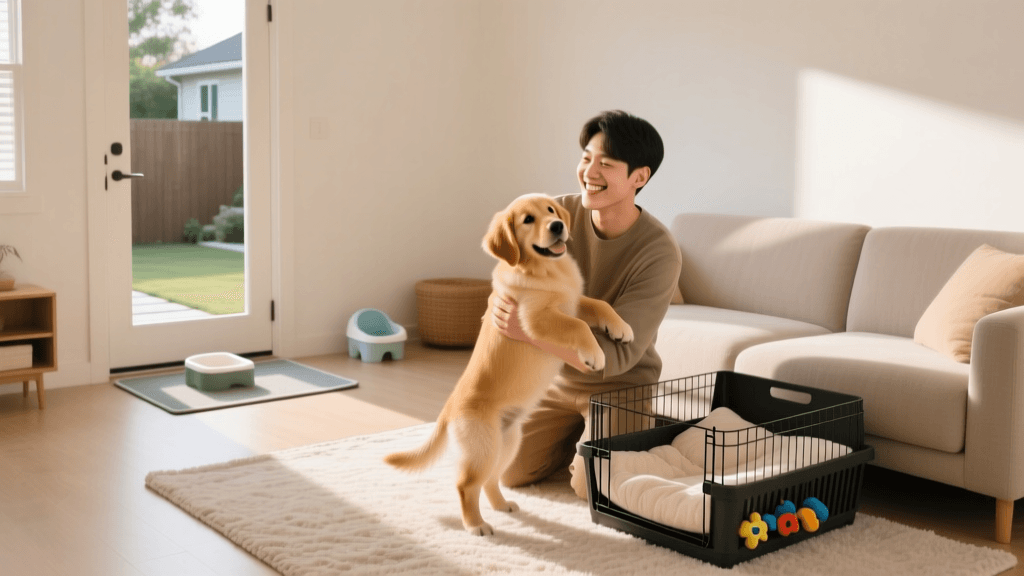
Crate training leverages a dog's natural instinct to keep their sleeping area clean. If a crate is too large, a puppy will simply designate one corner as their bedroom and the opposite corner as their bathroom. To prevent this, purchase a wire or plastic crate that will fit their estimated adult size, but use an adjustable divider panel to restrict their space while they are young. A mid-sized wire crate like the MidWest Homes for Pets iCrate typically costs between $60 and $90. The space should be just large enough for the puppy to stand up, turn around, and lie down comfortably. As they grow and demonstrate bladder control, you can move the divider back.
2. High-Quality Enzymatic Cleaners
Standard household cleaners, vinegar, and baking soda do not break down uric acid crystals found in dog urine. If you use standard cleaners, the urine may smell fine to human noses, but your puppy's highly sensitive olfactory system will still detect it, marking that spot as an approved bathroom. You must use an enzymatic cleaner that literally eats the organic bacteria causing the odor. Top-rated products include Nature's Miracle Advanced Stain and Odor Eliminator (around $12 to $15 per 32oz bottle) and Rocco & Roxie Professional Strength Stain & Odor Eliminator (around $20 per 32oz bottle). Buy a large gallon jug; you will use it more than you think during the first eight weeks.
3. High-Value Training Treats
When your puppy eliminates outside, you need to throw a party. Standard kibble rarely cuts it for high-distraction outdoor environments. Invest in soft, smelly, high-value treats that can be broken into tiny pieces. Zuke's Mini Naturals or boiled chicken breast are excellent choices. Keep a treat pouch by the door so you can reward your puppy the exact second they finish their business, not when they return inside. Timing is everything in positive reinforcement.
Step-by-Step Daily Routine
Here is exactly how to structure a typical day for an eight-to-ten-week-old puppy to minimize accidents:
- 7:00 AM - Wake Up & Immediate Potty: Carry your puppy directly from the crate to the designated outdoor potty spot. Do not let them walk, as walking stimulates the bladder and may cause an accident en route.
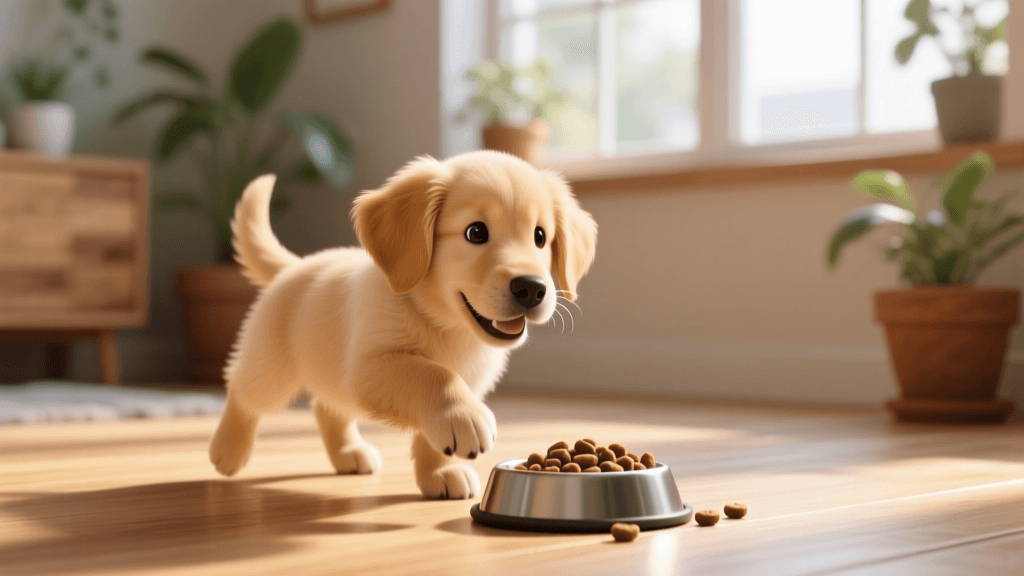
- 7:15 AM - Breakfast: Feed your puppy their measured morning meal. Remove the food bowl after 15 minutes to establish a strict feeding schedule, which in turn creates a predictable potty schedule.
- 7:45 AM - Second Potty Break: Take them back outside 20 to 30 minutes after eating.
- 8:00 AM - Supervised Play: Engage in training or playtime. Keep them in your line of sight at all times.
- 9:00 AM - Potty & Nap: Take them out, then place them in the crate for a morning nap.
- 11:00 AM - Wake, Potty, Play: Repeat the cycle. Every time they wake up, they go straight outside.
The Power of the Potty Command
First-time owners often miss the opportunity to build a verbal cue for elimination. While your puppy is in the act of sniffing and circling, calmly repeat a chosen phrase like 'Go Potty' or 'Do Your Business'. The moment they begin to eliminate, praise them softly. As soon as they finish, immediately give them a high-value treat and offer enthusiastic verbal praise. Within a few weeks, your puppy will associate the verbal cue with the action, allowing you to prompt them to go on command during bad weather or on long road trips.
Handling Accidents and Submissive Urination
Accidents will happen. How you react will dictate how quickly your puppy learns. If you catch your puppy in the act, clap your hands loudly once to interrupt them, scoop them up, and carry them outside to finish. Praise them if they finish outdoors. If you find an accident after the fact, do absolutely nothing to the puppy. Rubbing their nose in it or yelling will only teach them to hide from you when they need to go, leading to sneaky accidents behind furniture.
The Humane Society of the United States strongly advises against any form of physical punishment or scolding for housetraining accidents, noting that it damages the bond between owner and dog and increases anxiety. Furthermore, first-time owners should be aware of submissive or excitement urination. This is an involuntary physical response where a puppy leaks urine when greeting you or when being scolded. It is not a potty training failure; it is a communication signal. Ignore the behavior, clean it up with your enzymatic cleaner, and keep greetings calm and low-key until the puppy matures and gains confidence.
Patience is your most valuable tool. Puppies are babies learning a completely foreign concept in a new environment. Celebrate the small victories and manage their environment to set them up for success.
Final Thoughts for First-Time Owners
Potty training is a marathon, not a sprint. There will be days when you feel like you are taking a step backward, especially during teething phases or periods of rapid growth. Stick to your schedule, manage their water intake before bedtime (pick up the water bowl two hours before sleep), and utilize your crate to prevent unsupervised roaming. By combining the biological realities of your puppy's development with a consistent, reward-based routine, you will build a foundation of trust and cleanliness that will last a lifetime. You have got this!
priya-sutaria
All our authors care for dogs every day — read more of their work on the authors page.