First-Time Puppy Potty Training Schedule and Crate Guide
Master puppy potty training with our first-time owner guide. Get hourly schedules, crate training tips, and accident prevention strategies today.
Welcome to Puppy Parenthood: Setting Realistic Expectations
Bringing a new puppy home is one of the most thrilling experiences of your life, but it also comes with a steep learning curve. For first-time dog owners, the most daunting challenge is often potty training. Without a structured plan, your home can quickly become a minefield of accidents, leading to frustration for you and confusion for your new furry friend. The secret to success lies in understanding your puppy's biological limitations, establishing a rigid daily routine, and utilizing a crate as a positive training tool.
According to the ASPCA, puppies have very limited control over their bladders and bowels during the first few months of life. Expecting an eight-week-old puppy to 'hold it' for eight hours while you are at work is biologically impossible and sets the stage for failure. By setting realistic expectations and committing to a proactive schedule, you can housebreak your puppy efficiently and humanely.
Understanding Your Puppy's Bladder Capacity
A general rule of thumb endorsed by veterinarians is the 'month-plus-one' rule. A puppy can typically hold their bladder for one hour per month of age, plus one additional hour. Therefore, a two-month-old (eight-week) puppy can hold it for roughly three hours maximum under ideal conditions, but practically, they need to go out much more frequently when active and playing.
| Puppy Age | Maximum Crate Time (Day) | Active Potty Break Frequency |
|---|---|---|
| 8 Weeks | 2 Hours | Every 1 to 1.5 Hours |
| 12 Weeks | 3 Hours | Every 1.5 to 2 Hours |
| 16 Weeks | 4 Hours | Every 2 to 3 Hours |
| 6 Months | 6 to 7 Hours | Every 4 to 5 Hours |
Note: Nighttime bladder control is slightly different, as a puppy's metabolism slows down during sleep. However, first-time owners should still expect at least one midnight potty break for the first few weeks.
The First-Time Owner’s Daily Potty Schedule
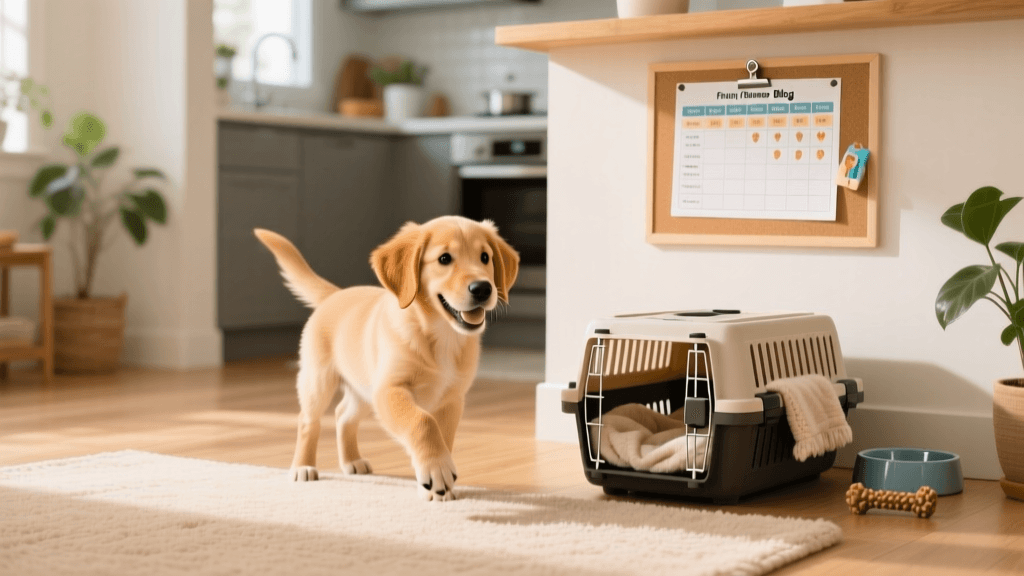
Consistency is the cornerstone of potty training. Puppies thrive on routine, and their digestive systems will quickly adapt to a predictable feeding and elimination schedule. Here is a sample schedule for an 8-to-12-week-old puppy:
- 7:00 AM: Wake up and immediately carry the puppy outside. Do not let their paws touch the indoor floor.
- 7:15 AM: Breakfast time. Measure food precisely according to the bag's guidelines to avoid digestive upset.
- 7:45 AM: Outside for the post-meal potty break. Puppies usually need to eliminate 15 to 30 minutes after eating.
- 8:30 AM: Supervised playtime and socialization.
- 9:30 AM: Potty break, followed by morning nap in the crate.
- 11:30 AM: Wake up, straight outside, followed by training and play.
- 1:00 PM: Potty break and lunch (if feeding three meals a day).
- 1:30 PM: Nap time in the crate.
- 4:00 PM: Potty break, playtime, and chew toy enrichment.
- 6:00 PM: Dinner time.
- 6:30 PM: Potty break and gentle evening activities.
- 8:00 PM: Water bowl removed to prepare for bedtime.
- 10:00 PM: Final potty break and into the crate for the night.
- 2:00 AM: Midnight potty break (keep lights dim and interaction minimal).
Crate Training: Your Greatest Potty Training Ally
The American Kennel Club (AKC) highly recommends crate training, noting that dogs are natural den animals and will instinctively avoid soiling their sleeping area. A crate is not a punishment; it is a safe haven and an indispensable management tool that prevents unsupervised accidents.
Selecting the Right Crate
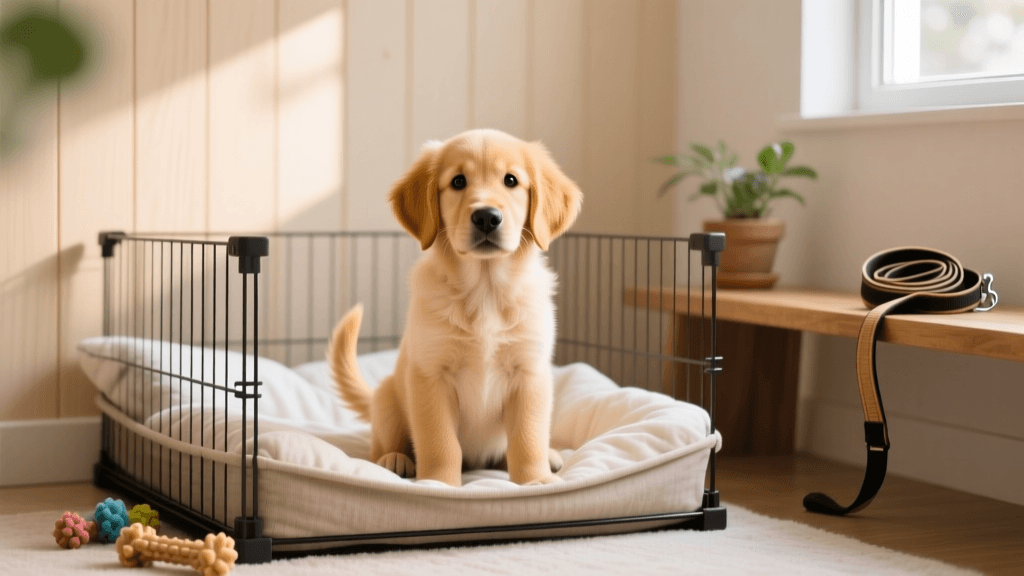
For a growing puppy, invest in a wire crate with an adjustable divider panel, such as the MidWest Homes for Pets iCrate (typically costing between $40 and $70 depending on size). The divider allows you to adjust the interior space as your puppy grows. The crate should be just large enough for the puppy to stand up, turn around, and lie down comfortably. If the crate is too large, the puppy may designate one corner as a bathroom and the other as a bedroom, entirely defeating the purpose of the crate.
Step-by-Step Crate Introduction
- Make it inviting: Place a soft washable blanket and a safe chew toy inside. Avoid plush beds initially, as teething puppies may chew and ingest the stuffing, leading to costly veterinary emergencies.
- Associate with positive rewards: Toss high-value treats, like small pieces of boiled chicken or Zuke's Mini Naturals, into the back of the crate. Let the puppy enter and exit freely without closing the door.
- Feed meals in the crate: This builds a strong positive association with the space.
- Practice short absences: Close the door while you are in the room, gradually increasing the time. Then, step out of the room for a few minutes, returning before the puppy begins to whine.
The Nighttime Survival Guide
Nighttime is often the most stressful period for first-time owners. To minimize sleep disruption, implement a strict evening routine. Remove your puppy's water bowl roughly two hours before bedtime. If you plan to crate the puppy at 10:00 PM, pick up the water at 8:00 PM. Take them out for a final, boring potty break right before you go to sleep. Keep the leash on, use a specific command like 'go potty', and return them to the crate immediately after they finish.
Set an alarm on your phone for 3 to 4 hours after bedtime. When the alarm goes off, calmly lift the puppy out of the crate, carry them outside, and wait for them to eliminate. Do not play or engage in exciting activities. Return them to the crate immediately. As the puppy's bladder matures, you can slowly push this alarm back by 30-minute increments until they are sleeping through the night.
Managing Accidents and Enzymatic Cleaners
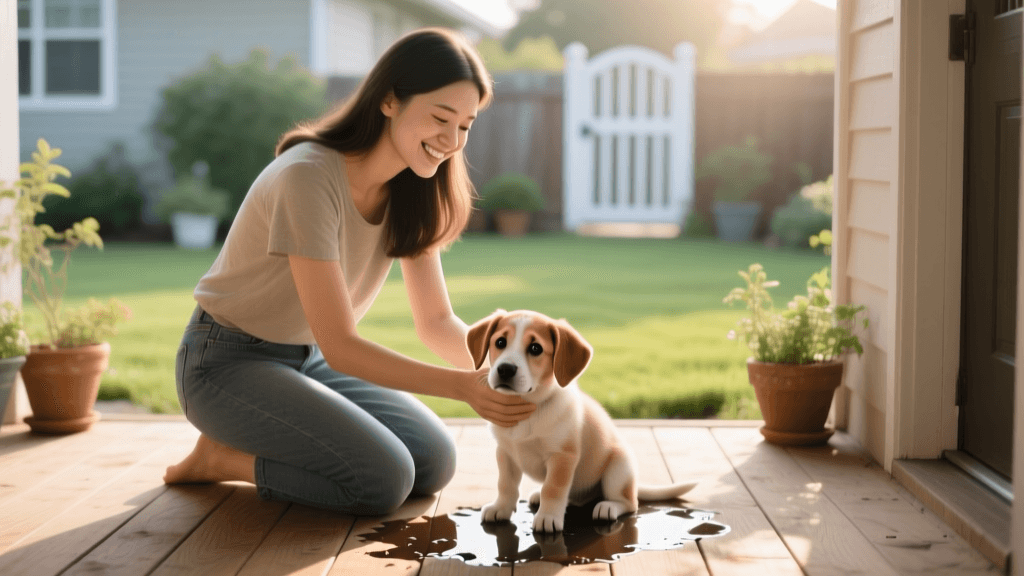
No matter how diligent you are, accidents will happen. How you clean them up dictates whether the puppy will repeat the behavior. Standard household cleaners, bleach, and ammonia-based products do not break down the uric acid crystals found in dog urine. While the stain may disappear to the human eye, your puppy's highly sensitive nose will still smell the biological markers, signaling that this is an acceptable bathroom spot.
Invest in a high-quality enzymatic cleaner like Nature's Miracle Advanced Stain and Odor Eliminator or Rocco & Roxie Stain & Odor Eliminator (approx. $15 to $20 per bottle). These products contain natural bacteria that produce enzymes to completely break down the organic matter and eliminate the scent. When an accident occurs:
- Blot up as much liquid as possible with paper towels.
- Saturate the area generously with the enzymatic cleaner, ensuring it reaches deep into the carpet pad or wood grain.
- Allow it to sit for 10 to 15 minutes as directed on the label.
- Blot dry and let the area air dry completely.
If you catch your puppy in the act of having an accident indoors, do not yell or rub their nose in it. The Humane Society of the United States warns that punishment only teaches the puppy to fear you and will cause them to hide behind furniture or in other rooms to eliminate next time. Instead, clap your hands loudly to startle them into stopping, immediately scoop them up, and carry them outside to finish. Praise them enthusiastically if they complete the job outdoors.
Reward Systems and Marker Words
Positive reinforcement is the most effective way to communicate with your puppy. Choose a specific 'potty phrase' such as 'go potty' or 'do your business' and use it exclusively when they are in the act of eliminating. The moment they finish, use a marker word like 'Yes!' and immediately deliver a high-value treat. Timing is critical; the treat must be delivered within one to two seconds of the puppy finishing, not after they have already run back to the door. Keep a treat pouch filled with small, easily digestible training treats near your main exit door at all times to ensure you never miss a reward opportunity.
Frequently Asked Questions
Why is my puppy suddenly having accidents after doing well?
Potty training regression is incredibly common, especially around the 4-to-6-month mark. This can be triggered by teething discomfort, changes in the household routine, or even a urinary tract infection (UTI). If regression is accompanied by frequent squatting or straining, consult your veterinarian immediately to rule out medical issues.
Should I use puppy pee pads?
For first-time owners planning to have an outdoor-trained dog, pee pads are generally discouraged. They teach the puppy that it is acceptable to eliminate indoors on soft, rectangular surfaces, which can easily translate to accidents on your area rugs or bathmats. Reserve pee pads only for owners living in high-rise apartments where immediate outdoor access is impossible, or for tiny toy breeds with extreme weather sensitivities.
How long does potty training actually take?
Most puppies can be considered reliably housebroken by the time they are 6 months old, though some larger breeds or stubborn terriers may take up to a year. Patience, consistency, and rigorous supervision are your best tools for long-term success.
beth-carrasco
All our authors care for dogs every day — read more of their work on the authors page.