The First-Time Owner's Guide to Puppy Potty Training
Master puppy potty training with our first-time owner guide. Learn crate schedules, accident prevention, and positive reinforcement tips.
Welcome to Puppy Parenthood: The Potty Training Reality
Welcome to the wild, wonderful, and occasionally frustrating world of puppy parenthood. If you are reading this, you likely have a new furry friend at home, and you are probably dealing with the most universal challenge every first-time dog owner faces: potty training. It is completely normal to feel overwhelmed when your adorable new companion uses your favorite rug as a bathroom. However, with patience, consistency, and the right strategy, you can successfully housebreak your puppy and build a foundation of trust.
As a first-time owner, it is crucial to understand that puppies do not soil your home out of spite or rebellion. They simply lack the physical bladder control and the cognitive understanding of where they are supposed to go. According to the American Kennel Club (AKC), the key to successful housebreaking is establishing a rigid routine and utilizing positive reinforcement. This comprehensive guide will walk you through the biology of your puppy's bladder, the exact gear you need, and a step-by-step daily schedule to guarantee success.
The Biological Reality of a Puppy’s Bladder
Before setting expectations, you must understand your puppy's physical limitations. A general rule of thumb endorsed by veterinarians is that a puppy can hold their bladder for one hour for every month of age, up to a maximum of about eight hours. This means an eight-week-old (two-month-old) puppy can only hold it for roughly two hours during the day, and often less when they are actively playing or drinking water.
| Puppy Age | Maximum Daytime Hold Time | Nighttime Expectation |
|---|---|---|
| 2 Months (8 Weeks) | 1.5 to 2 Hours | Needs 1-2 midnight potty breaks |
| 3 Months (12 Weeks) | 3 to 4 Hours | Needs 1 midnight potty break |
| 4 Months (16 Weeks) | 4 to 5 Hours | Can often sleep 6-8 hours straight |
| 6 Months (24 Weeks) | 6 to 7 Hours | Can sleep 8+ hours straight |
Understanding these biological limits prevents frustration. If you leave a 10-week-old puppy alone for six hours, an accident is not a training failure; it is a biological inevitability.
Essential Potty Training Gear (With Estimated Costs)
Setting yourself up for success requires a few specific tools. You do not need to spend a fortune, but investing in the right products will save your floors and your sanity.
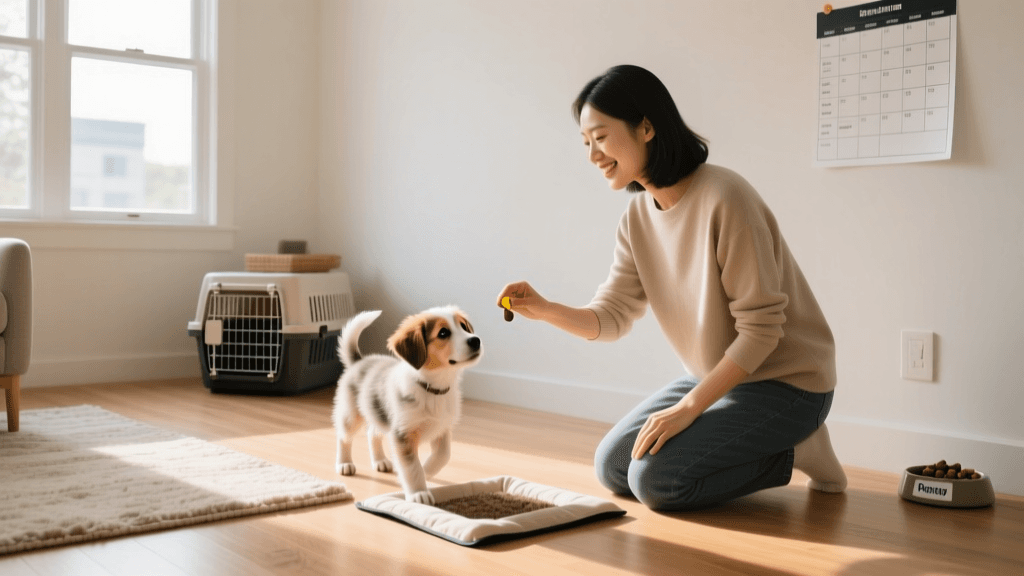
- Wireframe Crate with Divider (e.g., Midwest iCrate): $50 - $80. A crate is your most powerful potty training tool. Dogs naturally avoid soiling their sleeping area. The divider allows you to adjust the space as your puppy grows, ensuring the crate is only large enough for them to stand, turn around, and lie down. If it is too big, they will potty in one corner and sleep in the other.
- Enzymatic Cleaner (e.g., Nature's Miracle Advanced): $12 - $18. Standard household cleaners do not break down the uric acid in dog urine. If your puppy can still smell their previous accident, they will return to the same spot. An enzymatic cleaner literally eats the odor-causing bacteria.
- High-Value Training Treats (e.g., Zuke's Mini Naturals): $8 - $12. You need small, low-calorie, highly smelly treats to reward your puppy immediately after they eliminate outside. Timing is everything, and these treats are perfect for rapid reinforcement.
- Long Training Lead (15 to 20 feet): $15 - $25. This allows your puppy to wander and sniff in the yard while keeping them safe and allowing you to monitor their bathroom habits closely.
The Ultimate Daily Potty Training Schedule
Consistency is the bedrock of potty training. Puppies thrive on routine. Here is a sample schedule for a 10-week-old puppy that you can adapt to your daily life.
- 6:00 AM - Wake Up & Immediate Potty: Carry your puppy outside the second they wake up. Do not let their paws touch the indoor floor. Use a consistent cue word like 'Go potty' and reward heavily when they finish.
- 6:30 AM - Breakfast & Water: Feed your puppy their measured morning meal. Remove the water bowl 15 minutes after they finish eating to regulate their intake.
- 7:15 AM - Post-Meal Potty: Puppies usually need to eliminate 15 to 30 minutes after eating. Take them back to their designated outdoor potty spot.
- 8:00 AM to 10:00 AM - Nap Time: Puppies sleep up to 18 hours a day. Place them in their crate for a nap. Take them out immediately when they wake up.
- 10:00 AM - Play & Potty: Supervised indoor play, followed by another potty trip. Remember, intense play stimulates the bladder.
- 12:00 PM - Lunch & Potty: Mid-day meal, followed by a potty break 20 minutes later.
- 1:00 PM to 4:00 PM - Afternoon Nap: Back in the crate. Potty immediately upon waking.
- 5:00 PM - Dinner & Potty: Evening meal and subsequent outdoor trip.
- 8:00 PM - Water Curfew: Pick up the water bowl to minimize overnight accidents.
- 10:30 PM - Final Potty & Bedtime: A quiet, boring potty trip right before crating for the night.
- 2:00 AM - Midnight Potty (if needed): Set an alarm for young puppies to take them out once during the night.
Crate Training: Your Secret Weapon
The VCA Animal Hospitals emphasize that crate training is not cruel; it is a vital management tool that taps into a dog's natural denning instincts. When introduced properly, the crate becomes your puppy's safe haven. To build a positive association, feed your puppy their meals inside the crate, toss high-value treats into the back, and provide a safe chew toy like a Kong stuffed with frozen peanut butter. Never use the crate as a punishment. If your puppy whines at night, ensure they have been fully exercised and have emptied their bladder before bed. If they whine shortly after being put down, wait a few minutes to see if they settle. If the whining persists, take them out for a boring, silent potty trip, and immediately return them to the crate.
Handling Inevitable Accidents Like a Pro
No matter how diligent you are, accidents will happen. How you react in the moment dictates your puppy's future behavior. If you catch your puppy in the act, clap your hands loudly to interrupt them, scoop them up, and carry them outside to finish. Praise them if they finish outdoors.
What you should never do is rub your puppy's nose in the mess, yell at them, or hit them. The Humane Society of the United States strongly warns against physical punishment or scolding after the fact. Dogs live in the moment; if you yell at them five minutes after they have peed on the rug, they will not associate your anger with the puddle. Instead, they will learn that peeing in front of you is dangerous, which leads to them hiding behind furniture to eliminate or eating their own feces to hide the evidence. Simply clean the mess thoroughly with your enzymatic cleaner and evaluate your supervision. An accident is usually a sign that you missed a subtle cue—like sniffing, circling, or suddenly leaving the room—or that you waited too long between potty breaks.
When to Call the Vet
While frequent accidents are normal in the early weeks, sudden regression or an inability to hold urine can indicate a medical issue. Urinary Tract Infections (UTIs) are surprisingly common in young puppies. If your puppy is straining to urinate, producing only a few drops, licking their genitals excessively, or having accidents every 20 minutes despite a strict schedule, consult your veterinarian immediately. A simple urinalysis can rule out infections or congenital issues like an ectopic ureter.
Final Thoughts for First-Time Owners
Potty training is a marathon, not a sprint. There will be days when you feel like you are making incredible progress, followed by days where it feels like you are back at square one. This is a normal part of the developmental process. Keep your expectations realistic, celebrate the small victories, and remember that every accident is simply data that helps you refine your schedule. Stick to your routine, utilize your crate, and keep your enzymatic cleaner handy. Within a few months, your puppy will be signaling you to go outside, and this chaotic chapter will become a distant memory.
jonas-cole
All our authors care for dogs every day — read more of their work on the authors page.