The First-Time Owner Guide to Puppy Crate Training
Learn how to crate train your puppy with our first-time owner guide. Discover schedules, crate sizing, and positive reinforcement tips for success.
Welcome to Dog Ownership: Why Crate Training Matters
Bringing home a new puppy is one of the most exciting milestones in life, but it can quickly become overwhelming for first-time dog owners. Between the chewed shoes, potty accidents, and midnight zoomies, new puppy parents often find themselves exhausted. This is where crate training becomes your ultimate survival tool. According to the American Kennel Club (AKC), a crate is not a cage or a punishment; it is a safe haven that taps into a dog's natural den instinct. When introduced correctly, your puppy will view their crate as a personal bedroom where they can retreat to relax, sleep, and feel secure.
For first-time owners, crate training serves three critical purposes: it accelerates potty training by leveraging a dog's natural reluctance to soil their sleeping area, it prevents destructive behavior when you cannot supervise them, and it keeps them safe from household hazards like electrical cords or toxic plants. In this comprehensive guide, we will walk you through selecting the right equipment, establishing a realistic schedule, and troubleshooting common hurdles.
Choosing the Right Crate: Types, Sizing, and Costs
Walking into a pet store or browsing online can be daunting with the sheer volume of crate options. Here is a breakdown of the most common types and what you can expect to spend.
1. Wire Crates (Best for Training and Visibility)
Wire crates are the gold standard for puppy training. They offer excellent ventilation, visibility, and usually come with a divider panel. The MidWest Homes for Pets iCrate is a top-tier choice, typically costing between $50 and $80 depending on the size. The divider panel is crucial for first-time owners because it allows you to adjust the interior space as your puppy grows, preventing them from using one corner as a bathroom and the other for sleeping.
2. Plastic Crates (Best for Travel and Den-Like Feel)
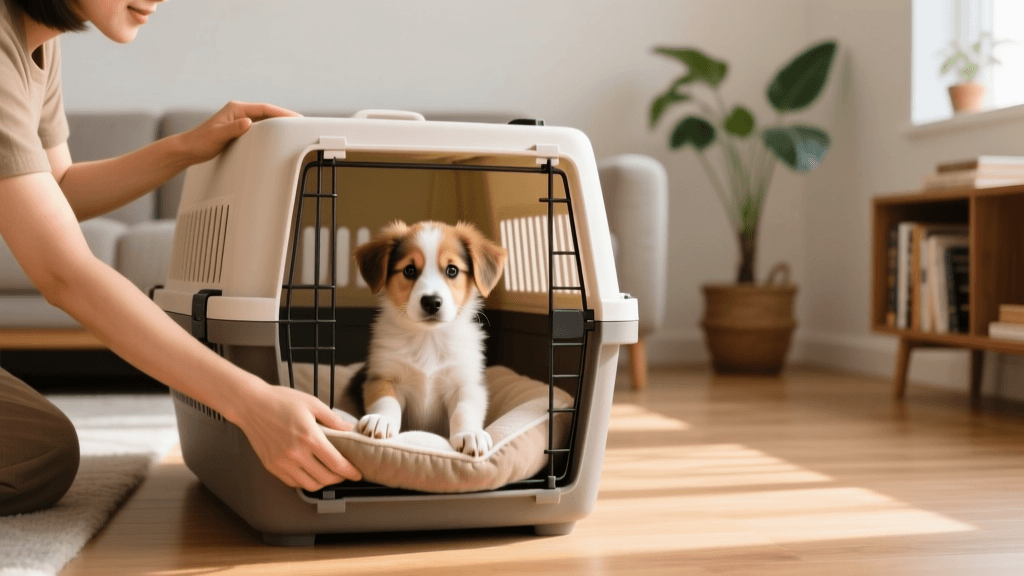
Plastic crates, such as the Petmate Ultra Vari Kennel ($60 to $90), are enclosed on three sides, creating a darker, cozier den environment. They are also airline-approved for travel. However, they offer less ventilation and can be harder to clean if your puppy has an accident.
3. Soft-Sided Crates (Not Recommended for Puppies)
While lightweight and portable, soft-sided crates are easily destroyed by teething puppies and offer no containment security. Save these for when your dog is fully mature and crate-trained.
The Golden Rule of Crate Sizing
A common mistake first-time owners make is buying a massive crate to 'give the dog room to roam.' If the crate is too large, your puppy will designate a corner for elimination. The correct measurement requires your puppy to be able to stand up without hitting their head, turn around completely, and lie down stretched out. Measure your puppy from the tip of their nose to the base of their tail (add 2 to 4 inches), and from the top of their head to the floor (add 2 to 4 inches). If you have a mixed breed, estimate their adult size based on their paws and parentage, and buy a large wire crate with a divider.
Step-by-Step Crate Training Schedule for Beginners
Patience and positive reinforcement are your best friends. Never force your puppy into the crate or use it as a time-out for bad behavior. Here is a phased approach to building a positive association.
Phase 1: Building Positive Associations (Days 1-3)
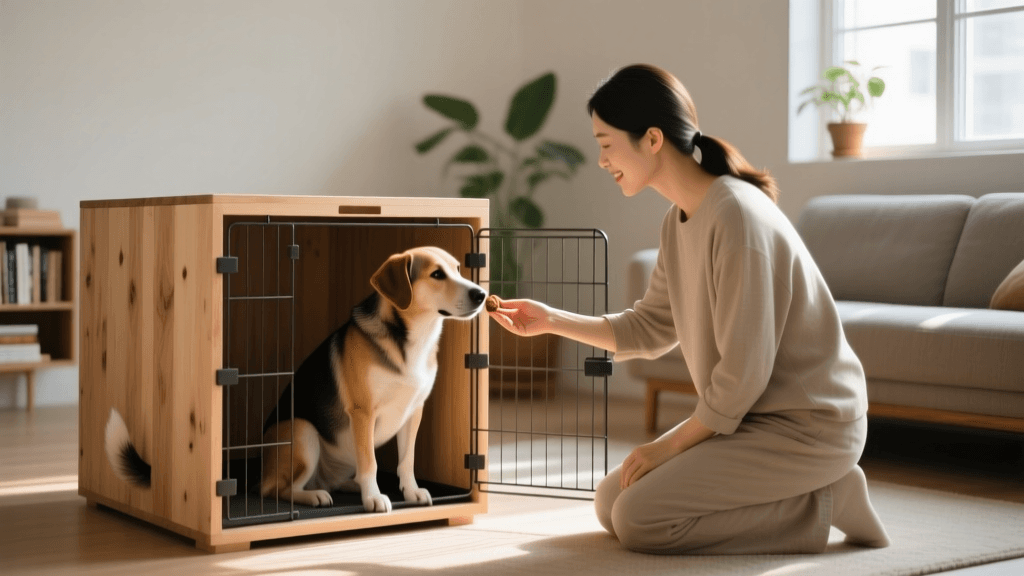
Leave the crate door open and place it in a high-traffic family area. Toss high-value treats like Zuke's Mini Naturals or small pieces of boiled chicken near the entrance, and gradually further inside. Feed all of your puppy's regular meals near the crate. You can also introduce a KONG Classic toy stuffed with dog-safe peanut butter (ensure it is xylitol-free) and freeze it. The goal is for the puppy to willingly enter the crate to enjoy their reward. Do not close the door during this phase.
Phase 2: Feeding and Short Confinements (Days 4-7)
Begin feeding your puppy their meals inside the crate with the door closed. Stay in the room, sitting quietly nearby. Once they finish eating, open the door immediately. Gradually increase the time the door remains closed after meals, starting with 2 minutes, then 5 minutes, then 10 minutes. If your puppy whines, wait for a brief moment of silence before opening the door so you do not reward the vocalization.
Phase 3: Building Duration and Distance (Weeks 2-3)
Start commanding your puppy to 'kennel' or 'crate' using a treat lure. Once inside, give them a long-lasting chew, such as a bully stick or a frozen KONG. Close the door and leave the room for 5 minutes. Return before they finish the treat and let them out quietly. Slowly increase your absence to 15 minutes, 30 minutes, and eventually a few hours. Always ensure your puppy has been exercised and has eliminated outside before a long crating session.
Crate Time Limits: A Guide by Age
A critical aspect of crate training is understanding a puppy's physical limitations. Puppies have small bladders and cannot hold it for a full workday. The ASPCA emphasizes that crating a dog for too long can lead to severe behavioral issues, anxiety, and urinary tract infections. Use the table below as a strict guideline for maximum daytime crating limits.
| Puppy Age | Max Daytime Crate Limit | Max Nighttime Limit | Potty Break Frequency |
|---|---|---|---|
| 8 - 10 Weeks | 30 - 60 Minutes | 3 - 4 Hours | Every 1 - 2 Hours |
| 11 - 14 Weeks | 1 - 3 Hours | 4 - 5 Hours | Every 2 - 3 Hours |
| 15 - 16 Weeks | 3 - 4 Hours | 5 - 6 Hours | Every 3 - 4 Hours |
| 17+ Weeks (Adult) | 4 - 6 Hours | 8 Hours | Every 4 - 6 Hours |
Note: If you work a standard 8-hour day, you must hire a dog walker, ask a neighbor, or come home during lunch to let your puppy out. Leaving an 8-week-old puppy in a crate for 8 hours is animal cruelty and will completely derail your potty training efforts.
Troubleshooting Common First-Time Owner Mistakes
The Midnight Whining
It is almost guaranteed that your puppy will cry the first few nights. Place the crate in your bedroom initially so they can smell and hear you. If they whine, take them outside on a leash immediately for a boring, 3-minute potty break. Do not play or cuddle them. If they eliminate, praise quietly and return them to the crate. If they do not eliminate, they are likely just protesting the confinement. In this case, ignore the whining. Earplugs are a new dog owner's best investment. Giving in and letting them out while they cry teaches them that whining equals freedom.
Potty Accidents Inside the Crate
If your puppy soils their crate, you must clean it immediately and thoroughly. Use an enzymatic cleaner like Nature's Miracle Advanced Stain and Odor Eliminator (approx. $12). Standard household cleaners do not break down the uric acid crystals, meaning your puppy will still smell the scent marker and return to the same spot. If accidents persist, evaluate your crate size (is it too big?), your feeding schedule (remove water 2 hours before bed), and your potty break frequency.
Crate Anxiety and Destructive Behavior
If your puppy is bending the wire bars, breaking teeth, or drooling excessively, they may be experiencing separation anxiety or confinement distress. The Humane Society of the United States recommends consulting a certified professional dog trainer (CPDT) or a veterinary behaviorist if your dog shows signs of severe panic. Never punish a dog for panicking in a crate, as this will only deepen the negative association.
Final Thoughts for New Dog Parents
Crate training is a marathon, not a sprint. As a first-time owner, it is easy to feel guilty when you close that metal door, but remember that you are providing your dog with structure, safety, and a lifelong coping mechanism. Stick to the schedule, invest in the right-sized wire crate with a divider, and rely on high-value treats to build a positive emotional response. Within a few weeks, you will likely find your puppy voluntarily retreating to their crate for a peaceful nap, giving you the well-deserved break you need to enjoy the beautiful journey of dog ownership.
robin-maitland
All our authors care for dogs every day — read more of their work on the authors page.