Step-by-Step First Day House Training Guide for New Dogs
Master your new dog's first day with this step-by-step house training guide. Learn crate setup, potty schedules, and essential tips for success.
Welcome Home: The Foundation of House Training
Bringing a new dog or puppy into your home is one of life’s most rewarding experiences, but the first twenty-four hours are absolutely critical for establishing long-term behavioral patterns. When you first open your front door, your new companion is experiencing massive sensory overload. Without a clear, immediate strategy, this stress can quickly manifest as indoor accidents, chewing, and anxiety. This step-by-step first-day house training guide will walk you through the exact protocols professional trainers use to set your new dog up for success from minute one.
According to the Humane Society of the United States, establishing a strict, predictable routine and closely supervising your dog are the most effective methods for preventing house soiling. By combining spatial management, positive reinforcement, and biological scheduling, you can drastically reduce the timeline of your dog's house training journey.
Step 1: Prepare the Environment and Crate Setup
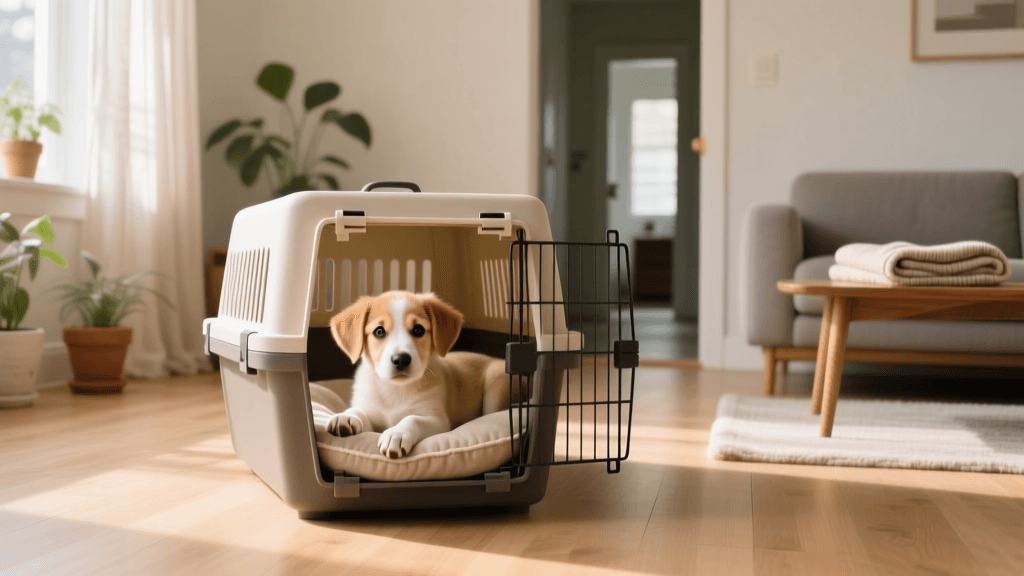
Before your dog even arrives, you must establish a 'success zone.' This involves puppy-proofing your living areas and setting up a properly sized crate. Dogs are naturally den animals, and a crate serves as both a safe haven and an essential house training tool, as dogs instinctively avoid soiling their sleeping quarters.
Choosing and Sizing the Crate
For your first day, we recommend a wire crate with an adjustable divider, such as the Midwest Homes for Pets iCrate (typically costing between $60 and $90 depending on the size). Wire crates offer excellent visibility and ventilation, which helps reduce the feeling of isolation.
The Golden Rule of Crate Sizing: The crate should be just large enough for your dog to stand up, turn around, and lie down comfortably. If it is too large, your dog may designate one corner for sleeping and another for eliminating, completely defeating the purpose of the crate. For growing puppies, use the included divider panel to restrict the space, moving it back every few weeks as they grow.
- Measurement Guide: Measure your dog from the tip of their nose to the base of their tail, then add 2 to 4 inches. Measure their height from the top of their head to the ground and add 2 inches.
- Bedding Warning: On the very first day, avoid placing plush, expensive dog beds inside the crate. Anxious puppies or stressed rescue dogs may chew and ingest fabric, leading to dangerous intestinal blockages. Use a tightly woven, chew-resistant mat or simply a folded, old cotton towel until their chewing habits are assessed.
Step 2: Establish the First-Day Potty Schedule
A common mistake new owners make is waiting for the dog to 'tell' them they need to go outside. On the first day, you must be proactive. You are managing their biological clock. The American Kennel Club (AKC) emphasizes that puppies and newly adopted adult dogs need frequent, scheduled trips outdoors to build a habit of eliminating in the correct location.
Understanding Bladder Capacity
Your dog's ability to hold it depends heavily on their age and stress levels. Use this general guideline for your first-day schedule:
- 8 to 10 Weeks Old: Every 1 to 2 hours, plus immediately after eating, drinking, playing, or waking up.
- 11 to 14 Weeks Old: Every 2 to 3 hours.
- 15 to 16 Weeks Old: Every 3 to 4 hours.
- Adult Rescue Dogs: While physically capable of holding it for 6 to 8 hours, an adult rescue dog is in a new, stressful environment. Treat them like a 12-week-old puppy on day one, taking them out every 2 hours to prevent anxiety-induced accidents.
Step 3: Executing the Perfect Potty Trip
When it is time for a potty break, do not simply open the back door and let the dog wander out. This is a training exercise, not just a bathroom break.
- Leash Up: Always attach a standard 4-to-6-foot nylon or leather leash. Avoid retractable leashes, as they do not provide the control needed for focused training.
- Carry or Lead Outside: If you have a young puppy, carry them outside to prevent mid-floor accidents on the way to the door. For adult dogs, lead them calmly.
- Choose a Specific Spot: Take them to the exact same patch of grass or gravel every single time. The lingering scent of previous eliminations will act as a biological trigger, prompting them to go.
- Use a Marker Word and Command: Stand completely still and ignore the dog until they begin to sniff and circle. As soon as they begin to eliminate, use a calm verbal cue like 'Go potty' or 'Do your business.'
- The Reward: The exact second they finish, praise them enthusiastically and immediately offer a high-value treat. Zuke’s Mini Naturals (approx. $8 for a 6oz bag) are excellent because they are small, low-calorie, and highly palatable, meaning your dog won't get full or distracted by chewing a massive biscuit.
'Timing is everything in dog training. If you wait until the dog comes back inside to give them a treat, you are rewarding them for coming inside, not for eliminating outside. The reward must happen within one to two seconds of the desired behavior.' — Professional Dog Training Consensus
Step 4: Essential House Training Supplies
Having the right tools on hand before the dog arrives eliminates panic and ensures consistency. Below is a structured comparison of first-day essentials you should have stocked in your home.
| Product Category | Recommended Item | Estimated Cost | Purpose & First-Day Application |
|---|---|---|---|
| Enzymatic Cleaner | Nature's Miracle Advanced Stain & Odor Eliminator | $12 - $15 | Breaks down uric acid crystals that standard household cleaners leave behind, preventing the dog from returning to the same spot to mark again. |
| Training Treats | Zuke's Mini Naturals (Chicken or Salmon) | $8 - $10 | High-value, low-calorie rewards used exclusively for outdoor potty success and crate entry. |
| Interactive Toy | KONG Classic Dog Toy (Red or Black) | $15 - $18 | Stuffed with frozen peanut butter or plain yogurt to keep the dog occupied and build positive associations with their crate on the first night. |
| Long-Line Leash | Standard 6-Foot Nylon Leash | $10 - $15 | Provides the necessary physical control to keep the dog focused on the designated potty spot rather than exploring the yard. |
Step 5: Managing Inevitable Accidents
Despite your best efforts, an accident on the first day is highly probable, especially if you are adopting an older dog from a shelter or transitioning a puppy from a breeder's home. How you react in the first five seconds after an accident will shape your dog's future behavior.
What to Do If You Catch Them in the Act
If you see your dog squatting or lifting a leg indoors, immediately interrupt the behavior with a sharp, neutral sound like 'Ah-ah!' or a quick clap of your hands. The goal is to startle them just enough to pause the flow of urine, not to terrify them. Quickly scoop them up or leash them, and carry or rush them outside to their designated potty spot. If they finish outside, reward them heavily. If they do not, simply bring them back inside and place them in their crate for 10 minutes before trying again.
What to Do If You Find an Accident After the Fact
If you find a puddle or pile after the dog has already finished, do not punish the dog. Dogs do not possess the cognitive ability to connect a past action with a present punishment. Yelling, rubbing their nose in it, or pointing at the mess will only teach your dog that you are an unpredictable, scary human who gets angry when bodily functions occur. Instead, they will simply learn to hide behind furniture or in other rooms to eliminate next time.
Silently clean the mess using your enzymatic cleaner. Follow the instructions on the bottle precisely: saturate the area, allow the enzymes to sit for the recommended 10 to 15 minutes to break down the uric acid, and then blot it dry. Avoid ammonia-based cleaning products, as ammonia smells similar to urine to a dog's sensitive olfactory system and can actually encourage re-soiling.
Step 6: Surviving the First Night
The first night is often the hardest. Your new dog is separated from their littermates or previous environment, and the darkness can amplify their anxiety. Place the crate in your bedroom, ideally on a nightstand or chair at eye level, so the dog can see, smell, and hear you. This proximity provides immense comfort and reduces separation distress.
Expect to set an alarm. If you have an 8-week-old puppy, set your phone alarm for 3 to 4 hours after they go to sleep. Wake up, take them out on a leash in the dark with minimal interaction and zero playtime, reward the elimination, and immediately return them to the crate. This teaches them that nighttime wake-ups are strictly for business, not for play.
Conclusion: Patience and Consistency
House training is not an event; it is a process that requires immense patience, spatial awareness, and consistency. By controlling the environment, adhering to a strict biological schedule, and utilizing the right tools like enzymatic cleaners and high-value treats, you are laying a foundation of trust and communication. Remember that every successful outdoor potty trip is a deposit into your dog's behavioral bank account. Stick to this step-by-step guide, and you will navigate the critical first days of dog ownership with confidence, setting the stage for a lifetime of a happy, well-adjusted, and house-trained companion.
tom-renshaw
All our authors care for dogs every day — read more of their work on the authors page.