Engage-Disengage Protocol for Reactive Dogs: 2026 Gear Guide
Master the engage-disengage protocol for leash-reactive dogs in 2026. Discover the best treat pouches, clickers, and timing techniques for success.
The Modern Reality of Leash Reactivity in 2026
As we navigate the behavioral landscape of 2026, many dogs born during the peak global adoption years are now fully mature adults. While they brought immense joy to their families, a significant subset of these dogs are now exhibiting entrenched leash reactivity. Reactivity—manifesting as lunging, barking, or freezing at the sight of other dogs, cyclists, or strangers—is not a sign of a 'bad' dog. Rather, it is a profound emotional response rooted in fear, frustration, or over-arousal. Managing this requires more than just patience; it demands a structured behavioral modification strategy paired with the right tactical gear.
Among the myriad of training methodologies available today, the Engage-Disengage Protocol (often associated with Leslie McDevitt's 'Look At That' framework) remains the gold standard for rewiring a reactive dog's emotional response. This guide will break down the neurology behind the protocol, outline the essential 2026 gear required for success, and provide a step-by-step field manual for your daily walks.
The Neurology of the Engage-Disengage Game
Before diving into the mechanics, it is crucial to understand why this protocol works. When a reactive dog spots a trigger (e.g., another dog), their amygdala initiates a fight-or-flight response. If the dog is pushed over their 'threshold'—the distance at which they can no longer process cognitive information—they enter an amygdala hijack. In this state, they cannot learn, and they will often refuse food.
The Engage-Disengage game operates strictly under threshold. By allowing the dog to look at the trigger (Engage) and then voluntarily turn away to look at the handler (Disengage), we are actively strengthening the neural pathways in the prefrontal cortex. This shifts the dog from an emotional, reactive state to a thinking, cognitive state. Over time, the presence of a trigger becomes a cue to check in with the handler rather than a catalyst for an explosion.
Essential 2026 Gear for Reactive Dog Walks
Success in reactive dog training is heavily dependent on your equipment. Fumbling with a treat pouch or being dragged by a poorly fitted harness will ruin your timing and increase your dog's anxiety. Here is the top-tier gear recommended by certified behaviorists in 2026.
1. The Treat Delivery System
For the Engage-Disengage game, your treats must be accessible in milliseconds. Traditional drawstring pouches are too slow and create frustrating friction.
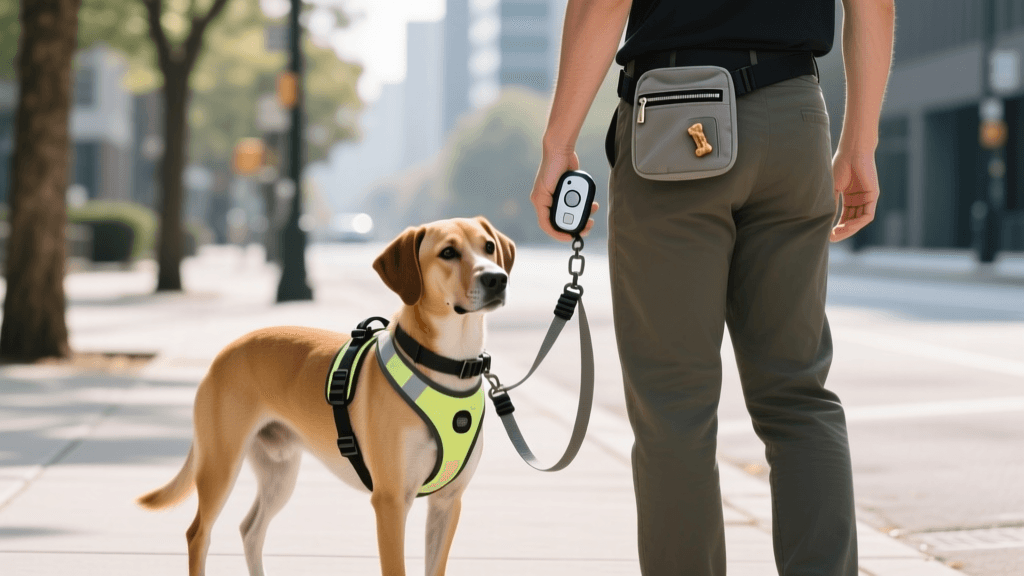
- Ruffwear Treat Trader (2026 Edition): Priced around $45, this pouch features a magnetic closure that allows for one-handed, silent access. The magnetic flap snaps shut automatically, preventing your dog from diving into the pouch when a trigger appears.
- Frostline Dog Gear Magnetic Pouch: A newer entrant in 2026 (approx. $38), this pouch uses a rigid, open-top design with a silicone wipe-clean interior. It is ideal for high-value, messy treats like real meat or cheese, which are mandatory for high-arousal environments.
2. The Harness and Leash Setup
Neck pressure can exacerbate a dog's physiological stress response, mimicking the feeling of being attacked and worsening reactivity. A front-clip, Y-shaped harness is non-negotiable.
- Perfect Fit Harness: Custom-sized to your dog's exact measurements, this harness features a soft fleece lining that prevents chafing during sudden movements. The front D-ring provides gentle steering without restricting the shoulder gait.
- Mendota Biothane Long Line (15ft): Biothane has completely replaced nylon for reactive dog handlers in 2026. It is waterproof, doesn't absorb odors, and, most importantly, doesn't cause rope burn if your dog suddenly lunges. A 15-foot length gives your dog enough space to decompress and sniff, which naturally lowers cortisol levels.
Step-by-Step: Executing the Protocol
The Engage-Disengage game requires precise timing. You will need a marker word (like 'Yes!') or a clicker, and a pocket full of high-value treats (boiled chicken, hot dogs, or freeze-dried beef liver).
Phase 1: The Engage (Marking the Trigger)
- Spot the trigger before your dog does, or at the exact moment they notice it.
- Allow your dog to look at the trigger. They should be observing, not barking or pulling.
- The second your dog looks at the trigger, mark the behavior with your clicker or marker word ('Yes!').
Phase 2: The Disengage (The Turn and Reward)
- After you mark the behavior, wait for your dog to turn their head toward you. In the beginning, you may need to lure them with a treat near your face.
- As soon as they make eye contact or turn their body toward you, deliver the treat directly to their mouth.
- Repeat this process. Eventually, your dog will see the trigger and immediately whip their head around to look at you, anticipating the reward. This is the ultimate goal.
Pro Tip for 2026: Never call your dog's name when a trigger appears. If your dog is over threshold, they will ignore their name, teaching them that their name is optional. Let the sight of the trigger be the cue to disengage.
Threshold Management: A Data Breakdown
Understanding your dog's threshold is the most critical aspect of this protocol. If you attempt the Engage-Disengage game while your dog is over threshold, you will only succeed in frustrating both of you. Refer to the table below to assess your dog's state and adjust your distance accordingly.
| Distance to Trigger | Dog's Body Language | Protocol Action | Expected Outcome |
|---|---|---|---|
| Under Threshold (50+ ft) | Relaxed ears, loose wag, sniffing, soft eyes | Engage-Disengage Game | Dog voluntarily looks at handler for treats |
| At Threshold (30-50 ft) | Stiff posture, closed mouth, fixed stare, whale eye | Increase Distance Immediately | Dog may take treats but is slow to chew; tension remains |
| Over Threshold (Under 30 ft) | Barking, lunging, panting heavily, refusing food | Emergency U-Turn & Retreat | Dog is in amygdala hijack; learning is impossible |
For a deeper understanding of canine body language and stress signals, consult the ASPCA's resources on common dog behavior issues, which provides excellent visual guides on recognizing early signs of canine anxiety before a reactive outburst occurs.
High-Value Treat Recipes for High-Arousal Environments
In 2026, the consensus among veterinary behaviorists is that kibble is entirely ineffective for counter-conditioning in high-arousal environments. You must compete with the adrenaline dump of seeing a trigger. Here is a highly effective, easily prep-able treat recipe:
The 'Liver-Broth Glaze' Bites
- Base: 1 lb of freeze-dried beef liver chunks (easily found in pet supply stores).
- Glaze: Low-sodium, onion-free bone broth mixed with a teaspoon of peanut butter (xylitol-free).
- Prep: Toss the liver chunks in the glaze and let them sit in the refrigerator overnight. The liver absorbs the broth, becoming soft, pungent, and incredibly high-value. Store them in a silicone pouch liner for easy cleanup.
Troubleshooting Common Setbacks
My dog won't take the treat.
If your dog spits out the treat or refuses to eat, you are over threshold. The digestive system shuts down during a fight-or-flight response. Do not force the issue. Perform an 'Emergency U-Turn'—cheerfully say 'Let's go!', pivot 180 degrees, and jog away from the trigger until your dog's breathing slows and they accept food.
The trigger is moving toward us.
In urban environments, you cannot always control the distance. If an off-leash dog or an oblivious owner approaches, advocate for your dog. Step between your dog and the trigger, use a firm 'Stop' or 'Please give us space' to the approaching person, and scatter a handful of treats on the ground (a 'treat scatter'). Sniffing is a naturally calming behavior that can help lower your dog's heart rate while you create distance.
Managing a reactive dog is a marathon, not a sprint. By utilizing the Engage-Disengage protocol, investing in silent-access gear like the Ruffwear Treat Trader, and strictly respecting your dog's threshold, you can transform your daily walks from a source of dread into an opportunity for connection. For further reading on structured training plans, the American Kennel Club's guide to reactive dog training offers excellent supplementary exercises to pair with your daily decompression walks.
marcus-aldridge
All our authors care for dogs every day — read more of their work on the authors page.