Managing Leash Reactivity: Engage-Disengage Guide 2026
Master the Engage-Disengage protocol for leash-reactive dogs in 2026. Learn step-by-step desensitization using biothane long lines and high-value treats.
Understanding Leash Reactivity in 2026
Leash reactivity remains one of the most pervasive and stressful challenges for dog owners in 2026. Whether your dog is lunging, barking, or freezing at the sight of other dogs, bicycles, or strangers, the underlying emotion is often fear, anxiety, or barrier frustration rather than true malice. According to the ASPCA's behavioral resources, many dogs labeled as aggressive on-leash are actually exhibiting fear-based reactivity exacerbated by the restriction of a standard leash. When a dog feels trapped by a six-foot nylon lead, their natural flight response is inhibited, triggering a fight-or-flight adrenaline dump that manifests as barking and lunging.
Managing a reactive dog requires a paradigm shift from traditional obedience correction to modern behavioral modification. In 2026, the gold standard for treating leash reactivity is a combination of desensitization, counter-conditioning, and the Engage-Disengage protocol. This guide will walk you through the exact mechanics, gear, and environmental setups required to help your anxious dog navigate the world with confidence.
The Neurology of Canine Anxiety and Reactivity
Before diving into training mechanics, it is crucial to understand what happens inside your dog's brain when they encounter a trigger. When a reactive dog spots a stimulus (like an unfamiliar dog), their amygdala—the brain's threat-detection center—hijacks their nervous system. Cortisol and adrenaline flood their bloodstream, effectively shutting down the prefrontal cortex, which is responsible for learning and decision-making. This is why asking a reactive dog to 'sit' or 'look at me' while they are barking at a trigger is neurologically impossible. They are not being stubborn; they are in survival mode. The goal of the Engage-Disengage game is to work at a distance where the amygdala is calm enough for the dog to process new, positive associations.
Essential Gear for Reactive Dog Management
Success in behavioral modification relies heavily on using the right equipment. Standard retractable leashes and choke chains are entirely counterproductive for anxious dogs, as they increase physical tension and mimic the sensation of being trapped. Here is the 2026 standard kit for reactive dog handlers:
1. The 15-Foot Biothane Long Line
A 15-to-30-foot Biothane long line is non-negotiable for reactivity training. Biothane is a waterproof, durable polymer that doesn't absorb mud, saliva, or rain, making it vastly superior to traditional cotton or nylon long lines. The extra length allows you to maintain your dog's 'threshold distance'—the exact footage where they notice a trigger but remain under their stress limit. Expect to invest between $35 and $60 for a high-quality, custom-made Biothane line with a brass or stainless steel snap.
2. Front-Clip No-Pull Harness
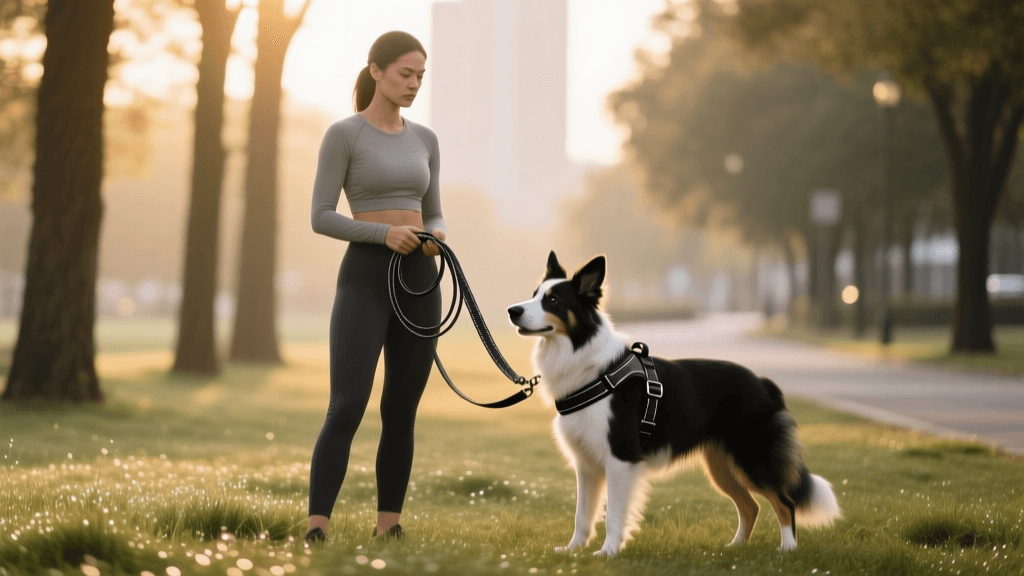
A well-fitted front-clip harness, such as the 2026 Rabbitgoo No-Pull model or the Kurgo Tru-Fit, gently redirects your dog's momentum toward you if they do lunge, without applying dangerous pressure to their trachea. Pair this with a dual-handle leash for close-quarters emergency management.
3. Dual-Compartment Treat Pouch
Timing is everything in counter-conditioning. Fumbling in a pocket costs precious seconds. A magnetic-closure treat pouch like the Doggone Good Rapid Rewards ($30) allows for sub-second treat delivery. Fill it with high-value, novel proteins like freeze-dried beef liver or boiled chicken breast.
The Engage-Disengage Protocol: Step-by-Step
Originally developed by canine behavior expert Leslie McDevitt, the Engage-Disengage game has been refined over the years and remains the cornerstone of reactive dog training in 2026. The game is split into two distinct phases.
Phase 1: Engage (Mark and Reward)
In this phase, you are simply pairing the sight of the trigger with a high-value reward. Find an environment where you can control the distance to the trigger (e.g., a quiet park bench 50 feet from a walking path).
- Spot the Trigger: The moment your dog looks at the trigger (another dog, a skateboarder), immediately use a marker word like 'Yes!' or click a clicker.
- Deliver the Treat: Within one second of the marker, feed a high-value treat directly to your dog's mouth. Do not ask them to sit or look at you first. The sequence is: Dog looks at trigger → Handler marks → Dog eats treat.
- Repeat: Do this 10-15 times per session. You are building a classical conditioning loop: Trigger predicts chicken.
Phase 2: Disengage (The Voluntary Look-Away)
Once your dog reliably expects a treat after looking at the trigger, you move to Phase 2. This phase tests if the dog's emotional response has shifted.
- Spot the Trigger: Your dog looks at the trigger. This time, do not mark immediately. Wait and count to three seconds.
- Wait for Disengagement: Because of the conditioning from Phase 1, your dog should voluntarily turn their head away from the trigger and look back at you, anticipating the treat.
- Mark and Reward: The exact millisecond they turn away from the trigger and look at you, mark with 'Yes!' and deliver a jackpot reward (3-4 pieces of chicken).
If your dog cannot disengage within three seconds, they are too close to the trigger. Increase your distance by 10 feet and return to Phase 1.
Threshold Management: Reading Your Dog's Body Language
The most common mistake handlers make is pushing their dogs past their threshold distance. The Humane Society emphasizes that counter-conditioning and desensitization can only occur when the animal is under their stress threshold. Use the matrix below to gauge your dog's mental state and adjust your training accordingly.
| Trigger Distance | Canine Body Language | Handler Protocol |
|---|---|---|
| Under Threshold (e.g., 50+ feet) | Soft eyes, loose wag, sniffing, willing to eat treats gently. | Initiate Engage-Disengage game. Mark and reward. Progress is possible. |
| At Threshold (e.g., 30 feet) | Stiff posture, closed mouth, whale eye, treat refusal or snatching. | Increase distance immediately. Toss treats on the ground for sniffing to lower heart rate. |
| Over Threshold (e.g., 15 feet) | Lunging, barking, snapping, complete dissociation from handler. | Emergency U-turn. Do not train. Manage the environment and retreat. |
Setting Up Your Environment for Success
Reactive dog training in 2026 is less about 'fixing' the dog on a busy sidewalk and more about meticulous environmental management. You must set up scenarios where you control the variables. Avoid peak walking hours (typically 7:00 AM - 9:00 AM and 5:00 PM - 7:00 PM). Utilize local school fields after hours, empty tennis courts, or quiet cul-de-sacs. If a surprise trigger appears (like an off-leash dog), your immediate job is advocacy. Step between your dog and the trigger, use a firm 'No' or 'Stop' to the approaching owner, and execute an emergency U-turn while scattering a handful of treats on the grass to engage your dog's natural foraging instincts, which naturally lowers their heart rate.
Troubleshooting Common Setbacks
Progress in reactivity training is rarely linear. You will experience 'extinction bursts'—sudden, intense flare-ups of reactive behavior when your dog realizes the old coping mechanism isn't working. You may also face 'trigger stacking,' a phenomenon where multiple minor stressors (a loud truck, a dropped leash, a distant siren) compound over 24 hours, causing your dog to react to a minor stimulus they usually ignore. When trigger stacking occurs, implement a 48-hour 'cortisol vacation.' Skip walks entirely for two days, replace them with indoor sniffing games, lick mats, and puzzle toys, and allow your dog's nervous system to reset.
Conclusion
Managing a leash-reactive and anxious dog requires immense patience, empathy, and consistency. By utilizing a 15-foot Biothane long line, high-value rewards, and the structured Engage-Disengage protocol, you can systematically rewire your dog's emotional response to the world. Remember that the goal in 2026 is not to force your dog to tolerate uncomfortable situations, but to change how they feel about them from the inside out. Celebrate the micro-victories—a single second of eye contact, a relaxed tail carriage, or a successful disengagement—and trust the science of behavioral conditioning to guide your journey.
beth-carrasco
All our authors care for dogs every day — read more of their work on the authors page.