Managing Puppy Fear Periods: Engage-Disengage Training in 2026
Learn how to manage puppy fear periods in 2026 using the Engage-Disengage game and threshold training to build confidence in reactive puppies.
The Challenge of Raising a Reactive Puppy
Raising a puppy is a journey filled with joyous milestones, but for owners of sensitive, anxious, or fear-reactive puppies, it can also be fraught with stress. In 2026, veterinary behaviorists emphasize that early intervention during critical developmental windows is the most effective way to prevent lifelong reactivity. If your puppy cowers at the sound of the garbage truck, barks frantically at passing dogs, or freezes on walks, you are likely dealing with a canine fear period. Understanding these periods and utilizing evidence-based techniques like the Engage-Disengage game can transform a fearful pup into a confident adult dog.
Understanding Puppy Fear Periods
Puppies go through specific developmental stages where their brains are highly primed to form negative associations. According to the American Kennel Club (AKC), the first major fear period typically occurs between 8 and 11 weeks of age, often coinciding with the time a puppy leaves the breeder or shelter and enters a new home. The second, less predictable fear period usually emerges between 6 and 14 months. During these windows, a previously confident puppy might suddenly become terrified of familiar objects, loud noises, or strangers.
It is vital to distinguish between normal developmental caution and true fear reactivity. Normal caution involves a puppy pausing, sniffing, and eventually acclimating to a novel stimulus. Fear reactivity involves prolonged freezing, frantic barking, lunging, or attempting to flee. Pushing a fearful puppy into a stressful situation—a practice once known as 'flooding'—is now widely condemned by modern animal behaviorists. Instead, the 2026 standard of care relies on threshold training and positive reinforcement to rewire the puppy's emotional response.
The Science of Threshold Training
Before implementing any behavioral modification, you must understand the concept of the 'threshold.' A threshold is the distance or intensity level at which your puppy notices a trigger (like another dog or a loud noise) but remains capable of learning and accepting treats.
- Under Threshold: The puppy notices the trigger but remains relaxed. Ears are forward or neutral, the body is loose, and they will readily eat high-value treats. This is the 'learning zone.'
- At Threshold: The puppy is alert and slightly tense. They might stare at the trigger and take treats more gently or with slight hesitation.
- Over Threshold: The puppy's fight-or-flight response is fully activated. They will not eat, they may lunge, bark, or hide, and they cannot learn. You must immediately increase the distance from the trigger.
Working under the threshold is the golden rule of reactive dog management. The ASPCA notes that keeping a dog under their reactivity threshold prevents the rehearsal of unwanted behaviors and keeps their nervous system in a state where cognitive processing is possible.
The Engage-Disengage Game: A Step-by-Step Guide
Developed by behaviorists and widely adopted by certified trainers, the Engage-Disengage game is a powerful classical and operant conditioning exercise. It teaches your puppy that noticing a scary trigger actually predicts good things, and that they have the power to turn away from the trigger to earn a reward.
Phase 1: Engage (Mark and Reward)
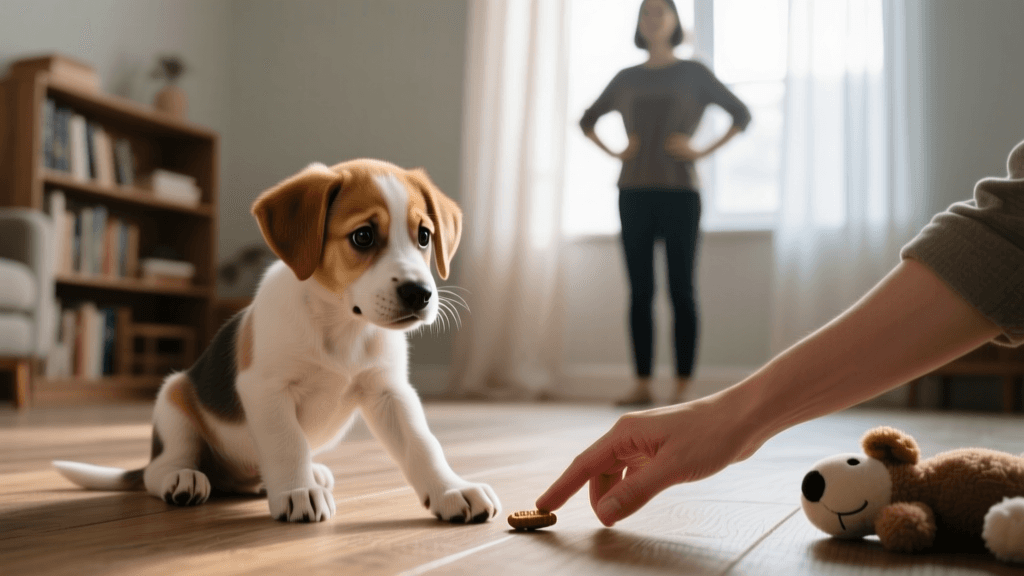
Find a location where your puppy is comfortably under their threshold. When the puppy looks at the trigger (e.g., a person walking 50 feet away), immediately mark the behavior with a clicker or a calm verbal 'yes.' Then, deliver a high-value treat. In this phase, you are not asking the puppy to look away; you are simply pairing the sight of the trigger with a positive outcome. Repeat this until the puppy begins to anticipate a treat when they see the trigger.
Phase 2: Disengage (Voluntary Check-In)
Once the puppy reliably looks at the trigger and then back at you for a treat, you can move to Phase 2. Now, when the puppy looks at the trigger, wait a brief second. Do not mark immediately. Wait for the puppy to voluntarily disengage and look back at you. The moment they turn their head toward you, mark and reward generously. This builds an automatic habit of looking to you for guidance rather than fixating on the stressor.
Essential Gear for Anxious Puppies in 2026
Successful management requires the right tools to support your puppy's nervous system and your training protocol. Here are the top recommended items for reactive puppy care this year:
- Adaptil Junior Calming Pheromone Collar: Priced around $28 in 2026, this collar releases dog-appeasing pheromones that mimic those produced by a nursing mother, helping to lower baseline anxiety during socialization outings.
- Rabbitgoo No-Pull Harness: For puppies that panic and pull on flat collars, a front-clip harness provides safe, trachea-friendly control without increasing their physical stress.
- K9 Natural Freeze-Dried Beef Liver: When working with reactivity, standard kibble rarely suffices. High-odor, single-ingredient treats are crucial for keeping a distracted puppy engaged.
- Lickimat Soother: Spreading wet food or plain pumpkin puree on a Lickimat promotes repetitive licking, which releases endorphins and naturally lowers a puppy's heart rate after a stressful encounter.
Tracking Progress: Trigger Distance vs. Reaction
Keeping a training journal is vital for identifying patterns and measuring progress. Use the table below to log your puppy's reactions and adjust your training plan accordingly.
| Trigger Type | Distance | Puppy's Reaction | Threshold Status | Action Taken |
|---|---|---|---|---|
| Passing Dog | 40 Feet | Stiffens, stares, refuses treat | Over Threshold | U-turned immediately, increased distance to 70 feet. |
| Mail Carrier | 60 Feet | Looks, ears perk, takes treat | Under Threshold | Played Engage-Disengage for 3 minutes, ended on success. |
| Loud Truck | 100 Feet | Barks once, looks back at owner | At Threshold | Marked the disengage, rewarded with high-value liver, moved away. |
The Role of Decompression in Puppy Care
Training sessions should be kept incredibly short—often just 3 to 5 minutes for a young, anxious puppy. Mental fatigue sets in much faster than physical fatigue. After a session, allow your puppy to engage in 'decompression walks' in a quiet, low-traffic area. Let them sniff freely on a long line (15 to 30 feet). Sniffing lowers a dog's pulse rate and allows their nervous system to return to baseline. For more on the importance of early positive exposures, the Humane Society of the United States provides excellent guidelines on safe, force-free socialization techniques that respect a puppy's emotional limits.
When to Seek Professional Help
While the Engage-Disengage game and threshold management are highly effective, severe reactivity or aggression requires professional intervention. If your puppy is breaking skin, exhibiting extreme panic (drooling, trembling, inability to settle), or if their fear periods seem to be worsening despite consistent management, consult a board-certified veterinary behaviorist or a Fear Free certified trainer. Early pharmacological support, such as short-acting anti-anxiety medications prescribed by a veterinarian, is increasingly utilized in 2026 to help severely anxious puppies reach a baseline where learning can actually occur.
Conclusion
Managing a reactive or anxious puppy is a marathon, not a sprint. By respecting their fear periods, maintaining strict threshold awareness, and utilizing the Engage-Disengage game, you are actively rewiring your puppy's brain to associate the world with safety rather than danger. Patience, high-value treats, and compassionate management will pave the way for a confident, well-adjusted adult dog.
robin-maitland
All our authors care for dogs every day — read more of their work on the authors page.