2026 Air Travel Guide for Service Dogs: DOT Rules & Best Gear
Master 2026 DOT air travel rules for service dogs. Discover the best TSA-approved harnesses, collapsible bowls, and cabin-friendly gear for working dogs.
Understanding the 2026 DOT Regulations for Service Dogs
Life with a service dog means your canine partner goes wherever you go, including 30,000 feet in the air. However, navigating the skies with a working dog requires meticulous preparation and a thorough understanding of current federal regulations. As of 2026, the U.S. Department of Transportation (DOT) continues to enforce strict guidelines that differentiate fully trained service dogs from emotional support animals (ESAs). Under current rules, airlines are only required to accommodate dogs that are individually trained to do work or perform tasks for a person with a disability.
Before booking your flight, you must complete the DOT Service Animal Air Transportation Form. This document requires you to attest to your dog’s training, health, and behavior. According to the U.S. Department of Transportation, airlines can require this form to be submitted up to 48 hours before your flight, or at the gate if the reservation was made within that window. Furthermore, the DOT mandates that service dogs must fit within the handler's footspace or on their lap without encroaching on aisles or emergency exits, making the right gear and training absolutely critical.
Essential Gear for Service Dogs in the Airplane Cabin
The airplane cabin is a high-stress, confined environment. Your service dog needs gear that maximizes comfort, ensures hygiene, and clearly communicates their working status to flight crews and fellow passengers.
1. The Right Harness and Identification
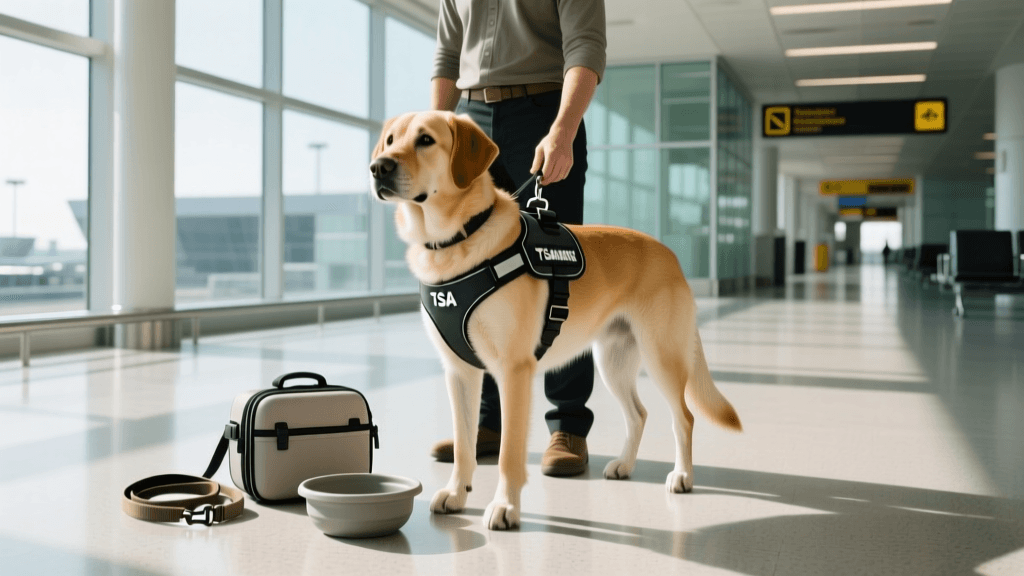
While the Americans with Disabilities Act (ADA) does not legally require service dogs to wear a vest or specific harness, doing so in an airport environment significantly reduces unwanted interactions from the public. For air travel, a multi-point, padded harness is superior to a standard flat collar or walking harness. A harness with a sturdy top handle is particularly useful for mobility tasks and for guiding your dog through crowded jet bridges. Look for breathable mesh lining, as cabin temperatures can fluctuate and your dog will be lying on the floor for extended periods.
2. Hydration and In-Flight Nutrition
Cabin air is notoriously dry, with humidity levels often dropping below 20%. Keeping your working dog hydrated is vital for their health and cognitive function. Rigid water bowls are impractical in the cramped footspace of an economy or premium economy seat. Instead, invest in high-quality, leak-proof collapsible silicone bowls. Some handlers prefer travel bottles with built-in troughs, which allow the dog to drink and then let the handler pour the remaining water back into the bottle without spilling a drop on the aircraft carpet.
3. Sanitation and Paw Care
Airplane floors and airport terminals harbor countless bacteria and debris. Before your dog settles into the footspace, it is highly recommended to wipe their paws. Portable paw cleaners featuring soft silicone bristles are excellent for this. Additionally, bringing a dedicated, washable travel mat provides a clean, familiar scent barrier between your dog and the public floor, helping them settle faster and protecting their joints from the hard cabin floor.
Comparison Chart: Top Service Dog Travel Gear for 2026
Below is a curated list of gear categories and features that top handlers are relying on in 2026 to ensure smooth transits.
| Gear Category | Recommended Feature | Top Brand Example | Est. 2026 Cost |
|---|---|---|---|
| Working Harness | Padded chest, dual-clip, top handle | Ruffwear Web Master | $95 - $115 |
| Travel Mat | Water-resistant bottom, machine washable | Kurgo Base Camp Mat | $40 - $55 |
| Hydration System | Leak-proof, one-handed operation | Mr. Peanut's Interactive Bottle | $18 - $25 |
| Paw Cleaner | Portable cup with silicone bristles | Dexas MudBuster | $15 - $22 |
| Treat Pouch | Silent closure (magnetic or silicone) | Ruffwear Treat Trader | $35 - $45 |
Pre-Flight Training and Acclimation
Even the most seasoned service dogs require specific preparation for the unique sensory experience of air travel. The goal is to create a dog that is virtually invisible to other passengers while remaining fully attuned to their handler's medical or physical needs.
Mat Training and the "Settle" Command
Mat training is the cornerstone of air travel etiquette. Your dog must understand that the travel mat equates to a "down-stay" until released. Begin practicing this at home, then move to busier environments like coffee shops or hotel lobbies. The dog should learn to fold their legs neatly underneath them (often called "turtling") to minimize their footprint. In 2026, with airlines strictly enforcing footspace boundaries, a dog that sprawls into the aisle can result in the handler being asked to deplane.
Desensitization to Airport Stimuli
Airports are a cacophony of rolling luggage, PA announcements, and sudden movements. Desensitize your dog to the sound of heavy wheels on tile floors and the proximity of strangers stepping over them. Practice having your dog wear their travel harness for hours at a time while you work at a desk, simulating the duration and confinement of a long-haul flight.
Navigating TSA Security and Boarding
Security checkpoints are often the most stressful part of the journey. According to the Transportation Security Administration (TSA), travelers with disabilities and medical conditions can request accommodations, but service dogs must still be screened. Generally, the handler will walk through the metal detector or body scanner first, leaving the dog on a "wait" command, and then call the dog through. Alternatively, the handler and dog can walk through together, but this often triggers the alarm, resulting in a manual pat-down for both of you.
During the pat-down, TSA agents will inspect the dog's harness, vest, and collar. You are not required to remove your service dog's working gear unless it contains large metal components that are causing persistent alarms. Communicate clearly with the TSA officer about your dog's tasks and what triggers they may have (e.g., "Please do not touch the dog's paws, as they are trained to alert to pressure changes").
When boarding, take advantage of pre-boarding if your airline offers it to handlers with service animals. This gives you an extra 10 to 15 minutes to get your dog settled on their mat, offer a small amount of water, and stow your carry-on without the pressure of a line of passengers waiting behind you.
Managing Layovers and Airport Relief Areas
One of the most significant improvements in modern air travel is the widespread implementation of indoor, post-security Service Animal Relief Areas (SARAs). As of 2026, all major U.S. hub airports are mandated to provide these facilities beyond the security checkpoint. These rooms typically feature artificial turf, a fire hydrant or rock feature, and waste disposal stations.
Always check your departure and layover airport maps online before your trip to locate the nearest SARA to your gate. Keep your dog's relief schedule in mind; a general rule of thumb is to offer a relief opportunity 45 minutes before boarding and immediately upon landing. If you have a long layover, utilize the SARA even if your dog doesn't seem desperate, as flight delays can easily turn a three-hour wait into a six-hour confinement.
By combining a deep understanding of current DOT regulations with the right tactical gear and rigorous environmental training, you can ensure that your service dog remains comfortable, focused, and compliant throughout your journey. Air travel in 2026 is highly accessible for working teams, provided you put in the groundwork long before you arrive at the terminal.
priya-sutaria
All our authors care for dogs every day — read more of their work on the authors page.