Is It Separation Anxiety or Boredom? Expert Vet Q&A
Is your dog destructive when alone? We asked a vet and a certified trainer to break down the differences between separation anxiety and boredom.

Decoding Your Dog's Alone-Time Behavior
Coming home to shredded couch cushions, scratched doors, or neighbor complaints about relentless barking is a nightmare scenario for any dog owner. When our canine companions act out while we are away, it is easy to assume they are either misbehaving or simply bored. However, the root cause of these destructive behaviors usually falls into one of two distinct categories: severe canine boredom or clinical separation anxiety. Misdiagnosing the issue can lead to ineffective training, wasted money on the wrong products, and a deteriorating bond between you and your pet.
To provide absolute clarity on this topic, we sat down with Dr. Sarah Jenkins, DVM (a veterinarian specializing in animal behavior) and Mark Evans, CPDT-KA (a certified professional dog trainer with over a decade of experience in behavioral modification). In this exclusive Q&A, they break down the psychological differences, provide actionable treatment protocols, and recommend specific products to help your dog thrive when left alone.
Meet the Experts
Dr. Sarah Jenkins, DVM: A graduate of the Cornell University College of Veterinary Medicine, Dr. Jenkins focuses on the neurochemical and pharmacological aspects of canine anxiety disorders.
Mark Evans, CPDT-KA: A certified professional dog trainer who specializes in force-free behavioral modification, specifically focusing on crate training and separation distress protocols.
Q1: What is the fundamental difference between boredom and separation anxiety?
Dr. Jenkins: The fundamental difference lies in the dog's internal emotional state and neurochemistry. Boredom is a state of under-stimulation. A bored dog is looking for a job, entertainment, or an outlet for pent-up physical energy. Their behavior is often opportunistic and rewarding to them—chewing a shoe feels good on their gums and tastes interesting.
Separation anxiety, on the other hand, is a genuine panic disorder. It is an acute stress response triggered by the absence of their primary attachment figure. The dog is not looking for entertainment; they are experiencing a fight-or-flight survival response. According to the ASPCA, dogs with separation anxiety exhibit extreme stress and panic, often resulting in self-injury as they attempt to escape confinement or the home to reunite with their owner.
Mark Evans: From a training perspective, I tell my clients to look at the 'why' behind the destruction. A bored dog chews the remote control because it was left on the coffee table and it smells like you. A dog with separation anxiety will ignore the remote control and instead chew through the drywall next to the front door, or break their teeth trying to bend the metal bars of their crate. The anxiety dog is trying to escape; the bored dog is just trying to pass the time.
Q2: How can I accurately diagnose the root cause at home?
Mark Evans: You need to become a detective. I highly recommend setting up a camera to record your dog's behavior for the first 30 minutes after you leave. You do not need an expensive setup; even an old smartphone connected to Wi-Fi works. Watch the footage and compare your dog's actions to this clinical breakdown:
| Behavioral Indicator | Boredom | Separation Anxiety |
|---|---|---|
| Destructive Chewing | Targets household items, shoes, trash, or furniture randomly. | Targets exit points: doors, window frames, doorknobs, or crate bars. |
| Vocalization | Occasional barking or howling triggered by outside noises (mail carrier, squirrels). | Continuous, panicked barking, howling, or crying starting immediately upon departure. |
| Potty Accidents | Rare if properly house-trained; may happen if left alone for excessive hours. | Frequent urination or defecation indoors, often in their sleeping area, despite recent outdoor trips. |
| Pacing & Movement | Minimal; dog usually wanders, plays, and eventually rests or sleeps. | Frantic, repetitive pacing in tight circles or back-and-forth paths near exits. |
| Escape Attempts | Very rare; may jump a fence if a squirrel is spotted, but not out of panic. | Common; may break teeth, tear nails, or bleed trying to escape crates or rooms. |
The Humane Society of the United States emphasizes that if your dog is injuring themselves or eliminating indoors purely out of distress, punishment is entirely ineffective and will only exacerbate the underlying panic disorder.
Q3: My dog is just bored. What is the actionable enrichment protocol?
Mark Evans: If the camera shows your dog sniffing around, taking a nap, and then deciding to dismantle the trash can an hour later, you have a bored dog. The fix is a combination of physical exhaustion and mental enrichment before you leave.
The Pre-Departure Routine
- Physical Exercise (45-60 Minutes): Take your dog for a brisk, sniff-heavy walk or play a vigorous game of fetch. A tired dog is a quiet dog.
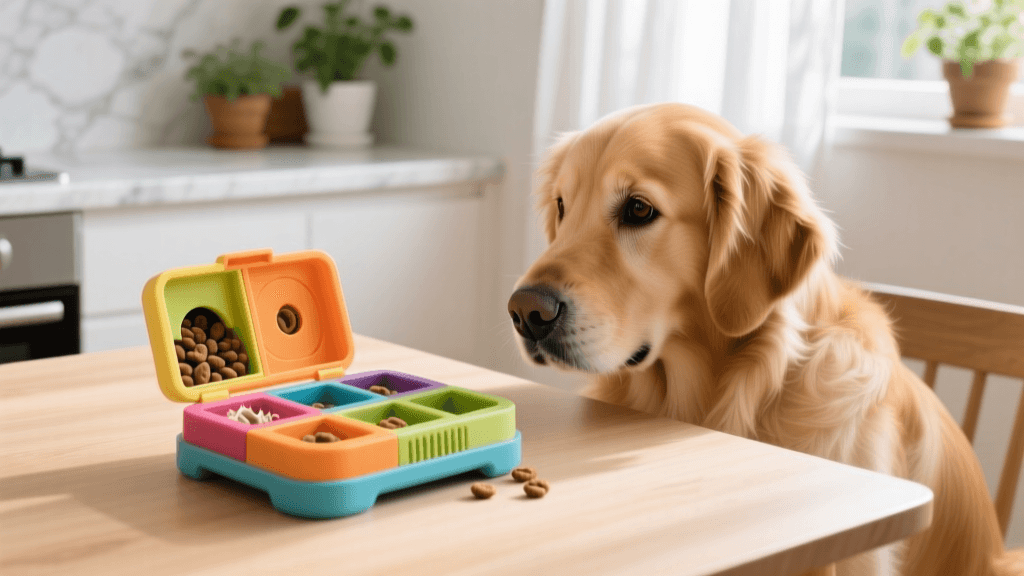
- Mental Enrichment (15-20 Minutes): Mental fatigue tires a dog out faster than physical exercise. Use puzzle toys to feed them their breakfast or a high-value snack right as you walk out the door.
Recommended Products & Costs
- KONG Classic (Red or Black): Cost: $15 - $22. The black version is for aggressive chewers. Pro-Tip Recipe: Soak 1 cup of kibble in low-sodium chicken broth, stuff it into the KONG, plug the small hole with a dab of peanut butter, and freeze it overnight. This will keep a dog engaged for 30-45 minutes.
- Outward Hound Nina Ottosson Dog Brick Puzzle: Cost: $25 - $30. This is an excellent intermediate-level puzzle that requires the dog to lift flaps and slide blocks to find treats, engaging their natural foraging instincts.
- Snuffle Mat: Cost: $20 - $35. Scatter dry treats through the fabric strips to simulate foraging in tall grass.
Q4: It is separation anxiety. What is the vet and trainer recommended treatment plan?
Dr. Jenkins: If your dog is exhibiting true separation anxiety, puzzle toys will not cure them. In fact, a dog in a state of panic will not eat, meaning they will ignore the KONG toy entirely. We need to address the neurochemistry first. For moderate to severe cases, I often prescribe Fluoxetine (Reconcile) or Trazodone. These medications help lower the dog's baseline anxiety, making them receptive to behavioral training. Costs vary by dog weight and pharmacy, but expect to pay $20 to $50 per month. I also recommend the Adaptil DAP Diffuser ($25 - $35), which releases synthetic dog-appeasing pheromones to create a calming environment.
Mark Evans: Once the vet has managed the chemical panic, we begin the behavioral protocol. The gold standard is Systematic Desensitization to Departure Cues. Dogs with anxiety learn the sequence of events that lead to you leaving (putting on shoes, grabbing keys, picking up a purse). We must break these associations.
The Desensitization Protocol (5-10 mins, 3x daily)
- Trigger the Cue: Put on your coat and pick up your keys.
- Do Not Leave: Instead, sit back down on the couch and watch TV for 5 minutes.
- Neutralize: Take off the coat and put the keys away.
- Repeat: Do this until the dog stops reacting (panting, pacing, whining) when you pick up the keys.
- Progression: Once the dog is bored by your keys, move to opening the door, stepping out, and immediately stepping back in. Gradually increase the time outside from 1 second to 5 seconds, to 1 minute, to 10 minutes.
Mark Evans: You must monitor this process. I highly recommend investing in a Furbo 360 Dog Camera ($150 - $210). It allows you to watch your dog's body language in real-time and even toss treats remotely. If your dog shows signs of stress at the 2-minute mark, you must return before the panic sets in, and adjust your next session to 1 minute. You cannot push a dog past their anxiety threshold during training.
Q5: What are the biggest mistakes owners make?
Dr. Jenkins: The biggest mistake is assuming the dog is acting out of 'spite' or 'revenge.' Dogs do not possess the cognitive ability to plot revenge. When an owner comes home to a destroyed living room and yells at the dog, the dog displays 'guilty' body language (cowering, whale eye, tucked tail). Owners interpret this as an admission of guilt, but behaviorists know this is actually an appeasement response to the owner's angry body language and tone. The dog is terrified of you, not sorry for the couch.
Mark Evans: Another massive mistake is relying on crate training as a cure-all for separation anxiety. If a dog has confinement distress (which often overlaps with separation anxiety), locking them in a crate is like locking a claustrophobic human in an elevator. They will literally break their teeth trying to escape. If your dog panics in a crate, you must abandon the crate and use a baby gate to confine them to a dog-proofed room while you work through the desensitization protocol.
When to Call in the Professionals
While mild boredom can be solved with a trip to the pet store and a longer morning walk, separation anxiety is a complex clinical disorder. If your dog is injuring themselves, refusing to eat when alone, or if your neighbors are threatening to call animal control due to endless howling, it is time to seek professional help. Ask your primary veterinarian for a referral to a Board-Certified Veterinary Behaviorist (DACVB) or a certified separation anxiety trainer (CSAT). With the right combination of veterinary science and force-free behavioral modification, even the most distressed dogs can learn to find peace in their own company.
hannah-wickes
All our authors care for dogs every day — read more of their work on the authors page.