Expert Q&A: Beating Dog Separation Anxiety When Returning to Work
Vets and trainers share actionable Q&A tips to cure dog separation anxiety, including crate training, puzzle toys, and daily routines for working owners.

Expert Q&A: Navigating the Return-to-Office Transition With Your Dog
For millions of dog owners, the shift from working at home to returning to the office has created an unexpected crisis: canine separation anxiety. Dogs that grew accustomed to 24/7 companionship are suddenly facing eight-hour absences, leading to destructive behavior, excessive vocalization, and immense stress for both pet and owner. To tackle this pressing issue, we sat down with two leading experts: Dr. Elena Rostova, a board-certified veterinary behaviorist, and Marcus Thorne, a Certified Professional Dog Trainer (CPDT-KA) specializing in behavioral modification. In this comprehensive Q&A, they break down the science of separation anxiety, provide a step-by-step desensitization protocol, and recommend specific, budget-friendly enrichment tools to keep your dog happy while you are away.
Q1: How can I tell if my dog is truly experiencing separation anxiety or just bored?
Marcus Thorne (Trainer): This is the most common question I get. Boredom and separation anxiety look similar on the surface—chewing furniture, digging at doors, or barking—but the underlying motivation and timing are very different. A bored dog will often entertain themselves by getting into the trash or chewing a shoe, but they will eventually settle down and sleep. Their destruction is usually opportunistic and not exclusively tied to your absence.
Dr. Elena Rostova (Vet): True separation anxiety, on the other hand, is a panic disorder. According to the VCA Animal Hospitals, dogs with genuine separation anxiety exhibit signs of extreme distress almost immediately after the owner leaves. We look for specific clinical signs: pacing, panting, drooling, inappropriate elimination (even in house-trained dogs), and self-injury from trying to escape crates or chew through drywall. If your dog is injuring their teeth or nails trying to break out, or if they refuse to eat high-value treats the moment you walk out the door, you are likely dealing with a panic response, not just boredom.
Q2: What is the most effective daily routine to prepare my dog for an 8-hour workday?
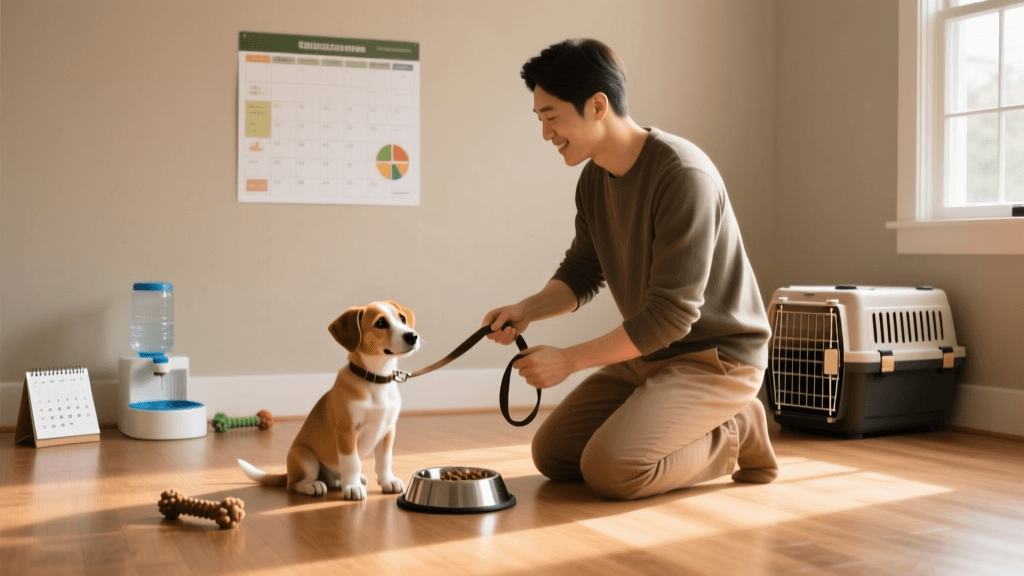
Marcus Thorne: You cannot go from zero to eight hours overnight. You must implement a systematic desensitization protocol over four to six weeks. The goal is to change your dog's emotional response to your departure cues. Dogs are highly observant; they know you are leaving when you put on your shoes, grab your keys, or pick up your briefcase. We call these 'departure triggers.'
Start by randomizing these triggers without actually leaving. Put your shoes on and sit on the couch. Pick up your keys and watch TV. This breaks the predictive chain. When you do practice actual departures, follow this progressive timeline:
- Week 1 (Micro-Absences): Step outside the door for 10 seconds, return, and ignore the dog. Repeat 10 times. Gradually increase to 5 minutes. Always leave them in a safe, dog-proofed area or a properly sized crate.
- Week 2 (Short Errands): Extend absences to 15, 30, and then 45 minutes. Drive around the block. Return calmly.
- Week 3 (Moderate Absences): Push to 1 to 2 hours. This is where you introduce long-lasting enrichment toys (detailed in Q3) to build positive associations with your absence.
- Week 4 (Workday Simulation): Gradually stretch to 4, then 6, then 8 hours. If your dog shows signs of panic at any stage, drop back down to the previous successful duration for three days before trying again.
Q3: Which enrichment toys actually work for long absences, and how should I prepare them?
Dr. Rostova: Enrichment is critical, but only if the dog is not already in a state of panic. A panicked dog will not eat or play. However, for dogs experiencing mild distress or simple boredom, food-motivated enrichment triggers the parasympathetic nervous system, promoting relaxation. Licking and chewing are naturally soothing behaviors for canines.
Marcus Thorne: I always tell clients to invest in a variety of toys because dogs habituate to them quickly. Here is my go-to comparison chart for the most effective products on the market, including exact prep instructions to ensure they last through your morning meetings.
| Product Name | Type | Best For | Estimated Cost | Prep Time & Recipe |
|---|---|---|---|---|
| Kong Classic (Red or Black) | Stuffable Rubber | Heavy chewers, long absences | $15 - $22 | 10 mins prep + 4 hrs freezing. Recipe: 1/2 cup dry kibble, 2 tbsp plain Greek yogurt, 1 tbsp xylitol-free peanut butter. Plug the small hole, fill the large hole, freeze solid. |
| Outward Hound Dog Brick | Sliding Puzzle | Mental stimulation, moderate absences | $12 - $16 | 5 mins. Hide 1/4 cup of high-value, low-calorie treats (like Zuke's Mini Naturals) under the sliding compartments. Supervise initially to ensure they don't chew the plastic. |
| Lickimat Soother | Textured Silicone Mat | Anxious dogs, soothing repetitive licking | $10 - $14 | 5 mins prep + 2 hrs freezing. Recipe: 1/2 cup wet dog food mixed with 1 tbsp mashed plain sweet potato. Spread thinly into the grooves and freeze. |
| Wooly Snuffle Mat | Foraging Fabric | Scent work, boredom busting | $25 - $35 | 2 mins. Sprinkle 1/3 cup of dry kibble deep into the felt strips. This forces the dog to use their nose, burning mental energy equivalent to a long walk. |
Dr. Rostova: Remember to factor the calories from these toys into your dog's daily intake to prevent obesity. If you use a frozen Kong every morning, reduce their breakfast bowl by 1/2 cup to compensate.
Q4: Should I consider supplements or prescription medications for my dog's anxiety?
Dr. Rostova: Absolutely. There is a persistent myth that using medication is a 'failure' of training. In reality, medication lowers the dog's threshold of panic, allowing the behavioral training to actually take hold. If a dog's brain is flooded with cortisol and adrenaline, they cannot learn new coping mechanisms.
For mild cases, I often recommend over-the-counter calming aids. Pheromone diffusers, like the Adaptil DAP (Dog Appeasing Pheromone) diffuser, cost around $25 to $30 and last for 30 days. They plug into the wall near the dog's resting area and mimic the comforting pheromones a mother dog produces while nursing. Supplements containing L-theanine or colostrum, such as Zylkene or Solliquin, can also take the edge off when given 45 minutes before you leave.
For moderate to severe separation anxiety, prescription medication is often necessary. The ASPCA's guidelines on separation anxiety note that medications like fluoxetine (a daily SSRI) or trazodone (an event-driven anti-anxiety medication) are highly effective when paired with a behavior modification plan. Always consult your veterinarian or a veterinary behaviorist to determine the correct dosage and ensure there are no contraindications with your dog's current health profile.
Q5: How should I handle departures and arrivals to minimize anxiety?
Marcus Thorne: Human guilt is the biggest enemy of separation anxiety training. When owners feel bad about leaving, they tend to hover, offer excessive petting, and say things like, 'Mommy will be right back, I'm so sorry!' in a high-pitched, emotional voice. Your dog reads this emotional display as a signal that something terrible is about to happen.
The golden rule of departures and arrivals is radical neutrality. When you leave, do not say goodbye. Simply walk out the door and lock it. When you return home, your dog will likely be jumping, whining, and spinning. You must completely ignore them. Do not make eye contact, do not speak to them, and do not touch them until all four paws are on the floor and they are entirely calm. This might take 5 to 10 minutes of you standing like a statue while they settle. Once they are calm, you can calmly offer a gentle scratch behind the ears. By making your comings and goings incredibly boring, you strip them of their emotional weight.
Final Thoughts on Rebuilding Independence
Transitioning your dog back to a solo routine requires patience, consistency, and empathy. It is vital to remember that your dog is not acting out of spite; they are expressing genuine distress. By combining systematic desensitization, strategic mental enrichment, and professional veterinary guidance when needed, you can help your dog regain their confidence and independence.
For further reading on keeping your dog's mind sharp and engaged, the American Kennel Club (AKC) offers excellent resources on daily mental enrichment exercises that can be integrated into your evening routine to ensure your dog is happily tired before the next workday begins. With the right plan in place, both you and your dog can thrive in your new normal.
beth-carrasco
All our authors care for dogs every day — read more of their work on the authors page.