Mastering Dog Portion Control: Calculate Daily Calories
Learn how to calculate your dog's daily caloric needs, measure portions accurately, and prevent obesity with our practical daily feeding guide.

When we look into our dogs' eyes, it is incredibly easy to equate food with love. A wagging tail, an eager stare, and those soulful puppy eyes can convince even the most disciplined pet parent to add just a few extra kibbles to the bowl or drop an extra piece of cheese from the cutting board. However, in the realm of canine health, love is not measured by the volume of food in the bowl. Mastering portion control and understanding your dog's specific daily caloric needs is one of the most profound ways you can ensure a long, vibrant, and active life together.
The Canine Obesity Epidemic: A Hidden Health Crisis
Before diving into the mathematics of feeding, it is crucial to understand why portion control matters so much. Canine obesity is no longer just a cosmetic issue; it is a pervasive medical condition that drastically reduces a dog's quality of life and lifespan. According to data published by the Association for Pet Obesity Prevention, more than 55% of dogs in the United States are classified as overweight or obese. This excess weight places tremendous stress on their joints, exacerbates conditions like osteoarthritis, increases the risk of cardiovascular disease, and can lead to metabolic disorders such as diabetes.
Many pet owners suffer from 'fat blindness,' a phenomenon where we become so accustomed to seeing slightly chubby dogs in our communities and on social media that a healthy, lean body condition begins to look emaciated. Reclaiming your dog's health starts with objective measurement and a commitment to daily nutritional strategy.
Step 1: Calculating Resting Energy Requirement (RER)
The foundation of any scientific feeding strategy is determining your dog's Resting Energy Requirement (RER). The RER is the number of calories your dog's body needs to maintain basic physiological functions while at rest in a thermoneutral environment. Think of it as the energy required just to keep their heart beating, lungs breathing, and cells repairing.
The standard veterinary formula for calculating RER is:
RER = 70 x (body weight in kilograms)^0.75
To use this formula, you first need to convert your dog's weight from pounds to kilograms by dividing by 2.2. Let us walk through a practical example. Imagine you have a Beagle named Barnaby who weighs exactly 25 pounds.
- Convert to kg: 25 lbs / 2.2 = 11.36 kg
- Calculate the exponent: 11.36 ^ 0.75 = 6.18
- Multiply by 70: 70 x 6.18 = 432.6 kcal/day
Barnaby's RER is approximately 433 calories per day. However, you cannot stop here. Barnaby does not just lie in a thermoneutral vacuum all day; he goes for walks, plays fetch, and digests his food. This brings us to the next critical step.
Step 2: Determining Maintenance Energy Requirement (MER)
To find out how many calories Barnaby actually needs to eat, you must multiply his RER by a specific factor that accounts for his life stage, neuter status, and activity level. This final number is the Maintenance Energy Requirement (MER).
| Life Stage / Status | MER Multiplier |
|---|---|
| Neutered Adult (Normal Activity) | 1.6 x RER |
| Intact Adult (Normal Activity) | 1.8 x RER |
| Senior Dog (Low Activity) | 1.2 to 1.4 x RER |
| Weight Loss Program | 1.0 x RER (based on target weight) |
| Highly Active / Working Dog | 2.0 to 5.0 x RER |
| Puppy (Under 4 months) | 3.0 x RER |
| Puppy (4 to 12 months) | 2.0 x RER |
Returning to our example, Barnaby is a neutered adult with a normal activity level. We multiply his RER (433 kcal) by 1.6. This gives us an MER of roughly 692 calories per day. This is Barnaby's total daily caloric budget, which must include his meals, his training treats, and any table scraps.
The Measuring Cup Myth: Why Grams Matter More Than Cups
One of the most common mistakes dog owners make is relying on a plastic measuring cup to portion out dry kibble. The guidelines on the back of a dog food bag often suggest feeding '2 to 3 cups' per day, but this is a remarkably imprecise metric. Kibble size, shape, and density vary wildly between brands, and even between different recipes from the same manufacturer.
Furthermore, human pouring habits are notoriously inconsistent. A 'level cup' for one person might be a 'heaping cup' for another, which can inadvertently add 20% to 30% more calories to your dog's daily intake. Over a year, that extra 20% can result in significant weight gain. The WSAVA Global Nutrition Guidelines strongly recommend weighing your dog's food using a digital kitchen scale for absolute accuracy.
| Kibble Type / Brand Style | Weight of 1 Standard Cup | Approximate Calories per Cup |
|---|---|---|
| Large Breed Kibble (Large, airy pieces) | 95 grams | 340 kcal |
| Standard Adult Kibble (Medium density) | 115 grams | 410 kcal |
| High-Protein / Performance Kibble (Dense) | 140 grams | 520 kcal |
| Small Breed Kibble (Tiny, compact pieces) | 125 grams | 460 kcal |
As the table illustrates, a single cup of performance kibble contains over 180 more calories than a cup of large breed kibble. If you are feeding a high-performance diet but measuring based on the volume guidelines of a standard diet, you are severely overfeeding your dog. Invest in a basic digital kitchen scale, check the kcal/kg or kcal/cup metric on your specific bag of food, and weigh out your dog's exact daily allowance in grams every single morning.
Managing the 10% Treat Rule
A daily caloric budget is useless if it is blown on treats. Veterinary nutritionists universally advocate for the '10% Rule,' which states that treats, chews, and table scraps should never constitute more than 10% of your dog's total daily caloric intake. The remaining 90% must come from a complete and balanced commercial diet or a veterinary-approved home-cooked recipe.
If Barnaby's daily budget is 692 calories, his treat allowance is strictly capped at 69 calories. To put that into perspective, a single medium-sized milk bone can contain 40 calories, and a one-inch cube of cheddar cheese contains nearly 70 calories. Just one piece of cheese maxes out Barnaby's treat budget for the entire day. For training sessions that require high repetition, swap out high-calorie biscuits for low-calorie alternatives like freeze-dried liver, boiled chicken breast, or even a few pieces of your dog's measured daily kibble.
Enrichment and Slow Feeding Strategies
Portion control often leads to a common behavioral complaint: the dog finishes their meticulously weighed meal in thirty seconds and then begs for more. To combat this without adding calories, integrate enrichment and slow-feeding strategies into your daily routine.
- Puzzle Feeders: Devices like the Kong Wobbler or Outward Hound puzzle toys force your dog to work for their kibble, engaging their brain and slowing down their eating pace.
- Snuffle Mats: Hiding dry kibble within the fabric strips of a snuffle mat taps into your dog's natural foraging instincts, turning a two-minute meal into a fifteen-minute mental workout.
- Scatter Feeding: Simply tossing your dog's measured portion of kibble across a clean grassy yard encourages sniffing and natural movement.
These methods not only prevent the rapid inhalation of food—which can reduce the risk of gastric dilatation-volvulus (bloat) in susceptible breeds—but they also provide a sense of satiety and mental fatigue that leaves your dog feeling satisfied long after the bowl is empty.
Adjusting for Life Changes and Activity Levels
Your dog's MER is not a static number; it is a dynamic target that shifts with the seasons and life stages. If your dog's activity level drops during a harsh winter, or if they are recovering from a minor orthopedic injury, you must proactively reduce their daily food intake by 10% to 15% to prevent weight gain. Conversely, if you begin training for a canine sport like agility or canicross, their caloric needs will spike.
The American Kennel Club advises owners to perform a monthly Body Condition Score (BCS) check at home. You should be able to easily feel your dog's ribs without pressing hard, and when looking from above, they should have a distinct waistline. If the ribs become difficult to feel, reduce the daily gram measurement of their food by 5% and reassess in two weeks. If the ribs become overly prominent, increase the portion by 5%.
Building a Sustainable Daily Routine
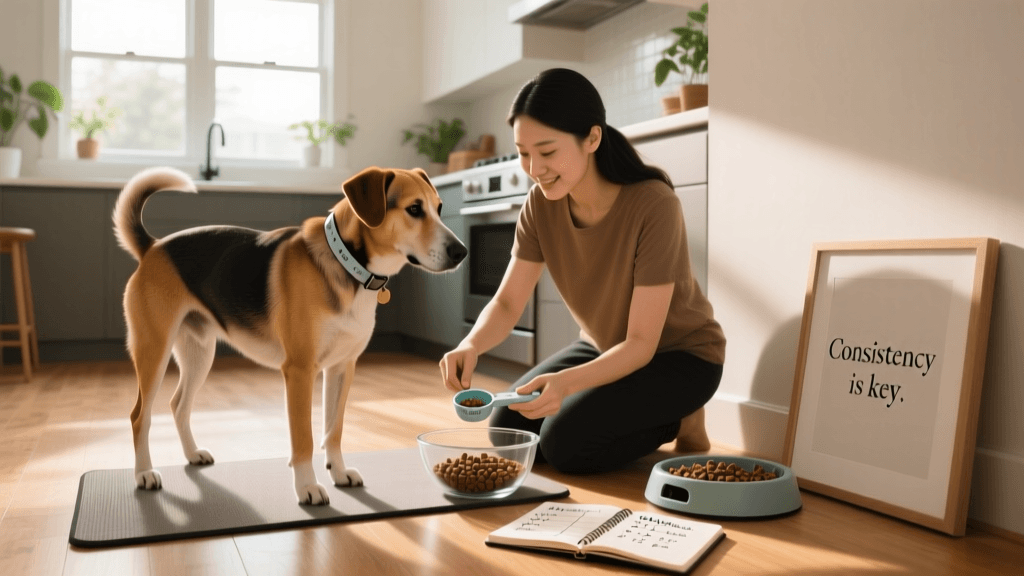
Success in canine nutrition relies on consistency. Establish a morning routine where you weigh out the entire day's food allowance into a dedicated daily container. This prevents the 'accidental double feed' if multiple family members are home and assume someone else already fed the dog. Divide this daily container into two or three separate meals. Feeding multiple smaller meals throughout the day helps maintain stable blood sugar levels and prevents the agonizing hunger pangs associated with a single daily feeding.
Ultimately, managing your dog's portion sizes is an act of profound care. By replacing the measuring cup with a digital scale, respecting the mathematics of their metabolic needs, and utilizing mental enrichment to satisfy their appetite, you are actively adding healthy, pain-free years to their life. True love is not an overflowing bowl; it is the commitment to keeping your best friend lean, energetic, and ready for your next adventure together.
marcus-aldridge
All our authors care for dogs every day — read more of their work on the authors page.