Budget-Friendly DIY Dog Enrichment and Puzzle Toys
Discover budget-friendly DIY dog enrichment ideas and puzzle toys. Keep your pup mentally stimulated without breaking the bank using household items.
The Hidden Costs of Dog Boredom
Every dog owner knows the sinking feeling of coming home to a destroyed couch cushion or a chewed-up baseboard. While it is easy to label these behaviors as 'naughty,' they are often the direct result of boredom and a lack of mental stimulation. Dogs are intelligent, working animals bred for specific tasks. When left without an outlet for their cognitive energy, they will invent their own 'jobs,' which usually involve destructive chewing, excessive barking, or digging up your garden.
Fortunately, the solution does not require an expensive trip to the pet boutique. According to the American Kennel Club (AKC), canine enrichment is about providing opportunities for dogs to engage in natural behaviors like foraging, sniffing, and problem-solving. While commercial puzzle toys and snuffle mats are fantastic, they can easily cost between $15 and $40 each. For multi-dog households or owners on a strict budget, these costs add up quickly. By shifting to a budget-friendly DIY dog care mindset, you can create highly effective enrichment tools using items you already have around the house.
The Science of Canine Enrichment
Before diving into the crafts, it is important to understand why enrichment matters. Mental stimulation is actually more exhausting for a dog than physical exercise. Veterinary behaviorists often note that fifteen minutes of intense sniffing or puzzle-solving can tire a dog out just as much as a one-hour walk. Sniffing lowers a dog's heart rate and releases dopamine, the 'feel-good' neurotransmitter. When we provide budget-friendly DIY dog enrichment, we are not just saving money; we are actively supporting our dog's neurological health and emotional well-being.
Store-Bought vs. DIY Enrichment: A Cost Comparison
How much can you actually save by making your own dog toys and puzzles? The table below breaks down the average costs of commercial enrichment items versus their DIY counterparts.
| Enrichment Type | Average Store-Bought Cost | DIY Cost | Durability | Customization Level |
|---|---|---|---|---|
| Snuffle Mat | $25.00 - $45.00 | $0.00 (Cardboard/Paper) | Low (Disposable) | High |
| Interactive Puzzle Toy | $15.00 - $35.00 | $0.00 (Muffin Tin) | Medium | Medium |
| Cong-Style Feeder | $12.00 - $20.00 | $8.00 (PVC Pipe) | Very High | High |
| Frozen Lick Mat | $15.00 - $25.00 | $2.00 (Silicone Tray) | Medium | High |
| Braided Tug Toy | $10.00 - $18.00 | $0.00 (Old T-Shirts) | Medium | Medium |
As the Humane Society of the United States points out, food puzzles are an excellent way to slow down fast eaters and provide mental stimulation, and they strongly advocate for safe, homemade alternatives to expensive commercial products.
5 Budget-Friendly DIY Dog Puzzle Toys
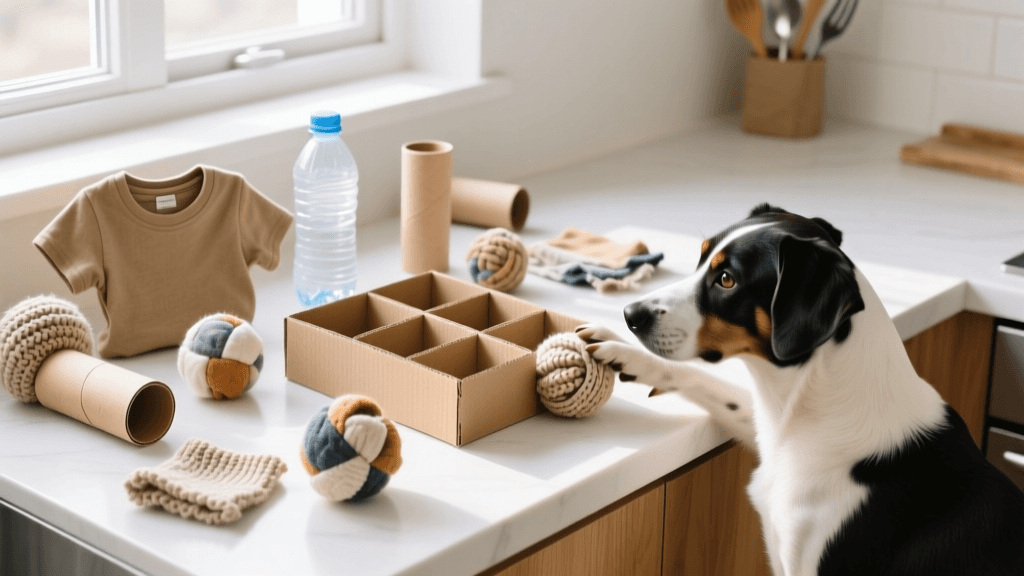
Here are five highly effective, incredibly cheap DIY enrichment projects you can build this afternoon.
1. The Muffin Tin Shell Game
Materials: A standard 12-cup metal or silicone muffin tin, 12 tennis balls (or similarly sized dog-safe balls), and high-value kibble or treats.
Estimated Cost: $0 (assuming you have a muffin tin and tennis balls).
How to Make It: Place a few pieces of kibble into six of the muffin cups. Then, place a tennis ball over every single cup, effectively hiding the treats and leaving the empty cups covered as decoys. Your dog must use their nose to locate the treats and use their paws or snout to knock the tennis balls off to access the reward.
Pro Tip: To increase the difficulty, only put treats in three cups, or use smaller balls that fit snugly inside the cups, requiring your dog to figure out how to pry them out.
2. The Upcycled T-Shirt Tug-and-Treat Knot
Materials: 3 to 4 old, clean cotton t-shirts (avoid synthetic materials that can splinter), scissors, and dry treats.
Estimated Cost: $0.
How to Make It: Cut the t-shirts into long strips, about 3 inches wide. Gather the strips together and tie a massive, tight overhand knot at one end. Braid the strips tightly down the length of the fabric. As you braid, periodically tuck a few pieces of dry kibble or jerky into the tight folds of the braid. Finish with another large knot at the bottom.
Enrichment Value: This serves a dual purpose. It acts as a satisfying chew and tug toy, while also forcing the dog to work their teeth and paws into the fabric folds to extract the hidden treats.
3. The Cardboard Snuffle Box
Materials: A medium-sized corrugated cardboard box (like a shoebox or Amazon delivery box), shredded paper or junk mail, and kibble.
Estimated Cost: $0.
How to Make It: Cut the cardboard into long, 1-inch wide strips. Crumple the strips lightly and fill the bottom of a larger cardboard box or a plastic storage tub with them. Sprinkle your dog's daily kibble allowance deep into the paper strips. Your dog will have to root, dig, and sniff through the cardboard 'forest' to find their meal.
Why It Works: This mimics the natural foraging behavior of wild canines. It is also completely free and easily recyclable once the cardboard gets too soggy or torn.
4. Frozen Broth and Kibble Popsicles
Materials: Low-sodium, onion-free, and garlic-free chicken or beef broth, a silicone ice cube tray or muffin tin, kibble, and dog-safe fruits like blueberries.
Estimated Cost: ~$2.00.
How to Make It: Place a small handful of kibble and a few blueberries into each compartment of the silicone tray. Fill the compartments with the low-sodium broth. Freeze for at least 4 hours. Pop them out and serve on a hot day or in a bowl for a messy, engaging licking session.
Safety Note: Always check the ingredient list on store-bought broths. Many contain onion or garlic powder, which are highly toxic to dogs. When in doubt, boil plain chicken breasts in water and use the resulting unseasoned broth.
5. The PVC Pipe Treat Dispenser
Materials: A 10-inch piece of 2-inch diameter PVC pipe, two PVC end caps, a power drill with a 3/4-inch drill bit, and 120-grit sandpaper.
Estimated Cost: ~$8.00 at a local hardware store.
How to Make It: Drill four to five holes randomly along the length of the PVC pipe. Ensure the holes are slightly larger than your dog's kibble so the food can escape, but not so large that it pours out all at once. Use the sandpaper to thoroughly smooth out any sharp plastic burrs around the drilled holes. Cap both ends tightly. Fill with kibble, and let your dog roll it around the floor.
Durability: This is virtually indestructible and can withstand even the most aggressive chewers, making it a one-time investment that will last for years.
Sourcing Free and Cheap Enrichment Materials
Living a budget-friendly life with your dog means looking at everyday trash as potential treasure. Before throwing items away, consider their enrichment value:
- Recycling Bin: Clean plastic water bottles (with the cap and plastic ring removed) can be placed inside an old sock and tied off. The crinkling sound drives many dogs wild, and it costs absolutely nothing.
- Thrift Stores: Look for heavy-duty silicone baking molds, muffin tins, and thick cotton towels. You can often find these for under $2 each.
- The Freezer: Save the liquid from canned tuna (ensure it is packed in water, not oil, and has no added salt) or the juice from boiling plain meats to use in your frozen popsicles.
Safety First: Supervising DIY Toys
While budget-friendly dog care is highly rewarding, safety must always remain your top priority. Unlike commercially manufactured toys that undergo stress testing, DIY toys require your direct supervision.
Always monitor your dog when introducing a new DIY puzzle or toy. If your dog tends to swallow non-food items (a condition known as pica), avoid cardboard or fabric-based puzzles and stick to heavy-duty PVC or metal muffin tins.
Inspect fabric toys like the t-shirt tug before every use. If the fabric begins to fray or long threads start pulling loose, throw it away immediately to prevent intestinal blockages. Similarly, ensure that any plastic items, like water bottles, are discarded before your dog manages to chew them into sharp, ingestible shards.
Ultimately, sharing your life with a dog does not require a massive financial investment. By tapping into your creativity and utilizing household items, you can provide a rich, stimulating, and joyful environment for your canine companion. Budget-friendly DIY dog enrichment is not just about saving a few dollars; it is about actively engaging with your dog's natural instincts and building a deeper, more fulfilling bond together.
beth-carrasco
All our authors care for dogs every day — read more of their work on the authors page.